Articles review on the net, revue d'articles sur la toile


Inscription : feeds, flux :
(Atom) Gabriel Real World News

Affichage des articles dont le libellé est world music. Afficher tous les articles

01 mars 2009

AR Rahman: "I share my Oscars with Peter Gabriel"

‘Oscar was like my national award’

CHENNAI: “There are many forces that divide us here from caste to religion. May music be the force that unifies us,” began AR Rahman, in a speech that was marked with characteristic humility and oodles of references to religion. Who better to state that than the musician himself who has left the entire country to collectively celebrate his arrival at the international platform with two Oscars? (...)

AR Rahman
says his award was a recognition for World Music, given the nature of his score for the film. “So, I thought I must owe it all to Peter Gabriel, the musician who is seen as one of the forerunners to propagate World Music. He has in fact, inspired many Indians like me and Mandolin U Shrinivas. I’d like to share my award with him,” Rahman said. (...)

Sharadha Narayanan, Express Buzz, 28 Feb 2009


21 février 2009

Soweto choir gets Oscar invite


The Soweto Gospel Choir will perform at the Oscars - the first time a South African act has received such an invitation. The choir has been nominated for an award for its song, Down to Earth.

Joburg's pride, the Grammy-Award winning Soweto Gospel Choir, will be performing at the 81st Academy Awards on Sunday, 22 February.

It's the first time the choir will perform at the Oscars, as the awards are better known, as well as the first time a South African act will perform at the annual red carpet event. The ceremony, taking place at the Kodak Theatre in Hollywood, in the United States, will be broadcast on MNET at 7.30pm on Monday, 23 February.

One of the choir's many songs, a collaboration with songwriters Peter Gabriel and Thomas Newman, has been nominated for an Oscar for Best Original Song. It already has a Grammy Award under its belt, for Best Song Written For Motion Picture, Television Or Other Visual Media. Down To Earth is the theme tune for the Disney animated movie, Wall-E, which itself has been nominated for Best Animated Feature Film.(....)


Angelique Kidjo in Hawaii

mauiweekly, Hawaii, February 19, 2009

Angelique Kidjo’s music celebrates the beauty of diversity, as well as the unity of cultures.

A four-time Grammy-nominated singer and composer, Angelique Kidjo brings her stunning voice and unforgettable stage presence to The MACC’s Castle Theater on Saturday, Feb. 21, at 7:30 p.m., as part of “The MACC Presents…” 2008-09 Global Rhythms Series.

Combining African and Western influences, Kidjo’s music celebrates the beauty of diversity, as well as the unity of cultures. Her musical influences include childhood idols James Brown, Aretha Franklin, Carlos Santana and Jimi Hendrix, as well as the Afropop, Caribbean zouk, Congolese rumba, jazz, gospel and Latin styles of music.

With her latest album Djin Djin (pronounced “gin gin”), she returns to her musical roots, bringing international artists such as Peter Gabriel, Alicia Keys, Ziggy Marley and Josh Groban to the musical world of Benin, her native country.

Kidjo launched her career at age six in the Beninese port village of Cotonou. The political turmoil in her country led her to relocate to Paris, the capital of world music, and then, ultimately, to New York City, where she now resides.

Fluent in multiple cultures and languages, Kidjo has won respect from her peers and expanded her following across national borders. Her diverse background also earned her access to humanitarians who sensed the passion in the words of her songs, resulting in her long-term dedication to global charity work. As a UNICEF goodwill ambassador, Kidjo has traveled far to mesmerize audiences on countless stages, speaking out on behalf of children for the international organization.

Kidjo recently sang at President Barack Obama’s inauguration, and now will bring her soul-stirring music to the Maui audience. Enjoy a delightful evening of African music, international beats, rhythms and tunes from this award-winning chanteuse.

Tickets are $12, $30 and $47 (half-price for keiki 12 and under), with a discount available to MACC annual donors. Visit The MACC Box Office or call 242-SHOW (7469) to charge by phone Monday through Saturday, 10 a.m. to 6 p.m. For patron convenience 24 hours a day, purchase tickets online at www.mauiarts.org.

February 19, 2009

08 février 2009

World Music Icon Angelique Kidjo visits Oahu

Angelique Kidjo is one of the hottest names in World Music today attracting the admiration of audiences and other renown musicians alike. Her last album, Djin Djin featured guest appearances by Josh Groban, Carlos Santana, Alicia Keys, Joss Stone, Peter Gabriel, Ziggy Marley and Branford Marsalis. Angelique Kidjo will be performing at LCC Theatre on Sunday, February 22, 2009 at 7 pm. Given that such a wide variety of notable musicians welcome the opportunity to collaborate with her, it should come as no surprise that Kidjo is backed by highly skilled musicians who support her in performances of original compositions as well as renditions of the songs of Jimi Hendrix, The Rolling Stones, George Gershwin and others. Kidjo is fluent in Fon and Yoruba, languages of her birthplace of Benin, and father and mother, respectively. She is also fluent in English and French and performs in each of these languages.

Kidjo is a voracious consumer of music. She started out performing with her family as a child. When she got older, she moved to Paris where she studied progressively more advanced music and vocal techniques with various teachers while performing with different musical groups. As her career grew from supporting greats like Nina Simone and personal idol Miriam Makeba, to being recognized as a headliner in her own right, her cultural repertoire likewise grew. Over the years her albums have included rock, jazz, funk, Caribbean and Brazilian flavors and techniques mixed with her rich Beninese heritage.

While Kidjo's name may not be familiar to people, her music just might be via its appearance in pop culture. Her songs have appeared in episodes of the Simpsons, Six Feet Under, Without A Trace and on the big screen in Ace Ventura, Streetfighter, Krippendorf's Tribe, The Wild Thornberrys Movie, Sahara, and Blood Diamond. Just as her songs are representative of different parts of the world, Kidjo is also a fervent advocate for improving the lives of peoples around the globe. She has been UNICEF Goodwill Ambassador since 2002. She created a foundation that supports and promotes secondary and higher education for girls in Africa. The number of occasions she has lent her talent to benefit or promote causes are legion.

A return to Ethiopia's musical greatness

February 4th, 2009, By PRI's The World


Politics and music have not always mixed well in Ethiopia. But governments change — and the music survives, and evolves. A fine example is a new project that highlights the work of Ethiopian musicians today.

Before we get to the big thing out of Ethiopia today, first a quick rewind to the origins of Ethio-funk. Sure, some of Ethiopia's super-cool pop music in the 60s was a bit derivative. But there were also some great jazz players in Addis Abeba who were wholly original.

When Mengistu Haile Mariam took over in 1974, his Derg military government imposed an all-night curfew that lasted for years. It effectively killed the nightclubs in the Ethiopian capital. But singers and bands managed to keep their chops alive — not with audiences. But for each other in small, secretive recording studios.

By the time Mengistu was pushed from power in 1991, Ethiopia's music scene found itself basically starting from scratch. The traditional azmari singers — wandering troubadours — the artist you're hearing now for example, had never gone away.

Azmari gathering places began to come alive again in the mid-90s. Younger up-and-coming musicians made themselves known, and began gigging and recording again. Today, between the artists who kept active in the Mengistu years and the newer ones, Addis has begun to recapture some of its former musical prowess.

This track "Azmari Dub" shows a new face of Ethiopian popular music. It's part of a new music project titled A Town Called Addis. Nick Page is the producer. He's from the UK and is a frequent traveller to Ethiopia. For this project, Page goes by the name Dub Colossus. And the CD logically is titled "Dub Colossus in a Town Called Addis."

That's Ethiopian vocalist Sintayehu Zenebe.

Dub Colossus brought her and four other rising Ethiopian singers and instrumentalists into Peter Gabriel's Realworld studio in Britain. Dub Colossus comes from a reggae background, but he's also had interest in all manner of global musical idioms over the years. In a recent promotional video, Nick Page (aka Dub Colossus) explained why he was a champion of Ethiopian music.

“Addis is a very vibrant and exciting musical scene that has an awful lot to offer and needs some kind of exposure.”

With "Dub Colossus in a Town Called Addis," Nick Page is doing his part to re-elevate Ethiopian music. And it taps into that time-tested tradition in Ethiopia of fusing local sounds with those of the outside world.

02 février 2009

Amadou and Mariam : Welcome to Mali


By Jonathan Rothman, Exclaim.ca

The funkiest blind, married, French-speaking Afro-pop couple around, Amadou and Mariam return after 2005's Manu Chao-produced Dimanche à Bamako with a potent blend of electronic twists and guests spots for Welcome to Mali. While feature artist turns include guest producer and knob-twiddler Damon Albarn (leadoff track "Sabali," with Mariam's piercing vocals), K'naan and Keziah Jones on the rousing "Africa," and Amadou's desert blues guitar with Toumani Diabaté's sublime kora ("Djuru"), none can outshine the main attraction here.

Playful call and responses, impassioned stories and meditations and wailing Malian violins over slow, bluesy jams — almost to the effect of a cuica over a slow samba canção — keep the focus on the world music duo now embraced by everyone from World Cup soccer fans to Scissor Sisters devotees. Yes, like mid-career Peter Gabriel, Amadou and Mariam are a safe world music act you can admit enjoying but that's also because they're brilliant, dynamic and passionate. (Because)

Totó la Momposina to take Afrocolombia to Bogotá


Colombia reports

Totó la Momposina
, the world's best known representative of Colombia's traditional music, will perform in Bogotá on both February 6 and 7.

The 61-year old singer from Mompox, Bolivár has released albums since 1983 and has garnered increasing international acclaim since Peter Gabriel decided to put her album 'La Candela Viva' out on his RealWorld label.

Totó la Momposina, whose real name is Sonia Bazanta Vides, comes from a family that's been involved in traditional Colombian music for generations. Her children also are musicians.

The diva of traditional music will perform in Bogotá's Roberto Arias Pérez theater. Tickets can be purchased online.

Les chants mystiques soufis et ceux des tribus pakistanaises vivent encore

Véronique Mortaigne, LE MONDE, Article paru dans l'édition du 03.02.09


Mis à mal par les graves turbulences politiques qui traversent la région, le Pakistan demeure un pays où la musique est reine. Cet art y est au carrefour entre les influences de l'ancien empire perse, des traditions tribales, notamment celles des zones qui font frontière avec l'Afghanistan, et des raffinements hérités de l'Inde, à laquelle le Pakistan appartenait avant la partition en 1947.

Terre musulmane, le Pakistan a perpétué les rituels mystiques soufis du nord de l'Inde et de l'Asie mineure, célébrant un dieu souverain par des chants dévotionnels débridés et des poésies enivrées. A cela, on ajoutera les allers-retours entre ceux qui sont restés au pays et la jeune communauté indo-pakistanaise du Royaume-Uni, friande de musiques électroniques rythmées et de cinéma Bollywood.

Le programme est passionnant, et le Théâtre de la Ville le suit depuis plus de vingt-cinq ans. On ne saura jamais assez gré à l'établissement parisien d'y avoir fait découvrir l'immense chanteur Nusrat Fateh Ali Khan, en 1985, avant que ce soufi pur sucre né près de Faisalabad, au Pendjab, n'aille s'encanailler en 1990 avec le chanteur de rock Peter Gabriel et les précurseurs du trip-hop de Bristol Massive Attack pour un génial tube planétaire, Mustt, Mustt.

Icône du chant mystique qawwal - le chant dévotionnel soufi du sous-continent indien, 700 ans d'âge -, Nusrat Fateh Ali Khan est mort prématurément en 1997, à 49 ans. Avec son physique de bouddha, sa voix hors du commun, sa bande de joueurs d'harmonium et de claqueurs de main, Nusrat a été au qawwal ce que Glenn Gould fut à une génération de pianistes désireux de jouer Bach : paralysant.

Au rayon de la foire aux spectacles, Nusrat avait des concurrents : les délirants frères Sabri Brothers, de Karachi : cheveux longs et teints en roux, bagues à tous les étages, yeux maquillés au khôl. L'un des frères, Ghulam Farid, trépassa en 1994, et le groupe disparut.

Samedi 31 janvier, dans l'un de ces concerts de fin d'après-midi du Théâtre de la Ville qui ne cessent d'être des havres de paix dans le bruit parisien, c'est un jeune chanteur, Javed Bashir, et son groupe qui se risquent à la succession. Ils choisissent une troisième voie, un qawwal fervent, mains déployées, yeux au ciel, mais plus discret. L'emballement rythmique du qawwal de la génération Nusrat, et son empressement à atteindre Dieu par l'extase, est refréné par des éléments d'un chant classique très maîtrisé, très intériorisé, proche de l'ancienne Perse. Javed Bashir n'en travaille pas moins son physique, taillé à la serpe, par des allures de chevalier noir dans un costume d'ébène avec paillettes, car il a aussi des accointances cinématographiques - il a chanté pour le film Khuda Kay Liye (In the Name of God), de Shoaib Mansoor (2007), un film à succès sur l'après-11-Septembre.

La voix de Javed Bashir s'enfonce profondément dans les graves, dans des contrées sonores d'où il faut revenir par paliers, sauf à vouloir s'y perdre à jamais. A ses côtés, son frère Ali Akbar, en blanc, voix aérienne, plus haute, modulations de gorge en dentelle. Des tablas, une flûte, et des harmoniums portatifs (héritage des missionnaires portugais), et le tour est joué. Les voici chantant des poèmes de Bullhe Shah (XVIIe siècle), d'Amir Khusro (1253-1325), des hymnes à Ali, le guide des musulmans sunnites.

ZARSANGA, LA BRANCHE D'OR

Dire qu'il fait bon vivre au Pakistan serait osé. A Peshawar, où habite la chanteuse Zarsanga, attendue au Théâtre des Abbesses, autre salle du Théâtre de la Ville, le 7 février, les musiciens aussi craignent la violence, et évitent de s'aventurer vers le col de Khyber qui mène à l'Afghanistan. Dans des temps moins rigoureux, Radio Peshawar diffusait de la musique et les chants de Zarsanga ("branche d'or"), née il y a cinquante-cinq ans à Bannu.

Elle fut bergère, nomade, fille d'une tribu pachtoune, célèbres gardiens de ces montagnes, infiltrés aujourd'hui par la drogue, la CIA et Al-Qaida - pour résumer. Hier illettrée, elle a élargi ses compétences en chantant des ghazal classiques, posés au milieu de la complexe tradition pachtoune. Sa qualité de Pachtoune lui permet de se faufiler encore en Afghanistan pour y chanter. Zarsanga est venue en France pour la première fois en 1989, au Festival d'Avignon. Depuis, elle fume toujours des cigarettes, elle porte toujours des voiles brodés, et chante dans un souffle discret.

Zarsanga, le 7 février à 17 heures, Théâtre des Abesses, 31, rue des Abbesses Paris-18e, M° Abbesses. Tél. : 01-42-74-22-77. De 12 à 17 euros. Disques : Zarsanga, songs of the Pashtu, 1 CD Long Distance. A consulter : www.mondomix.com.


22 janvier 2009

Concert du Hadouk Trio au Mail de Soissons

Hadouk : mot valise composé de : Hajouj ou gumbri basse africaine et de Doudouk hautbois arménien.

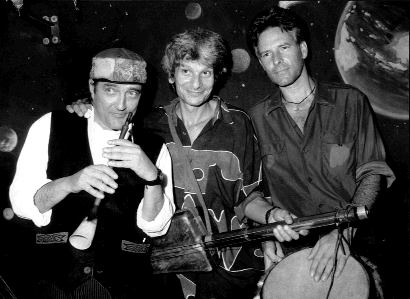
Bien plus qu'un concept fédérateur, l'utopie est l'essence même du trio Hadouk, sa nature profonde, sa force vive depuis plus de dix ans, son âme insaisissable aussi. Car Hadouk est un monde par lui-même, fait de racines aériennes et de terres rêvées, un continent imprévu qui pointe entre l'Afrique et l'Orient, un rivage improbable qui s'avance entre jazz et world, une véritable rose des vents qui se dessine sur le portulan des musiques du monde. Bref, Hadouk c'est une cosmologie en soi, avec ses constellations et ses horizons libres, ses lignes de grande transhumance et ses astres de première magnitude.

Charmeur de vents, Didier Malherbe attrape de son phrasé inimitable, les mélodies que zéphyrs et alizés lui apportent de toutes les latitudes. Cofondateur du mythique Gong avec Daevid Allen, il défend ensuite bec et anche la trille alerte et le slap éolien auprès de Jacques Higelin et de Brigitte Fontaine, de Robert Wyatt et de Pierre Bensusan. Depuis longtemps, à côté du saxophone et de la flûte, Didier apprivoise la bourrasque et cisèle la volute dans ces exquis réceptacles à turbulences que sont le bansouri, les ocarinas, et bien sûr le doudouk, hautbois arménien en bois d'abricotier au son doux et pensif. Grand connaisseur du roseau et infatigable babilleur, il a également publié un recueil de sonnets intitulé L'Anche des Métamorphoses.

Méhariste éclairé, Loy Ehrlich a été de toutes les équipées trans-sahariennes, aux côtés de Youssou N'Dour, Touré Kunda, Geoffrey Oryema, mais aussi de Peter Gabriel. Poly-instrumentiste, fin joueur de kora et de sanza, spécialiste du hajouj, la basse des gnawas, Loy a également mis dans ses claviers toutes les épices des marchés du monde. On le connaît aussi comme arrangeur et producteur, ainsi que programmateur du festival d'Essaouira.

Bourlingueur invétéré, Steve Shehan promène quant à lui son grand sac à rythmes sur toutes les coutures de la planète, pour en capter les forces sismiques. On l'a entendu avec Paul Simon, John McLaughlin, Paul McCartney, Christian Vander, Brian Eno et tant d'autres... Bois et argiles, cuirs et métaux n'ont plus de secret pour lui. Car Steve joue avec le temps comme avec la matière, et c'est le diaphragme du monde qui bat entre ses peaux. Il a par ailleurs à son actif plus d'une douzaine d'albums.

Après avoir célébré la chimère totémique (Shamanimal) et s'être hissé au sommet du perpétuel présent (Now), Hadouk emprunte désormais l'orbe altière du gyroscope cosmique. Après l'amble du désert et le groove végétal, voici le swing météorique ! Placé sous les auspices de la toupie céleste, ce cinquième album fait ainsi la part belle aux élans tourbillonnants, valse, pulse ternaire, danse spiralée et autres envolées giratoires.

De nouveaux instruments ont rejoint la panoplie de nos chasseurs de sons : khen, orgue à bouche du Laos, gumbass assemblant la caisse du guimbri et le manche de la basse électrique, hang au croisement chatoyant du steeldrum et du gamelan . Autant de territoires sonores qui s'inventent dans la distance prise depuis le terroir d'origine...

Hommage de trois navigateurs au long cours, à celui qui fut le pionnier de la world music à travers son concept de Quatrième Monde, Hadouk invite le trompettiste américain Jon Hassell sur trois morceaux : dans un ultime envoi, l'utopie rejoint alors l'orbite des grands empires imaginaires. Entre toupies et utopies, voici donc une nouvelle série de belles tourneries et de rêveries nomades, qui enlacent et emportent sur l'autre face du monde.

Bruno Heuzé?source : happy aisne

25 décembre 2008

THE OTHER STREAM: Some of 2008's best albums

Since its inception 10 years ago, "The Other Stream" has been a monthly column devoted to showcasing uncompromising artists who go beyond the commercial mainstream -- be it in rock, jazz, hip-hop, avant garde, World Music or some hybrids that are almost impossible to categorize.

Their music explores almost every genre you can imagine -- and any number you can't -- with skill and imagination, humor and pathos, if little regard for conventional "commercial" appeal. Some sing in languages you've never heard. Others don't sing at all, preferring to let their instruments express what words alone sometimes cannot.

A number of these artists are fearless innovators or reverent traditionalists, while others revere the traditions they are boldly reshaping. These are some of our favorite "Other Stream" albums of 2008. For listeners seeking sonic thrills, musical chills and consistently rewarding listening, the adventures start here.

Orchestra Baobab, "Made in Dakar," World Music/Nonesuch (nonesuch.com)

Groove, in all its many manifestations, is an art for the multinational members of Senegal's Orchestra Baobab (shown at right), who teamed up in 1970, disbanded in 1985, and have been hailed as returning heroes in many parts of the world since reactivating in 2001.

With its second album since reuniting, this 11-man band mixes new and old songs while reaffirming its mastery of rhythm, melody and the ability to create musical propulsion in virtually any tempo, no matter how relaxed or accelerated. Ghanian high-life, Jamaican reggae, Congolese rumba, Senegalese mbalax, the salsa hybrid mbalsa and all manner of Afro-Cuban styles are performed with consistently infectious results. They are joined by such stellar guests artists as Afropop superstar (and longtime Peter Gabriel collaborator) Youssou N'Dour and Cuban trombone star Jesus "Aguaje" Ramos of the Buena Vista Social Club.

On top of this dance-happy melange are brassy vamps and the wonderfully fluid guitar work of Barthelemy Attisso. Better still are the alluring vocals of Assane Mboup, who sings in French, Malinke, Wolof and Portuguese Creole. His sweet falsetto rivals that of Smokey Robinson and Aaron Neville in their primes, while Orchestra Baobab's pulsating ensemble work makes every song a celebration. (...)


23 décembre 2008

Best of 2008: Top world music of the year

By Patrick Varine, GateHouse News Service, Posted Dec 22, 2008

When it comes to world music, most people are a little apprehensive … probably because they’re thinking Peter Gabriel and Enya.

No, no, no. We’re talking about music from all over the world. And there’s more than enough to go around from 2008. Just a few examples:

Etran Finatawa, "Desert Crossroads" – As the first few strains of “Kel Tamascheck” waft through the air, you’re not quite sure what to make of it. It could be a swampy blues guitarist from backwoods Louisiana. But there’s a slight Arabic-style lilt to the scales. Then the percussion kicks in, and you’re transported to the rugged, wide-open spaces of northwest Africa. In the tradition of groups like Tinariwen and Tartit, Etran Finatawa takes their tradition nomadic music and adds electric guitar, combining African and Arabic rhythms with the voodoo-blues drone of John Lee Hooker. A mesmerizing experience. Key tracks: “Kel Tamascheck,” “Ganya Maada,” “Alghalam Taxat”

Alborosie, "Soul Pirate European Tour 2008" – With an ashy, pleading tenor and a thorough command of Jamaican DJ chat in the mode of toasters like Nicodemus and Super Cat, Alborosie plows through a solid set of classic and original riddims with the ease and flash of reggae godfather Bob Marley. Key tracks: “Sound Killa,” “Moonshine,” “Police,” “Bad Mind”

Various Artists, "Nigeria 70 Lagos Jump: Original Heavyweight Afrobeat Highlife & Afro-Funk"If you wanna dance, there’s no better way than afro-beat. The polyrhythms of central Africa have kept hips shaking since Fela Kuti brought it to the world in the 1970s, and this collection of tunes is proof that it can definitely still get the party started. Key tracks: “Everybody Likes Something Good,” “Igbehin Lalayo Nta,” “African Dialects,” “Yabis”

"The Very Best of the Red Army Choirs" (self-titled) – OK, so they’re singing songs from communist Russia, but that doesn’t change the fact that it’s a collection of masterful eastern European classical music, with a choir to beat the band.

Busy Signal, "Loaded" – One of Jamaica’s hottest dancehall artists, Busy Signal’s sophomore disc is, at times, a few beats-per-minute slower than the average riddim, but a clear, full tenor and reliance on splashes of Auto-Tune here and there make for one of the year’s best dancehall discs. Key tracks: “Wine Pon Di Edge,” “Jail,” “Cool Baby,” “Murderer”

"Seun Kuti & the Egypt 80" (self-titled) – Picking up right where his dad, Fela, left off – and with some of the same musicians – son Seun kicks up a refreshingly retro set of Afro-beat tunes with all the neverending grooves and political consciousness that Dad taught him. Key tracks: “Na Oil,” “Mosquito Song”

And the world-music song of year -- in my completely biased yet humble opinion -- goes to a re-release of Stelios Katzantidis' "Efuge Efuge," from "...And All the Pieces Matter," the soundtrack from HBO's "The Wire."

Sussex Countian

21 décembre 2008

Soul Science rocks the Casbah

< Justin Adams (right background), Juldeh Camara (foreground) and Salah Dawson Miller create a mighty groove music on Soul Science. CREDIT: photo Gavin Matheson
John Goodman, North Shore News, Friday, December 12, 2008

Like his idol Joe Strummer, British musician Justin Adams was brought up overseas. A childhood spent in the Middle East gave him a unique perspective and an infinite number of options.

"I just read Strummer's biography," says Adams over the phone from London, grabbing a bite between soundcheck and show. "He was a total hero of mine. And I grew up very much with that Do-It-Yourself punk ethic. I value engagement and passion -- I hate confusing music with sport and showing off virtuosity without emotional content. I just don't see the point of that."

In his own music Adams combines Western rock and blues with African and Islamic traditional influences although it took him awhile to reconcile the different approaches. Going to school in England in the late '70s he was immersed in punk and post-punk culture like everybody else and started playing music during that time. "It was a very creative period," he says. "We were listening to James Brown, Fela Kuti and Public Image Ltd. I kind of forgot about my childhood."

On a trip to Turkey he heard Islamic music for the first time since his childhood and began exploring the exotic, modal sounds of his youth. "I bought myself a couple of Turkish instruments and immediately started incorporating that into my playing," he says. "Often people would say, "Why are you playing those funny scales or what are you doing?' It took a little while before I found any kindred spirits that were into that. I met up with this guy Jah Wobble and he encouraged me. As did Robert Plant further on down the line."

Adams himself is the consummate collaborator. Since the early '90s he's worked with the likes of Sinead O'Connor, Natacha Atlas, Brian Eno, Hector Zazou, Peter Gabriel, Billy Bragg and Tinariwen. For several years he was a member of Jah Wobble's Invaders of the Heart and more recently he has been guitarist in Robert Plant's Strange Sensations band on and off between other projects.

Plant and Adams encourage each other in their explorations of North and West African music and its connection to American blues. One listen to Led Zeppelin's Kashmir will tell you Plant has known a thing or two about non-Western music for some time. "He was playing Gnoua music and working in Morocco before I ever met him," says Adams. "You can't say I introduced him to those things but I don't think he had worked with an English musician before who was as into it as me. We're like fellow enthusiasts and whenever one of us goes to Barbesse in Paris, where the North Africans live, we always bring each other back a DVD or a CD of music. We enthuse together. A real high point in my life was taking Robert out to the Festival in the Desert and playing together. It really was an incredible thing I still can't quite believe it happened."

To repay the favour Plant introduced his guitarist to Deep South Delta Blues culture while they were on an American tour. "He took me to Clarksdale, Mississippi. We had an incredible time going round and meeting friends of his there, going to juke joints and stuff. Unbelievable."

For more than a decade Adams has been heavily involved in the North and West African music scenes as both a musician and a producer. He's made several albums with the French band Lo'Jo and through them became intstrumental in getting the word out about the brilliant Tuareg band Tinariwen.

There's nothing the least bit stuffy or academic about Adams' musical projects. All traditional sources are respected but they are also only a starting point for further exploration. Everybody at a Justin Adams session is expected to find their place in the mix and groove accordingly.

Gambian spike fiddle player Juldeh Camara is the perfect foil for Adams' unique take on music. Traditional and modern worlds come together on their new album, Soul Science, which was released earlier this year on the World Village label. The duo recorded the album in Adams' home studio with percussionist Salah Dawson Miller sitting in on many of the tracks.

Camara called Adams up out of the blue one day when he was working with Plant. The African musician was working in England and had learned about Adams from a mutual friend. They arranged to meet up but first Adams thought he'd better do some research and be prepared. "I did have a CD of Gambian music which I knew I had and there were particularly some tracks I liked so I went to those looked at the small print on the back of the CD and sure enough it was Juldeh playing on those tracks I'd been listening to for ages. What had attracted me to the tunes is that mixture of trancy, often 6/8 rhythms that you find in Moroccan music. They have that slight pained thing of the blues about them -- they're not sweet, sugary, happy tunes. The overall mood is slightly dark. You know those slightly uneasy notes that come from Islamic music or that you find in the blues. It really attracted me."

Although Camara was known primarily as a traditional musician he had worked on some Western fusion projects before meeting Adams. "I think what is maybe unusual about my approach is that outwardly it's really modern. I mean I'm into all kinds of stuff from Velvet Underground to dub reggae to hip hop and experimental Ornette Coleman and all that but I really like the old African rhythms. I love the subtle swing in them. A lot of people doing, quote 'world music', start with what is basically a 4/4 rock beat and then they add flavours on top but what I' m doing is almost the reverse. My building blocks are pretty traditional and then I'm more liable to use a flavour of rock. You think you're listening to rock music but actually any African musician can play along with it."

Adams prepared a couple of rhythms in advance before meeting up with Camara. "I'd just overdubbed some percussion instruments and I said, 'Do you think you can play to this?' And thank God my years in music taught me to record the first take. Don't think this is just a tryout and we'll do it all properly later -- record the first because you never know what is going to happen. Track one on the album is pretty much (the first thing we played). It might be a second or third take but it's certainly within the first hour of us doing anything together. I'd prepared the rhythm and he just played over the top."

All of the material on the album is credited to Adams and Camara. They constructed the songs in the studio with both written and improvisational sections and recorded them over five days. "Juldeh is a Fulani griot," says Adams. "Griot's are ancestral storytellers of their people who tell oral histories and play all the important ceremonies. It reminds me of what people say when they are analyzing Robert Johnson -- 'There's two lines here you can also find in a Bukka White song -- the second verse has nothing to do with the first verse.' The griot can improvise like a well of sayings and poems and social injunctions and that's what Juldeh's doing. Some of the time it's an actual written song but everything has an improvisatory note to it."

The whole record rocks with a vengeance. As much as Adams defers to Camara, Soul Science, wouldn't have come out the way it did without the British musician pushing the conceptual envelope at every turn. "Having worked with Robert Plant for a few years I wanted to rock," he says. "I've become less scared of rocking out and more into that primal rock'n'roll spirit. Also working with Tinariwen influenced me hugely in that trancy rhythm and that whole approach to guitar playing. I was really primed by those two experiences and I just wanted to do something that was gritty and not too glossy. That's really what I was thinking about."

07 décembre 2008

1960s Cambodian rock alive and well in America

By VANESSA FRANKO, The Press-Enterprise, 12-3-08
Few American indie bands are playing 1960s-style Cambodian rock these days. And Dengue Fever is the only one to have a documentary made about it. You can check out both the band and the film tonight at Garrison Theater, Scripps College Performing Arts Center, in Claremont, when Dengue Fever performs and the documentary is screened. The film "Sleepwalking Through the Mekong" follows the band on a tour to Cambodia.

Dengue Fever has been climbing the buzzmeter with shows across the U.S. and a recent tour of Europe. The band was signed by Peter Gabriel's Real World Records to release its newest album, "Venus On Earth," outside the U.S. and Canada.

"I thought when the band was starting, I was optimistic locally -- like in Los Angeles and the music scene there. I knew it'd be a lot of fun to play this style at the local clubs where my brother and I live in Echo Park and Silver Lake. ... I knew it would go over well there," keyboardist Ethan Holtzman said. "I didn't know it was going to become our careers."

He and brother Zac Holtzman, who plays guitar, started the band in 2001 after discovering their mutual interest in Cambodian music from the 1960s.

Ethan traveled throughout Southeast Asia about 10 years ago and got into Cambodian pop music and bought cassettes. Around the same time, Zac was living in San Francisco, working at a record store where a colleague turned him onto the music. The brothers were staying together in Los Angeles and Ethan heard some of the music in Zac's collection.

"That's crazy -- I know that stuff," Ethan remembered thinking.

They decided it would be fun to play the music, which has psychedelic rock tones blended with traditional Cambodian music and sometimes lyrics, and formed the band. Saxophone player David Ralicke, drummer Paul Smith and bassist Senon Williams joined and they looked for a Cambodian singer, finding Chhom Nimol singing karaoke in Long Beach.

Nimol, who is from Cambodia, was known around the country and had performed for the king and queen.

Nimol's homecoming is documented in "Sleepwalking Through the Mekong," directed by John Pirozzi, which follows the band on their tour of Cambodia. It was filmed over 10 days in 2005. Tonight, Pirozzi will be on hand for a Q&A after the film.

"We'll remember it for the rest of our lives," Ethan said of the tour.

Some people knew the band before they toured Cambodia. Other recognized them from a television program and spoke to them as they traveled the country. Shows were packed, including one at a bar on a swamp. The owner was afraid would fall into the water.

"It went down in Cambodian history," Ethan said.

The new wave of cross-culture

Written by Jody Prewett, Sevenglobal,Thursday, 27 November


Not so long ago, the very utterance of the term “world music” to the proverbial indie kid or NME reader would be greeted with an onslaught of chortling and sneering. Rather like the new age genre, we’ve come to associate it with saccharine compilation albums called Sacred Spirit or the earthy ethnic hymns of Enya. The genre itself is something of a misnomer; all music should fall under the banner of world music. I’d like to think that music is a universal language that transcends cultural boundaries; surely it is a language that speaks to everyone alike?

However, it has been some time since modern pop really embraced the music of multiple cultures. Not since Peter Gabriel’s flirtations with African percussion or Paul Simon’s epochal Graceland have we been exposed to a true mingling of musical cultures. Recently, though, the tide seems to be turning with a clutch of new guitar bands being directly influenced by the music of Africa.

In recent times, indie has remained stationary and landlocked inside its own hemisphere. In the last year, there has been a new wave of bands far more at ease with the idea of world music, looking towards the primal rhythms of Africa for inspiration. This latest incarnation of guitar music has as much in common with Fela Kuti as it does with The Beatles; there is a sense of cultural crossover in pop that hasn’t been heard since The Clash collided head on with reggae.

For those unfamiliar with the genre, Afrobeat is a style that became popular in Africa during the Seventies and was spearheaded by Kuti. The music is a celebratory melting pot of African folk, funk and jazz with political undercurrents; Kuti, in particular, was compelled to react to the unsteady political climate of most African countries during the Sixties through his music. For Kuti, music is an impetus for social change, both a celebration of African folk traditions and a desire for human unity. The rich combination of primitive folk with modern electric sounds certainly seems to reflect this.

Two of the hottest new bands currently coming from the States are Brooklyn’s Yeasayer and Vampire Weekend. Both can be loosely referred to as guitar bands, but something sets them apart: they have a desire to go beyond simply being referred to as alternative rock. The debut album from Yeasayer, All Hour Symbols, is characterised by an emphasis on percussiveness combined with a sense of struggle and protest in the lyrics that echoes the great Kuti. On “2080” they sing, “I can’t sleep when I think about the future I’ve been born into” over a wash of guitar scales reminiscent of Thomas Mapfumo. This sounds unusually spiritual for a white guitar band, the kind of statement you would normally associate with the struggle against injustice of Africans during the Sixties. Perhaps this desire for universality and multi-culture in the music is symptomatic of the times we are in and represents a yearning for change in a separatist America and divided international community.

It is important to note that, on the surface, Vampire Weekend is a guitar band in the mould of Arctic Monkeys. But listen closer and there is something decidedly African in the spangling sun-soaked guitars and danceable rhythms. Both of these bands are injecting a sense of colour into the traditionally white indie alternative arena, seduced by the exoticism and splendour of the music of Africa.

Also from New York is Antibalas, an Afrobeat orchestra whose brass section forms an integral part of Foals’ Antidotes. As an album, it bypasses traditional song craft in favour of a reliance on infectious polyrhythms and repetition. The guitars, in particular, are peculiarly alien to ears trained to the established conventions of alternative music. Their two guitarists play cyclic staccato riffs, recalling the playing style of many Senegalese guitarists. In their music, you can hear the same carnivalesque sense of energy and repetition that is prevalent in African music. The Oxford-based band is regarded as one of the most progressive bands of the moment and is a front-runner in British music right now. Yet they hardly fit the stereotype of British guitar bands we’ve grown accustomed to. While the likes of The Enemy and Kaiser Chiefs are synonymous with the North of England, Foals sound like a truly international group.

It seems as though our audiences are becoming more open and accepting of more unfamiliar sounds. This wouldn’t seem so relevant if it were some underground phenomenon, but this bringing together of styles is taking place well within the radar of the mainstream press. It promises the kind of step forward that has previously been stunted by the regressive Britpop boom and the consciously retro “New Rock Revolution”.

In the 1980s, Talking Heads were heavily influenced by Afrobeat and very reactionary to the grit and grime of punk rock. Their sound was built on a funk groove that celebrated the concept of a large group of musicians singing and dancing in a kind of musical celebration of unity. In many ways, Talking Heads embody the idea of diversity and seem driven to distance themselves from the mono-culture of hard rock and punk of the 1970s. At the same time in Britain, The Clash played a politicised amalgamation of punk and reggae while The Specials were at the front of the ska movement. The current resurgence seems to mirror what happened during the Eighties in the borrowing of sounds from beyond the realms of recognised pop culture.

In dance music, Afrobeat is also thriving, with DJs Giles Peterson and Laurent Garnier regularly mixing Kuti or Ethiopia’s Mulata Astatke into their sets. Certainly, African music lends itself more directly to the dance floor, yet it is hugely symbolic that audiences are embracing Afrobeat to such an extent that it is beginning to influence our own popular music. It doesn’t seem to be a conscious source of influence either, more a subconscious gradual change in how people are approaching music-making.

Looking back to the 1990s and the turn of the millennium, pop culture seems to have its own distinct regional identity. From Britpop to grunge through to nu-metal and nu-rave, the mainstream has had a traditionally Anglo-American soundtrack and pop music hasn’t really made any great leaps across cultural boundaries. The renewed sense of openness displayed by the likes of Vampire Weekend and Yeasayer is an indication that universal divisions in the music world are narrowing once more. Perhaps today’s bands are tiring of the same reference points or are simply fed up with being conveniently categorized and thrown into a whirlpool of multiple genres and sub-genres. The timing is almost perfect. In the wake of Barack Obama’s vote of confidence from America, could this be the opening to a new dawn of truly multicultural music?

16 novembre 2008

Fever Pitch


Music Interview - Dengue Fever / Sugar Club

Rachel McMahon (The Event guide) speak to Zac Holtzman of American/Cambodian psychedelic sextet, Dengue Fever.

Sung mostly in Khmer (one of the exceptions being the seductive but comically manipulative duet ‘Sober Driver’), LA-based six-piece Dengue Fever is a blend of American psychedelic sounds and 60’s Cambodian pop. Guitarist and vocalist Zac Holtzman explains how he and his brother Ethan were first drawn to the music of 1960’s wartime Cambodia; “In the 90’s, my brother (Ethan) went to Cambodia and collected a bunch of tapes of old music. I was living in San Francisco at the time. And then he got back and I moved from San Francisco down to LA and I, on my own, had a CD with some of the old, really neat music from Cambodia. Then when I was playing it, he was like ‘Where did you get that?’ and he showed me his tapes and then we just started talking about it and we just thought it would be a neat idea to bring back a band that was based on that body of music.”

With their newfound inspiration, the guys set out in search of an authentic Cambodian singer. “We started driving down to Long Beach because there’s a big population of Cambodians, probably 50,000 people. So we started driving down there and going to the nightclubs and seeing just different singers perform,” the guitarist recollects. “Then we went into this one club called the ‘Dragon House’ and we saw (Chhom) Nimol on stage singing with a band, and then as soon as we saw her we were really hoping that she would be the one who would sing for us. So we approached her that night and we gave her a CD and at the time she didn’t speak any English, she was just able to say ‘Yes’ and ‘Thank you’ and so we asked her if she wanted to join the band and she said ‘Yes. Thank you’”, says Zac.

As well as their American/Cambodian fusion, Zac acknowledges the influence of other cultures; “A lot of us were really into all that Ethiopian jazz music. So some of our grooves have that kind of a feel. I like a lot of like Krautrock, like German sort of electronic music, and so some of our songs have sort of that feel but (with) instruments playing, that kind of a feel.”

In 2005, the band made the trip to Phnom Penh, Cambodia where they performed a number of shows and recorded some new material. Zac recalls their reception; “When we first got there, we played the biggest television show which is called CTN –Cambodian Television Network. They had us on for like a two-hour episode and then they heard that we were going to be there for like two weeks, so they aired it like three or four times a day for the entire time that we were there, so it was pretty crazy. It was like they instantly got us. So we played about six shows - some of them were like smaller clubs where there would be a mixture of Cambodians and people that were over in Cambodia doing work, for NGOs or Embassy workers, or just people over there doing humanitarian type of work, and so it was kind of a mixed crowd. And those shows - everyone kind of picked up on the vibe and went crazy, kind of rock n’ roll/punk rock style.” He adds however, “But then we also played some shows that were entirely made up of a Cambodian audience and kind of in a very poor neighbourhood, and so at that show everyone tended top be more reserved and just kind of checking us out, kind of just tripping out on what they were seeing.”

From Cambodia, Nimol was given a warm welcome, as Zac explains, “They were really happy that Nimol came back, because she hadn’t been home for five years. So they were really happy that when she did come home that she was playing Cambodian music and staying true to her roots, instead of being like just completely Westernised, you know, a Hollywood pop singer.” Whether their performances will encourage other bands to start up in Cambodia, Zac is optimistic; “I hope so, because the music scene there is a little bit in need of that, you know. I mean there are a few bands that, for the most part, is just a lot of karaoke going on.”
After releasing their last record ‘Venus on Earth’ in June, plans for a new album are already well underway, as Zac explains, “We’re going to record it in December and January…we’ve got about probably seven or eight songs so far. And we recorded two of them when we were in England, because we are working with Real World and so we went to their studio for a week.” Getting involved with Peter Gabriel’s record label, Real World, began when the label “Saw us in Spain once at this festival and then I think they were very interested and wanted to see us play a few more times. So then they came to a couple of our shows in England. And after that they wanted to work together. We put out our last record with them, just in Europe, and I think we’re going to hopefully do another one,” says the guitarist/vocalist.

Contemplating Dengue Fever’s possible future developments, Zac considers, “There’s this Cambodian instrument called a chapei dong veng, which means like a long-necked guitar - it’s kind of like a long-necked banjo instrument that has a really deep kerplunky kind of a sound and I’d like to get one of those. I think that would be really cool to have an electric chapei.” Zac muses, “So we badly need to get one of those. And then I feel a couple of our tunes that we’ve been jamming in the studio have sort of a psychedelic disco kind of feel, so that’s a direction that I feel it’s sort of going”.

11 novembre 2008

Womad NZ line-up announced

NZherald, Thursday Oct 30, 2008


Natacha Atlas will be entertaining at New Plymouth's Womad festival.

The line up for Womad has been announced and a renowned Nigerian musical family make another headlining appearance at the annual three-day world music festival in New Plymouth in March.

This time round it's saxophonist, singer and band leader Seun Kuti who plays the March 13-15 event at New Plymouth's Brooklands Bowl, following in the footsteps of older brother Femi who played the festival in 2007. The pair's father, Fela, was the pioneer of Afro-beat and Seun now leads his dad's former band Egypt 80 (whom he first played with aged 8). So expect some psychedelic, arse-shaking African jazz and funk.

The big local name on the bill is Fat Freddy's Drop who - all going well - should have the follow-up to their multi-platinum-selling debut, Based On A True Story, out before the festival.

Elsewhere the line-up is a lolly scramble of bands and musicians from countries and cultures around the world. Belgian-born belly dancer and chanteuse Natacha Atlas, who mixes Arabic and North African music with Western electronica and pop, will be one to see, as will Dengue Fever, who conjure up Cambodian psychedelic pop via the lusty streets of Los Angeles, and former Yothu Yindi member Geoffrey Gurrumal is also on the bill. Then there's Egyptian storytellers Bedouin Jerry Can Band, blind Portuguese singer Dona Rosa, The Gyuto Monks from Tibet and Australia, and Ska Cubano who, as the name suggest, fuse Jamaican ska and Cuban mambo.

Other locals include Shona Laing, Little Bushman, harmonica player Brendan Power, and Moana and the Tribe.

Womad, which stands for World of Music, Arts and Dance, was started 24 years ago by musician and former Genesis singer Peter Gabriel and while it has visited other venues in New Zealand it has been held in New Plymouth since 2005.

Tickets to the festival are available from Ticketek with 3-day passes $179 and there are also camping ($229) and marae-style ($249) accommodation passes on sale.

For more information and full line-up go to womad.co.nz

10 novembre 2008

Africaine du monde

23 octobre 2008, Auteur(e) : Pauline Lebrec, French Morning.com


Rendez-vous pris un dimanche après-midi dans sa maison de Brooklyn avec celle que les médias surnomment "la Diva Africaine". Pourtant, c’est un petit bout de femme qui arrive, à qui on donnerait à peine ses 48 ans. Mais tout de suite, Angélique s’impose par sa présence et son énergie hors-du-commun. Depuis le mois d’octobre, pour la promotion de son nouvel album, elle enchaîne les concerts aux Etats-Unis, revient tout juste de Milan, sera pour deux dates à New York la semaine suivante, avant de repartir pour Londres, et l’année prochaine l’Australie, la Nouvelle-Zélande peut-être...Infatigable, la chanteuse, qui a vécu au Bénin, en France et à New York, dit se sentir à l’aise partout.

Son secret ? Son identité africaine qu’elle assume et revendique. "Si on n’a pas d’identité, on ne peut rien faire. C’est grâce à elle que je peux me confronter à toutes les autres cultures sans me perdre en chemin". Et à toutes les musiques aussi. Angélique ne se reconnait aucune influence en particulier. "J’ai tout écouté quand j’étais gamine", du rock aux tubes des yé-yé, en passant par la funk, la soul américaine, le jazz et bien sûr la musique traditionnelle béninoise. Ses chansons sont le fruit de toutes ces rencontres musicales, et rien ne l’agace plus que lorsque les médias essaient de la catégoriser. "La musique n’a pas de frontière. Mes albums sont de la musique point. Aucun genre en particulier. Différencier les musiques est une invention marketing". La chanteuse n’admet qu’une source d’inspiration : elle-même. "Souvent je déstabilise les gens car je ne suis jamais là ou ils m’attendent. Je ne le fais pas exprès, je suis mon inspiration".

Pour son onzième album, Djin Djin, sorti en mai 2007, son inspiration l’a menée chez elle, au Bénin. L’idée de départ était de "construire le disque autour des percussions de [son] pays, en faisant appel à des musiciens traditionnels". Un retour à ses racines dont Angélique avait besoin, après un long voyage musical commencé en 1997 et qui l’a conduite, le temps de trois albums, aux États-Unis, au Brésil et dans les Caraïbes pour retracer l’histoire de l’esclavage. Une façon de clore un cycle, explique-t-elle. Pour cet hommage au Bénin, la chanteuse a également souhaité que ses amis l’accompagnent : Alicia Keys, Peter Gabriel, Carlos Santana, Joss Stone, sont autant de guest-stars sur l’album d’Angélique. Après avoir exporté la musique africaine tout au long de sa carrière, elle a voulu cette fois-ci emmener les autres dans son univers. C’est aussi le sens des deux reprises, version béninoise, de "Gimme Shelter" des Stones, et du "Boléro" de Ravel, car "toutes les musiques viennent d’Afrique". Au final, Djin Djin (comme le son des cloches qui annoncent le levé du jour en Afrique), est un album dense et varié, ou la voix puissante d’Angélique diffuse une joie de vivre et un optimisme sincère.

Dès sa sortie, le disque a été acclamé par la critique internationale, surtout aux États-Unis, ou il a reçu le Grammy Award du meilleur album World de l’année. Un succès qui ne se dément plus, la chanteuse a déjà reçu des trophées en France, au Danemark, en Afrique, en Grande-Bretagne...la liste est trop longue pour être exhaustive, et qui récompense 20 années de travail assidu. "C’est pour ça que je ne prend pas la grosse tête, parce que je suis constante dans mon travail". Cette réussite, Angélique a décidé de la mettre au service de causes humanitaires et caritatives. Depuis 2002, elle est ambassadrice de l’UNICEF, dont elle a elle-même bénéficié étant enfant. "Grâce aux vaccinations gratuites de l’UNICEF, j’étais en bonne santé. Et c’est la clé pour pouvoir recevoir une bonne éducation". En 2005, elle a également crée l’association Batounga, qui œuvre pour la scolarisation secondaire des jeunes filles au Bénin, Mali, Sierra-Léone, Éthiopie et Cameroun.

Pour autant, cette responsabilité vis-à-vis du monde qui l’entoure, elle l’a toujours eu. Sa première prise de conscience politique remonte à ses 9 ans, lorsqu’elle découvre l’esclavage sur une pochette d’un disque de Jimi Hendrix : "Comment des noirs pouvaient aussi être américains ?". Durant son adolescence, un sentiment de colère se met à l’animer : "Comment peut-on faire, chacun d’entre nous, pour ne pas mettre en danger le genre humain ?". Elle décide alors de devenir avocate des droits de l’homme. Espoir rapidement déçu quand elle comprend que les lois ne sont souvent pas au service de la Justice. Mais Angélique réalise aussi qu’à l’absurdité de ces lois s’oppose l’universalité de la musique.

"Par la musique, je cherchais un moyen de créer un pont de compréhension entre les hommes". "Quand je suis en concert, j’ai le monde devant moi" explique celle qui déteste le studio et préfère l’intensité des lives. Et Angélique l’humaniste s’anime, s’emporte contre les injustices, le racisme, le malheur des hommes. Elle se met en colère contre les gens qui préfèrent mettre des pulls à leurs chiens que secourir les SDF. "Tout le monde a le pouvoir de changer quelque chose dans sa et dans celle des autres". "Les gens me touchent, le monde me touche, c’est pour cela que j’écris. Je n’écris pas pour me faire plaisir". Elle raconte avec des frissons comment elle veut que ses chansons recréent l’espoir. "Ma plus belle récompense, c’est de voir les gens me remercier, me dire qu’ils ne croyaient pas que c’étaient possible qu’une musique leur fasse autant d’effets".

17 octobre 2008

Her eccentric Highness

Kenny Chee, Asia One, Tue, Oct 14, 2008


Chinese artiste Sa Ding Ding is poised to crack the Western market

By her own admission, Mongolian-born Chinese singer Sa Ding Ding can come across as a tad eccentric. "Even I think I'm a bit strange," the singer, who was born in Mongolia, told my paper. "That's because I tend to be very focused when I'm doing something and I'm apt to forget what's happening around me." To that end, she has shown up at recording sessions dressed in winter clothes in summer, oblivious to the fact until someone pointed it out.

Sa - who was in town recently to perform at the Esplanade Outdoor Theatre as part of the Formula One Singapore Grand Prix's entertainment programme - has been billed by some as Asia's answer to Icelandic singer Bjork. Sa fuses electronica with Chinese folk music, and this melange is topped by her warbly vocals.

She is also inspired by ancient Chinese texts such as the Materia Medica, a Ming Dynasty encyclopaedia of Chinese herbs written by naturalist Li Shizhen. She sings in Mandarin, Tibetan and Sanskrit, as well as a self-created language. Born to a Mongolian doctor mother and a Chinese government- official father, Sa was raised by her grandmother in the grasslands of northern China.

Her upbringing influenced her ear for ethnic music, and Sa later moved to Beijing to study philosophy and music at the Central Conservatory of Music. She released a debut album in 2001, followed by her sophomore release, Alive, last year. It caught the ears of the Western media, winning the British Broadcasting Corporation Radio 3 World Music Award for the Asia-Pacific region in April.

That win led to Sa performing at London's Royal Albert Hall and the World of Music, Arts and Dance (Womad) festival, where she enjoyed four encores. After her performance, she was approached backstage by many who told her that she "completed (their) music experiences", she said.

"I was incredibly moved; I treasure that much more than fame or fortune," she added. And what did she think of the world's first night race, which she was here to support? "I've watched F1 races on television, but this is the first time I've seen it so up-close and it's very exciting," she enthused. "I sometimes ask why the cars need to be so fast. But maybe I ask that because I'm a girl."

Sounds of Soweto, and history

by Kevin Ransom, Special To The Ann Arbor News, Thursday October 16, 2008


When the Soweto Gospel Choir first formed in 2002, the group members could not have envisioned how much of a world-music phenomenon they would become.

Since then, the group has won two Grammy Awards, seen two of its albums reach the No. 1 position on the Billboard World Music Chart, collaborated with big names like Bono, Robert Plant, Peter Gabriel and Celine Dion, and performed five times for Nelson Mandela, including a star-studded London concert to celebrate his 90th birthday. They have also raised more $1 million to provide care for those whose families have been victimized by AIDS.

In September, they simultaneously released their "Live at the Nelson Mandela Theatre" CD and DVD - a release timed to coincide with their current tour of North America, which comes to Hill Auditorium on Friday for a show sponsored by the University Musical Society.

Stylistically, the Soweto Gospel Choir's music owes more to traditional African music than it does to American gospel - even though they do deliver the Christian message in some of their songs. The Christian faith has been practiced in South Africa since the 19th century, when missionary schools were established there.

But many of the songs are about South African pride, which is fitting for a country where, for more than 40 years, until 1990, the native black majority was oppressed and even brutalized by the white minority under the rule of apartheid, the legal practice of institutionalized racism, racial segregation and the stripping of the rights of the black native majority.

"Yes, it is important for us to sing about our love for our country, and our pride in our heritage," says choir member Thembisa Khuzwayo. "It's our way of letting the rest of the world know about South African history and culture, and how much pride there is here among our people, and how much we love our culture and our country."

As in American gospel music, the Soweto choir constructs a rich, call-and-response vocal interplay. All the choir members are dressed in traditional, brightly colored African robes, while African dancing is a show-stopping element.

The group's repertoire include songs sung in three different languages - Zulu, Sotho and English, which are only three of South Africa's 11 official languages.

"Culture is always evolving, and popular music is part of that evolution," observed Khuzwayo, who was born in Johannesburg but grew up in Ladysmith in the KwaZulu-Natal province. "We know it's important for us to preserve and convey traditional music, but it's also important for us to connect with various audiences, and to do that, we use the many different musical styles we know and love."

15 octobre 2008

Musiciens et soufis : Youssou n'Dour et Nusrat Fateh Ali Khan

Mondomix, 13/10/2008

Dans le cadre des rencontres et débats des Jeudis de l'IMA, Etienne Bours animera, jeudi 16 octobre à 18 h 30, un débat sur le thème "Musiciens et soufis. Youssou n'Dour et Nusrat Fateh Ali Khan". Avec Gérald Arnaud et Pierre alain Baud, le débat portera su la nouvelle manière d’être musicien et soufi sera examinée à travers l’expérience de deux grands interprètes, Youssou N’Dour et Nusrat Fateh Ali Khan. L'événement est organisé par les éditions Demi-Lune.

Nusrat Fateh Ali Khan (1948-1997) est issu d’une famille de chanteurs traditionnels soufis (qawwâlî) du Pakistan dont il prolongera la tradition avant de la faire évoluer grâce à sa rencontre avec la musique occidentale et des musiciens tels Peter Gabriel.

Youssou N’Dour (né en 1959 à Dakar, Sénégal), lui, puise dans la tradition musicale des griots d’Afrique mais aussi dans les arrangements afro-cubains. Auteur, interprète et compositeur, il est considéré comme le plus grand chanteur qu’ait connu l’Afrique.

De courts extraits inédits des performances de Nusrat Fateh Ali Khan seront projetés.

Les participants :

Gérald Arnaud : auteur de nombreux films documentaires archéologiques et musicaux, ancien rédacteur en chef de la revue Jazz Hot, journaliste indépendant, il se passionne pour les expressions musicales de l’Afrique. Son dernier livre est Youssou n’Dour, le griot planétaire, (Demi Lune, Paris, 2008).

Pierre Alain Baud : conseiller artistique et journaliste, il s’intéresse à la diffusion des expressions artistiques de l’Orient soufi dans notre monde contemporain, il est l’auteur de plusieurs ouvrages sur le Pakistan. Son dernier livre est Nusrat Fateh Ali Khan, le messager du Qawwali, (Demi Lune, Paris, 2008).

Etienne Bours : conseiller musiques du monde à la Médiathèque de Belgique, il est l’auteur du Dictionnaire thématique des Musiques du monde, (Fayard, Paris, 2002).

Entrée libre dans la limite des places disponibles
Institut du monde arabe, 1, rue des Fossés Saint-Bernard – Place Mohammed V -75236 Paris Cedex 05