Articles review on the net, revue d'articles sur la toile


Inscription : feeds, flux :
(Atom) Gabriel Real World News

26 août 2005

Block rocking beats

Friday August 26, 2005

Block rocking beats

Bhangra has leapt to mainstream imagination in the recent past. NANTHA KUMAR finds out from Dhol Foundation’s Johnny Kalsi whether the beat will go on or slip away again.

When bhangra moved away from its origins as music of the field workers in the northwest state of Punjab in India right into the nightclubs in England, it spawned a thriving industry along the way.

The bhangra of popular entertainment – at least on British soil – has been transformed into a genre that has adopted various others: Reggae, rave, garage, house, hip-hop and pop, and assumed the symbolic music of the second and third generations British-Indians.
Alaap, the band that propelled bhangra into popular conscience in England almost 30 years ago, is credited with the popularisation of the music and defining the famed “Southall Sound” (the west London suburbia of yore preferred by Indian immigrants). Eversince then, it has moved away from its roots and pushed itself up the mainstream as bhangra mania hit in the mid-1990s, but it gradually cooled off after it lost its momentum.

However, now, the talk is again of bhangra being the next big thing.

Missy Elliot’s runaway hit single, Get Yr Freak On, pulsated with bhangra energy while Britney Spears and Craig David hopped on the bhangra bandwagon for their remixes through producer Rishi Rich. Juggy D, Jay Sean and Panjabi MCs have followed the path blazed by Bally Sagoo and Apache Indian and become the principal “bhangra” figureheads.

In this illustrious company is Dhol Foundation – a much more serious proposition in the appreciation of bhangra and the most vocal in the preservation and promotion of the music.

Dhol’s main man Johnny Kalsi, also the snarling face of Afro-Celt Sound System and whose music has been featured in the soundtracks of Gangs of New York and The Hulk, has been part of the bhangra industry in England for years now and is aware of the fleeting nature of bhangra’s popular existence. He is the founder-leader of the Dhol Foundation institute and band.

The Dhol Foundation appears at the annual three-day Womad Festival at Fort Canning Park in Singapore, starting today. It performs tonight as the festival’s headlining act, and will also be a part of the workshop activities scheduled over the next three days.

Kalsi has strong opinions about why the music must be kept pure.

“Most of the good bhangra artistes have built their own personal fan bases but I think there is a great deal to be said about DJs who don’t know an ‘A’ note to a ‘C’ note and their coarse re-mixes. Some of these albums, however, are very well done and put together in very high-class studios. Productions from bands such as Alaap will not cut corners or compromise in any form to hinder the sound and result.

“Any album is in danger of over production but I think in their case, the formula was just right. This was mainly due to the fact that the band did the production on it and Inder Kalsi, the sound engineer for Dhol Foundation as well, did an immaculate job of refining and finishing all of Alaap’s previous work – and that was before the wonderful ‘cut and paste’ days of Atari 1040,” he said in an e-mail interview.

Kalsi is not alone in believing that the many permutations of music that had threatened to swamp bhangra have not managed to remove its longevity and have only made it resilient. If proof is required, Alaap – the band of which Kalsi was a member – is still the rear-kicking group that it was when it started out in the 1970s and passed over record deals to remain independent.

“Bhangra has always been a keen style of music for the Asian dance scene. It’s just that occasionally it comes up to surface and gets noticed then a follow-up is needed to hold the attention but never quite makes the same impact as the first. Back in (those) days, Alaap was one of two bands that was offered a real record deal by Island Records.

“Island had plans, new ideas and conditions. One of those conditions was that the band stop performing at weddings. The band members refused and the deal was off. They knew that by doing the weddings they could earn far more money in the band than by having a record deal.

“I guess in that sense it was the right move. They stood their ground and Alaap is still the live bhangra band ? tight and still sounding the way it did before.”

Dhol Foundation will be supplying their rocking dose of bhangra at Womad Singapore 2005. Other acts to appear include Mali’s Tinariwen, Apache Indian, Sheila Majid, Billy Cobham and more.

For details on gig schedules, browse www.womadsingapore.com. Tickets and travel packages are also available from Holiday Tours & Travel at 03-2273 2200.

24 août 2005

Darkness, Tina and the Full moon

Moon Club News : 19-Aug-2005

Greetings lunatics,

We must apologise for the relatively sparse nature of posts on the site of late. It's been all hands to the pumps here as we work on two new double DVD sets - "Africa Calling - Live 8 at Eden" and 'Peter Gabriel Still Growing Up, Live and Unwrapped" - watch this space for more on these DVDs. All I can say is that we are pumping hard, but the water's still up around our necks.
We have however found a moment to mark the the full ripeness of the moon which should be sailing overhead some time this evening, and it should be noted that this months choice of a 'Darkness' demo is no reflection on the generally light and summery mood at Real World. This rendering of the track dates from 1996 and is relatively early in it's life-cycle, coming before the band have played a note on the track.

Tina has also made an update to her pages, so why not download some Darkness and ponder the origins and meaning of lines like “…did I dream this belief? Or did I believe this dream?

Download Darkness

22 août 2005

Concert FM Radio Broadcast Peter Gabriel

Concert FM Radio Broadcast Peter Gabriel - Composer of the Week. Presented by Kate Mead

Why do I feel justified to talk about Peter Gabriel? Is it because I've played cello at his studio, the Real World, in Box, a village outside Bath? Or because I've run around at night, naked, on Solsbury Hill (it's a Bath tradition)? Or because I've been to WOMAD Festivals on the beach in St Austell, Cornwall, and in the Bowl of Brooklands, Pukekura Park, New Plymouth?

All of the above and more. It's because I'm a fan, a dyed in the wool early-Genesis, WOMAD, Real World, Peter Gabriel fan and my ambition is that in six hours of Composer of the Week, Sunday 4 - Friday 9 September I can show you the various facets to this musical, social and political human being. For more information, click on the link above.

------------

Concert FM

Concert FM is Radio New Zealand's fine music network, broadcasting the best in classical music and contemporary music and spoken features about the music world.

Concert FM broadcasts via 33 FM transmitters around the country. Concert FM reaches about 92% of the population via these transmitters (although, like National Radio, it is also available on the Sky Television satellite service - Sky Channel 102 - which means than it is available to 100% of the population).

http://www.nzonair.govt.nz/radio_detail.php?pid=405&sid=400&hid=403

Sunday 4 September 9am

Composer of the Week: Peter Gabriel

Presented by Kate Mead CFM

This week’s composer is Peter Gabriel - original and reluctant, pre-Phil Collins, frontman of Genesis, inventor of Stage Dive, solo artist, driving force behind WOMAD, film score composer and founder of the Real World studio and record label.

As the leader of Genesis in the early 1970s, Peter Gabriel helped move progressive rock to new levels of theatricality. In his solo career, Gabriel was no less ambitious but he was more subtle in his methods.

He reached international stardom with a series of groundbreaking videos and the number one single Sledgehammer. Instead of capitalising on his sudden success he began to explore other interests, including recording soundtracks and running his company Real World.

His commitment to promoting political messages through his music came to a head with Biko a song about a murdered anti-apartheid activist which became one of the 1980s biggest protest anthems.

However, just as his solo career was taking off Gabriel participated in a one-off reunion with his former band Genesis to finance his WOMAD (World of Music, Arts and Dance) Festival.

Designed to bring various world musics and customs to a Western audience, WOMAD soon turned out to be one of today’s most successful international music festivals.

In this week’s Composer of the Week, Kate Mead looks at one of today’s most diverse musicians.

Festival de Womad : Voix du monde

Comme lors des festivals précédents, ils étaient venus en force, quelque 30 000 personnes, en quête de nouveaux sons, de nouvelles sensations, passions et vibrations venues des tropiques, de l’Afrique, berceau de la civilisation, de l’Asie de la sagesse et des philosophes, et de l’Amérique latine des poètes et des mouvements révolutionnaires.

Ces humains que l’on croit à jamais disparus réapparaissent le temps d’un festival, avec toute la panoplie des t-shirts, tracts, livres et autres signes qui dénoncent les effets dévastateurs de la mondialisation qui « permet aux riches de devenir plus riches et enfoncent les pauvres un peu plus dans leur misère », pouvait-on lire sur une banderole. Leurs enfants, adultes précoces, semblent prêts à reprendre le flambeau et à perpétuer les rêves, les idéaux et l’étendard politique de leurs parents.

Petites filles et garçonnets copient maman et papa en portant des sarouels indiens ou pakistanais et des tuniques africaines aux couleurs chatoyantes. Ils arborent des coiffures rasta avec tresses africaines et se trémoussent aux sons de la musique gnawa, rap, raï, funk, punk ou hard rock comme de vrais danseurs professionnels. «

On ne les voit jamais, ou alors très rarement, pleurer, rechigner ou se plaindre. Ils passent leur temps à jouer comme des fous et ne sont jamais fatigués », fait remarquer un ami. Womad a été une fois de plus à la hauteur de sa réputation avec des dizaines de chanteurs, de groupes et de musiciens venus des quatre coins du monde.

L’Algérie, cette année, n’a pas été représentée par les poids lourds habituels que sont Khaled, Mami, Souaâd Massi, l’Orchestre national de Barbès et autres « monstres » des divers genres musicaux du terroir. L’honneur est donc revenu au chanteur et joueur de kamancha, Akim El Sikameya, qui a comblé le vide avec brio. Ce jeune natif d’Oran s’est choisi un nom de chanteur qui est un croisement de sika et de meya, deux des noubas les plus interprétées de la musique arabo-andalouse.

Sa performance samedi soir sous la tente géante de Siam a déclenché une véritable tornade de la part d’un public qui le découvre pour la première fois à Womad. « More, more, more » scandaient les milliers de festivaliers qui l’applaudirent pendant plusieurs minutes à la fin de son concert. Akim s’exécute et revient sur scène pour « enivrer » le public avec sa voix douce et mélodieuse, exprimant aussi bien le grave que le léger dans une musique qui mélange l’andalou, le flamenco, les cadences afro-hispaniques, les ballades sereines, le tout pimenté de couleurs celtiques, tziganes et bossa.

Lors du grand finale, dimanche soir, Akim, à la demande du public, a rejoint un géant de la folk music américaine, Ritchie Heaven, qui avait fait le festival de Woodstock, dans une performance où la voix grave et rythmée du chanteur Noir américain s’est mêlée à celle langoureuse et chaude du chanteur algérien dans un duo qui rappelle celui de Sting et Mami dans Desert Rose.

Même mélange de l’Orient et de l’Occident. A vous couper le souffle ! L’Afrique noire est toujours présente à Womad, avec cette fois-ci l’Ethiopien Mahmoud Ahmed, qui a fait sensation avec son style de musique soul ; l’étoile montante Jaojoby venue de Madagascar, ainsi que la belle Cap Verdienne Lura, qui chante accompagnée d’une simple guitare et de percussions.


Cependant, la palme est revenue samedi soir à la vedette mondiale, une des fiertés de l’Afrique, le Sénégalais Youssou N’dour et son groupe Super Etoile. Quel accueil ! Quelle popularité ! N’dour, égal à lui-même, a enthousiasmé le public avec une performance où se mélangent le style griot, l’African pop-rock-folk et la musique traditionnelle sénégalaise, le tout ponctué de ses longues envolées vocales. Une voix d’or que les mordus de Womad adorent.

Dans le registre international, les festivaliers se sont délectés des sons féroces de l’Asie avec les batteurs sud-coréens Kiki Dee et Dulsori, un ensemble de percussions composé de trois hommes et de deux femmes, aux style jazz à la Nouvelle Orléans, et jazz-funk exécutés par les jeunes Américains du Youngblood Brass Band.

Il y avait également le Renegade Steel Orchestra, un groupe très très « hot » de Trinidade, de la salsa dans la pure tradition argentino-uruguayenne avec le Bajofondo Tango Club, et d’autres chanteurs et groupes qui font que le festival mérite son nom de World of Music, Art and Dance. Les amoureux de cette « orgie » des musiques du monde aiment encore plus l’ambiance du festival, ses stands qui permettent de découvrir les plats aux sauces épicées et piquantes, les arômes et les boissons du monde entier et le formidable esprit de fraternité, de camaraderie et de convivialité qui y règnent.

Il faut voir ces bébés qui dorment dans leur poussette fleurie et peinte aux couleurs de l’Afrique, tandis que leurs parents se joignent à d’autres pères et mères pour partager le pain, le vin et le joint. Il faut voir cet esprit de tolérance, ces échanges de mots doux et de gentillesse entre gens qui partagent le même amour pour leur prochain, sans distinction de race, de sexe ou de religion. Merci Peter Gabriel d’avoir créé ce festival il y a 26 ans.

Merci de nous donner l’immense sentiment d’un bonheur profond de savoir que dans ce monde de terrorisme et de mondialisation, des gens humbles, chaleureux et foncièrement bons continuent de rêver, de vivre en paix et de transmettre leurs rêves et leurs idéaux à leurs enfants. La relève est assurée. We love you Womad.

M. Afroukh

"La musique me portait, c'était ma seule langue"

Article paru dans l'édition du monde du 13.08.05, Propos recueillis par Véronique Mortaigne


Un soir de sa tournée estivale, Youssou N'Dour, dîne avant un concert au Palais des festivals de Cannes. Le surlendemain, vers 1 h 30, il chantera dans la banlieue de Dakar ; la veille, il était avec Bono au G8 près d'Edimbourg pour réclamer l'annulation de la dette. Chaussures de sport américaines, tee-shirt rouge estampillé du nom de sa boîte dakaroise, le Thiossane, chic, souriant. Après son récital, le service de sécurité lui demandera de sortir par une porte dérobée pour éviter les centaines de fans ­ - boubous colorés, complets blanc cassé ­ - descendus de Grasse ou de Nice. Scrupuleux et attentif, Youssou N'Dour demandera à la voiture de faire demi-tour vers la Croisette afin de venir à la rencontre des siens, "pour ne pas les décevoir".

VM: Vous aimiez, enfant, aller à la plage de Soumbédioune de Dakar cueillir les takgaal, petits poissons à ventouse, et les griller sur la plage. Mais vous êtes un enfant de la Médina, dont la pâtisserie demeure votre quartier général après concert, au petit matin...

La Médina, c'est magnifique. Elle n'est ni fermée ni ouverte, on s'y sent bien, les gens y viennent par sympathie. Ce n'est ni le Plateau -le quartier européen de Dakar- ni le côté paumé où l'on baisse les bras. La Médina, c'est comme New York, avec ses rues 2e, 4e, 6e, 8e, 10e, pairs et impairs. Pour l'adresse, on dit rue 15, angle 6. La médina, c'est incroyable. Imaginez : une télévision qu'on regarde devant la porte ; une marmite entr'aperçue, qui signifie que la famille peut vous inviter à manger. Dans la Médina, la création est cachée. Et puis, c'est le son pour tout le monde. Malheureusement, ma mère n'y habite plus. La maison où j'ai grandi est aujourd'hui le siège d'une radio. Et j'ai beau en avoir créé une moi-même - Radio-Futur Meilleur -, la Médina a été ma première radio, sans antenne, avec les jeunes qui parlaient.

VM: En 1986, le rocker anglais Peter Gabriel vous entend et tombe en admiration, découvrant, dira-t-il, "le mariage de rythmes puissants et de cette passionnante innovation musicale provenant des accents islamiques de sa voix".

Peter Gabriel sait écouter. Enfant, j'entendais les muezzins, le matin très tôt, et les prières quand j'allais me coucher, des sons extraordinaires, qui prennent entièrement. Et Oum Kalsoum à l'époque du ramadan. Alors, aujourd'hui, le link, le lien entre tous ces sons, c'est Youssou : l'Afrique noire des griots, l'islam, l'Afrique urbaine. Je viens de gagner un Grammy Award aux Etats-Unis pour Egypte. Je ne pensais pas que ce disque allait sortir du ghetto des amateurs éclairés.

Sur la forme, j'ai adoré l'enregistrer : je n'ai jamais eu autant d'espace pour ma voix. Le contenu de cet album n'est pas lié au 11-Septembre, mais il est cependant sorti après, et a beaucoup apaisé ceux qui craignaient l'islam en ignorant tout de l'Afrique musulmane. Pour cet album, j'ai travaillé avec des Egyptiens, dont le chef d'orchestre Fateh Salama, qui ne connaissait rien à l'islam noir.

Même si je danse, si j'organise le grand bal de Bercy depuis cinq ans ­ 18 000 personnes en un soir de fête dédiée à toute l'Afrique, du nord au sud ­, la religion a toujours été contenue dans ma musique, ainsi que le message de cheikh Amadou Bamba -leader des Mourides-.

Au Maroc, les barbus sont aux portes, au Sénégal nous défendons un modèle libéral. Nous avons eu longtemps un chef d'Etat chrétien, le poète Léopold Senghor. Moi, à Dakar, je vois le vendredi des jeunes qui font la prière avant d'aller s'éclater en boîte. Par ailleurs, les musulmans radicaux ­ il y a des extrémistes dans toutes les religions ­ sont une minorité dans le monde.

VM: Quel est votre plus grand souvenir de concert ?

Le premier, à Saint-Louis. J'avais 14 ans, j'avais composé avec un de mes oncles musiciens une chanson en hommage à Mba, un grand musicien de là-bas qui venait de mourir. Dans le stade où tout le monde pleurait encore, moi, j'ai donné de la joie, j'ai vibré, j'ai senti que Mba, c'était comme une étoile qui partait. La radio nationale était là. A la fin de la chanson, quelqu'un m'a porté. En réalité, ma vie professionnelle a débuté très tôt : je n'ai pas profité de la vie en tant que gamin.
VM: On dit que Youssou N'Dour est le produit du Sénégal, façonné par son public. Est-ce vrai ?

Sincèrement, oui. Je suis un produit du Sénégal, je suis comme les gens voulaient que je sois.

VM: Dans le livre qu'elle vous consacre, Michelle Lahana, votre manageuse, écrit que quand elle vous a rencontré pour la première fois, alors qu'elle travaillait pour Radio France Internationale, elle vous a trouvé insupportable parce que vous aviez demandé un traducteur français-wolof.

J'en avais besoin. Je n'étais pas confiant, je ne voulais pas faire d'erreur. J'étais sûr de ce que je disais en wolof, pas en français. Gazelle -nom attribué dans toute l'Afrique occidentale à Michelle Lahana- a pris cela pour de la frime, j'avais des lunettes noires, j'étais timide. J'ai arrêté l'école en CM2, la musique me portait, c'était ma seule langue. Ensuite, j'ai compris qu'il fallait convaincre, comme sur un marché.

VM: Vous avez fait des progrès depuis. On vous a vu en juillet à Gleneagles, près d'Edimbourg, au coeur du dernier G8, en petit comité.

Il y avait avec moi Wangari Maathaï -ministre kényane, Prix Nobel de la paix-, George Clooney, Bono et Bob Geldof, les organisateurs du Live 8 -dix concerts planétaires le 2 juillet pour l'effacement de la dette africaine-. Nous sommes allés dans ce lieu magnifique et sécuritaire, pour communiquer, et non pas pour jouer au golf. Il fallait atteindre ces gens qui dirigent le monde, qui ont fait tellement d'erreurs, tellement tardé à régler les problèmes.

Je suis pour l'annulation généralisée de la dette, parce que les générations passées l'ont déjà payée. Cette annulation sans contre-partie n'est qu'une première étape. Nous demandons aux Occidentaux de cesser de subventionner leurs agriculteurs, empêchant ainsi l'Afrique de vendre et d'exporter. Sinon, je dis : les Africains, réveillez-vous ! La Chine offre des solutions moins coûteuses pour les pays émergents. Si nous achetons chinois, nos enfants porteront peut-être des tee-shirts de qualité médiocre, mais ils seront habillés. C'est une question de dignité. Il faut que nous soyons mis en condition de parler et non de nous taire.

VM: En 1985, vous êtes dans le Band Aid pour l'Ethiopie ; en 1988, vous chantez à Wembley pour la libération de Nelson Mandela ; puis aux côtés de Sting, Tracy Chapman, Bruce Springsteen, pour Amnesty International. Depuis, vous n'arrêtez jamais. Ambassadeur de l'Unicef, ami de Peter Gabriel, vous avez écrit des chansons sur la femme, les déchets toxiques, les enfants des rues, les immigrés. Pourquoi ne pas vous lancer directement dans la politique ?

Ce que je fais est plus fort, je vis et j'utilise ma musique. Et tant pis si, comme on dit en wolof, tout ce qui aboutit trouve son propriétaire, l'important est d'avancer. Nous disons à l'Occident : ne faites pas tout pour nous, nous le ferons pour nous. Dans cette optique, je me suis engagé à lutter contre le paludisme, notamment par le biais d'un concert, Africa Live, organisé au profit de la lutte contre le paludisme en mars à Dakar.

Comme beaucoup d'Africains, j'ai pris le palu comme un petit truc gênant parce que les moustiques te piquent, on a la fièvre, et c'est normal, mais jamais comme une maladie grave qui peut faire perdre la vie. Et puis, invité à chanter lors de la Journée mondiale contre le paludisme, à Matam au Sénégal en 2004, j'ai appris que le paludisme tuait deux millions de personnes par an, trois mille par jour, surtout des enfants de moins de cinq ans, des femmes enceintes.

Tout de suite, ma fondation - la Fondation Youssou N'Dour, créée il y a six ans, axée sur les jeunes - a contacté à Genève le programme des Nations unies Roll Back Malaria. Nous avons trouvé des moustiquaires, expliqué aux gens les précautions à prendre. Lors d'un dîner donné à Dakar par le président Wadé, où j'étais invité avec d'autres artistes sénégalais, dont le sculpteur Ousman Sow et la romancière Fatou Diome, Jacques Chirac nous a assurés du soutien de la France, après le Japon qui vient de nous promettre le don de dix millions de moustiquaires et les Etats-Unis qui ont annoncé 1 milliard de dollars pour lutter contre le paludisme. C'est bien, mais nous n'acceptons plus qu'on fasse des choses pour l'Afrique sans l'Afrique.

VM: Est-ce difficile d'être Africain en Occident ?

Ce qui est insupportable, gênant, c'est d'entendre le commentaire journalier des Européens sur l'Afrique, sans aucun regard positif. Quand je regarde la télévision française, je suis halluciné, je ne vois pas de Noirs. C'est le signe d'une non-volonté d'ouvrir le débat, dans une France impliquée en Afrique depuis très longtemps, et qui a participé massivement à la traite esclavagiste. Mais les dirigeants de la France médiatique, les acteurs des débats d'opinion, n'ouvrent toujours pas la porte.

Or je crois en l'Afrique, qui est une, du Cap à Alger et au Caire. Les jeunes sont en train de mettre en place un réseau qui dépasse les contraintes de langues, les clivages de micro-Etats, grâce aux nouvelles technologies, aux associations, aux médias, à la musique, au sport, ­ lors de la dernière Coupe du monde de football, l'équipe des Lions sénégalais a réalisé en quatre-vingt-dix minutes ce qui m'imposera vingt ans de travail. L'Afrique de ce réseau-là veut des autoroutes et des cases, mais avec l'air conditionné. J'essaie d'être l'un de leurs porte-parole.

VM: Vous avez commencé sous le signe des étoiles, plutôt américanisées : le premier club où vous avez joué ne s'appelait-il pas le Miami, et votre groupe le Star Band ?

Le Star Band était détenu par un vieux, Ibra Kasse, patron d'un club appelé le Miami, qui engageait des musiciens payés à la semaine. Quand j'ai atterri au Miami, j'avais 15 ans. Puis je suis parti, et j'ai francisé le nom du Star Band en Etoiles de Dakar. Ensuite, en solo, j'ai retenu la suggestion d'un animateur de radio : le Super Etoile. Cela étant dit, c'est bien qu'il y ait des Américains en Afrique, ça équilibre.

VM: Vous avez eu une période Spike Lee, enregistrant sur son label, 4 Acre and A Mule ­ - ce qui était donné aux esclaves libérés aux Etats-Unis ­-, portant la casquette marquée du X de Malcolm X, qui est aussi celui de votre studio d'enregistrement, Xippi.

Cette période est lointaine. Spike voulait ouvrir l'Amérique à l'Afrique avec une vision très personnelle, intelligente, et très américaine. Mais je ne pense pas qu'il aille au magasin acheter des disques africains.

VM: Pourquoi vous voit-on si peu dans les magazines ?

Je suis discret, la presse me laisse tranquille. Je me suis marié en 1990 avec Mami, j'ai six enfants. Je vis à Dakar. On m'a laissé en paix. Jamais de photos, du respect. Mon épouse n'aime pas ce système médiatique. Si jamais on me prenait ces moments de solitude et d'intimité à Dakar, avec ma famille, mes amis, je serais beaucoup moins productif. Je me sens parfois prisonnier d'un système ; mais je me remets, je me calme en revenant au Sénégal.

VM: N'êtes-vous pas pourtant le "beau sexy" de 7 Seconds, que vous chantez avec Neneh Cherry sur l'album The Guide, où figurait aussi une reprise sahélienne de Chimes of Freedom de Bob Dylan ?

7 Seconds est une magnifique chanson, très éloignée de ce que je fais par ailleurs, magique, parce qu'elle a une relation à la tradition, notamment par Neneh Cherry qui est africaine par son père.

Moi, je suis un artiste "album", et j'ai toujours fonctionné par rencontres : Peter Gabriel, Paul Simon, Jacques Higelin, qui m'a appris qu'en scène on devait improviser, plus tard Wycleff Jean, Pascal Obispo. Je souhaite à tout le monde de faire un tube, mais ce qui est grave, c'est l'obligation d'en faire sans arrêt.

Pour la musique africaine, ce sont les Touré Kunda qui ont commencé, avec les rythmes du sud du Sénégal, de la Casamance, proche de la Guinée-Bissau. J'étais fan des Touré Kunda. J'étais fan de Mory Kanté. Je l'ai écouté avec les Ambassadeurs quand il chantait Soundiata. Je suis wolof, bien que mon père ait des origines sérères. Musicalement, le rythme wolof, le mblax, est complexe, difficile à comprendre pour le reste de l'Afrique, contrairement à ceux de la Casamance.

VM:Etre wolof, cela veut dire quoi ?

Etre au centre.

VM: Pourquoi votre club s'appelle-t-il le Thiossane ?

Thiossane, ça veut dire notre histoire, la réalité, celle des lignées que le griot savait et racontait. Ma grand-mère et ma mère, Sokhna, étaient griottes, toucouleurs. Les griots sont là pour les circoncisions, les baptêmes, les nuits de noces, ils ordonnent le cours des fêtes.

Mais au quotidien, ils s'invitent chez les uns et les autres, passent leur journée à raconter des histoires, à fredonner des récits du pays, des ancêtres, avec le khalam, une guitare à quatre cordes. On reconnaît les griots à ce qu'ils ont toutes les parties du corps qui parlent : les yeux, les mains, les fesses... Le Thiossane est devenu un lieu mythique du mblax, qui n'est pas seulement un rythme, mais ce que l'on incarne.

Au Thiossane, il nous arrive d'apercevoir quelqu'un dans la salle et de chanter ses louanges. Je fais le griot moderne, insoumis aux princes qui le nourrissaient, et qui conteste. Le griot est celui qui te prête les yeux. La musique est la seule manière de toucher l'invisible. Le son prend les gens ­ ils sont dès lors une seule personne et je m'oublie. Je joue depuis vingt-cinq ans avec eux. Je crois sincèrement que le Super Etoile est le groupe qui a la plus grande longévité du monde, parce que nous ne nous séparons jamais, ni en tournée ni à Dakar.

VM: Et comment faites-vous pour conserver intacte une telle voix ?

Je dors huit heures par jour. Le reste est naturel en moi. La voix c'est d'abord un don, puis on arrive à sortir un timbre. Le talent ne suffit pas. Je fume quelquefois, mais j'évite de manger la soupe kandja, mon plat préféré, qui fatigue la voix à cause de l'huile de palme et du gombo, un légume gélatineux qui a tendance à s'installer sur les cordes vocales et à s'endormir dessus.

Freedom Fighter

J. Poet, Sunday, August 14, 2005

Johnny Clegg's music was the unofficial soundtrack of the anti- apartheid movement. In 1976, Clegg and his friend and musical partner, Sipho Mchunu, a member of the Zulu nation, made an album of Zulu ethnic songs under the name Juluka. Since even radio in South Africa was segregated at that time, the album created problems.
...
"I'm recording with Tchad Blake at Peter Gabriel's studios in Bath," Clegg says. "He's a good chap with a good sense of space and an ability to get down to the best basic sound for a song. I'm using my band and some invited guests; it's about 40 percent Zulu with some interesting new directions. I'm concentrating on doing two or three good videos -- which I haven't done in 10 years -- finishing the album, shopping it around and touring.

"I want people to see the live show and see the energy we put out. The bottom line is always the live show and exchanging energy with the audience."

Baaba Maal: New Release from Palm World Voices

Palm World Voices: Baaba Maal

Baaba Maal

Music from Palm Pictures (Audio)
Release date: 09 August, 2005

Senegal sticks out into the Atlantic Ocean on the tip of the round curve of Western Africa. For as long as people have lived there, it has been a stop on the trading and migration roots. With the coming of the European nations, it became an instrumental port in the slave trade.

When the last colonial rulers, the French, banned slavery in 1857, the country reverted to its traditional role of safe haven for political refugees and centre for trade. The majority of nations in North West Africa and Arabia relied on Senegal for salt. This intermingling of cultures and nations has played a major role in the development of Senegalese music.

In Senegal, like other West African nations, there exists a type of caste system. Though not as rigid as others, it still can dictate a person’s choice of career. Musicians, especially singers, are drawn from those who are members of a griot family.

More then just a singer, a griot serves as the repository of local history, knowing the stories of all the local families and able to recount their deeds in poems or song. They have been advisors to kings, teachers who instruct people in the right way to live, and what role they play in society as they grow up.

To aspire to be a singer when not from a griot family is to dream the unthinkable. To actually succeed in that dream is the sign of a unique individual. Not only do they have to be a person of singular talent, but display some characteristic that allows them to transcend traditional cultural boundaries.

Baaba Maal is one such man. Born the son of a fisherman, and destined, at best, for the professional class, he developed a love of singing at an early age. Discouraged by his parents and the griot form pursuing this hopeless dream, he nevertheless did not give up hope. His faith was rewarded when he began to receive assistance from the son of his family’s griot.

Mansour Seck has since become Baaba Maal’s closest friend and musical companion. Without him, he would have never learned learn the different styles of music and singing that are practiced throughout West Africa.

“...if a griot didn’t want Baaba Maal to sing...the music of the griots, they couldn’t say no to Mansour Seck, because Mansour Seck was from one of the best families of the griots...” Baaba Maal talking about learning music
Palm World Voices’ third collection in their series of world music focuses on this remarkable man from Senegal. Simply titled Baaba Maal we are told the story of his rise from the son of a fisherman to that of an international music star who now shares the stage with the likes of Peter Gabriel and Sting.

The story of his music is also the story of Senegal. For music is the lifeblood of Senegalese society. From the griot’s songs of history and learning to the calling of the faithful to prayer in the mosques, music permeates all aspects of their culture.
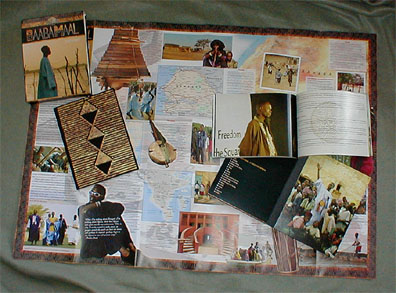
Like Africa and Vedic Path before it, Baaba Maal contains a CD of music, a documentary DVD, an illustrated information booklet, and a detailed National Geographic map. Each component enhances our appreciation of the man and the musician. Just as importantly, they place his music into the cultural context of Senegal.

The music is magnificent. He lives up to his billing as being one of the most exciting musical talents in Africa. Not only does he integrate traditional Senegalese instruments with contemporary, the music seamlessly combines elements from all over the world. Pop, jazz, and reggae meld with African rhythms and sounds to create a true world music.

Baaba Maal may sing in his native tongue, but the listener loses little of the emotional impact. His voice is one more musical instrument being played in harmony with the rest of the band. Soaring from the bottom of the scale to its heights, he takes one on a roller coaster ride not easily forgotten.

The DVD is split into two parts. The first is a documentary that recreates Baaba Maal’s story. Acting as our guide, he retraces the path he took from his fisherman roots to his current position of international performer. Combined with the information booklet, this section of the disc gives the viewer insight into the cultural world of Senegal.

The concert footage included in the DVD allows one a tantalizing glimpse of Baaba Maal’s incredible power on stage. From frenetic up-tempo dance numbers to a slow ballad we see his complete range as a performer. African dance parties can continue for hours on end, some of that energy and exuberance are captured in these performance clips.

Baaba Maal is Palm World Voice’s third release in their initial six part series of explorations into World Music. Once again, they have created a package that takes one beneath the surface of the music to show the heart beating behind the exterior. These box sets are a wonderful addition to any music lover’s library.

Baaba Maal will be in stores everywhere on August 9th 2005.

05 août 2005

Lo'Jo

Sakifo (île de la Reunion), c’est parti pour trois jours

Coup d’envoi, ce midi, de trois jours et trois nuits de fête musicale.

Les nomades sont de retour Ils ont été repérés par Baguett’ du temps de Komela et des premières scènes de rue avec Jo Bitume. “C’était en 1991”, racontent les piliers de Lo’Jo, Denis Péan et Richard Bourreau. “On a joué un peu partout dans l’île pendant un mois et on en garde un vrai bon souvenir. Ça nous a permis de connaître non seulement un pays mais aussi sa musique, avec, en particulier, un kabar mémorable chez Firmin Viry. Et depuis, on n’a pas cessé de transmettre notre amour pour cette musique”.

Comme eux, elle voyage, se marie à toutes les autres traces musicales d’ailleurs tout aussi féconds et nourrit des chansons, ou des échanges voire des retrouvailles avec des dalons comme René Lacaille. “Il a participé à la bonne franquette à l’enregistrement de notre dernier disque et nous a même mitonné de bons caris !”, ajoute Denis avec l’approbation gourmande de ses compagnons. Six musiciens et musiciennes angevins aux racines différentes, aux goûts et aux choix de vie originaux. “Pour faire notre chemin, comme une famille avec la diversité en guise de richesse”.
“On ne fait rien de conventionnel ”

Et l’esprit grand ouvert, comme leur maison communautaire, sur le reste de la planète. “On accueille des artistes de partout, des Indiens Navajos, des nomades du Sahara, en résidence. Il y a toujours un mouvement d’échanges autour de nous avec de la musique et des artistes à la maison”. Les différences, c’est leur souffle, leur respiration. “Le groupe a germé autour de ça. Un alliage de senteurs. On ne fait rien de conventionnel, on a dit non au conformisme. En réalité on a inventé une sorte de créole musical, poétique, n’ayant pas de limite dans nos sentiments. On raconte la vie, on tisse des liens, on dessine des lignes...”

En évitant comme la peste la tendance au produit formaté pour plaire au plus grand nombre, note encore Denis Péan. “Je reviens de Rodrigue où j’ai été sidéré de découvrir qu’à la radio, on passe les mêmes disques que partout ailleurs. Pourtant, il existe tant de musiciens là-bas comme dans tous les pays qui ont des secrets dans leur musique et qui n’ont pas d’audience...” Lo’Jo, si. “Sans sacrifier un pouce à ses goûts, ses ambitions L’obsession de créer notre propre musique, notre image sonore. Il a fallu du temps pour faire ce groupe”. Un groupe dont Philippe Ducayron a écrit que la musique est l’une des plus lumineuses qui soit.

Rien d’étonnant à ce que le Billboard américain ait flashé sur leur dernier enregistrement en studio, le consacrant “meilleur album world de l’année”. Un bel hommage pour ces étonnants voyageurs qui ont leur place au Womad. “Le genre de festival sans stars mais avec que des gens intéressants. Il nous a conduit cette année en Australie et en Nouvelle-Zélande”. De quoi ajouter d’autres sonorités à leurs échappées musicales pour l’album à venir en janvier “Bazar Savant”. En attendant, rendez-vous tout à l’heure à 18 h sous le Chapitô. “On donnera le meilleur, forcément on a envie d’être aimés !” C’est à notre avis l’un des concerts à ne pas manquer.

Textes et photos Marine Dusigne

04 août 2005

Africa Calling 2

Eden's hopes for Africa Calling 2

The spectacular biomes of Cornwall's Eden Project may ring to the sounds of African music again in 2006. The attraction has confirmed that talks are taking place about hosting Africa Calling 2 next year.

More than 4,000 people attended the Africa Calling concert in July as part of Make Poverty History's Live 8. Artists on this year's bill included Angelique Kidjo, Coco Mbassi and Youssou N'Dour who performed a duet with Dido.

"There's a real desire to make it happen" Bryher Scudamore, Eden Project.

Bryher Scudamore, Eden's director of communications, told BBC News its success had prompted the idea of another. She said: "It was a fantastic thing and there was a massive response afterwards.
"I can confirm talks have started and there's a real desire to make it happen. It's very early days though and nothing is set in stone."

Senegalese star Youssou N'Dour said Africa Calling was the most important concert of Live 8. It was compered by Peter Gabriel, the co-founder of World of Music, Arts and Dance (WOMAD), and set up after criticism over the lack of black artists at the Live 8 show. More than 35,000 people applied for the 4,200 tickets available for the Eden show.

Console for Womad

Ampco chooses Midas for WOMAD

UK - For a record twelfth consecutive year, Holland's Ampco Pro Rent (APR) has supplied the complete audio production for the WOMAD Festival at the Rivermead in Reading, where nine stages present an eclectic blend of tunes, poetry, dance and arts workshops, all featuring performers from around the globe. APR's primary console brand of choice for WOMAD is Midas, with around 80% of the Reading event's 25 desks being Midas Heritage Series or XL3 consoles.

"We rarely have time for sound-checks and of course there are a lot of visiting engineers around all the stages who need to be able to jump on a desk and be ready to mix instantly," says APR production manager Dieter van Denzel. "Midas gives us the familiarity, the reliability and of course the essential audio quality."

All in all, APR oversaw the action at the main (Open Air) stage, the ever-popular Siam Tent, the Village Stage, Rivermead Club WOMAD, Spiegeltent, Green Room workshops Thames Suite dance studio and the One World Platform. "The festival has grown again since last year," says van Denzel, who also mixed many of the bands. "This year they added a ninth stage - the BBC Radio 3 World On Your Street Stage, to one side of the main arena. This was planned to be a little booth for 200 people but ended up being a club-sized sound system that drew up to 2000 people."

In the past 12 months, Ampco has also worked on WOMAD festivals in Singapore, Cáceres and Madrid in Spain, Grand Canaria, New Zealand, Australia and Sicily. These locations are being added to this autumn by the first WOMAD Sri Lanka. All operate as a joint partnership in each country between WOMAD, co-founded by Peter Gabriel and Thomas Brooman, and local site production, with APR in charge of the audio and Stage Miracles providing stage management.

"Consistency is a huge part of it," says van Denzel. "Artists love to know that at every WOMAD they'll find the same team, the same technical crew, the same stage setup, the same sound." Among the artistic highlights of the Reading event were Senegalese superstar Youssou N'Dour, Bill Cobham, Nitin Sawhney, Richie Havens, the Fatback Band, Yasmin Levy and Robert Plant.

(Lee Baldock)

03 août 2005

Brit-Asian Stars Rock Womad

British Asian stars including Apache Indian & The Dhol Foundation rocked the WOMAD festival over the weekend....

[ClickPress, Wed Aug 03 2005]

The WOMAD festival rocked across the UK on Sunday July 31st August when reggae superstar Apache Indian took to the main stage and entertained over 50 000 to probably one of his finest ever performances and too make WOMAD even hotter when The Dhol Foundation made a surprise appearance with the main man, Johnny Kalsi at the helm. A 15 000 audience watched the king of Dhol go wild on stage and at one point, fans were asked to not make so much noise as they we’re drowning out the main stage audience of about 50 000.

Apache Indian headlined the Sunday festival and gave workshops for the younger fans of Womad generation. Apache performed live alongside his now legendary musicians, The Reggae Revolution Band. Ten tracks were played, starting off with classics such as Movie Over India and Chok There and then taking people through various songs from his new album “Time For Change”.

As part of his live set, Apache also spoke to the audience about the world we lived in and how we must all work together to end racism and violence which immediately led to a rapturous applause from the WOMAD crowd. He finished his set with three classics including his new single Israelites, followed by two of his former chart hits Boom Shak-alak and Ruggermuffin Girl.

Johnny Kalsi of the Dhol Foundation hosted the BBC Radio 3 Village stage over the three days. The stage featured live acoustic sets of acts from all over the globe including Syria, Palestine Argentina, Korea, Uganda, France and Iraq with a live broadcast on BBC Radio 3 each night. Johnny introduced each act over the three days and acted as an ambassador for WOMAD, which meant running around the festival to give various interviews for radio, tv and press in between introducing all the Village stage to crowds of 15 000 plus.

Over the three days the Dhol Foundation new album sold out at the WOMAD store and after various requests and constant demands by fans who had seen Johnny perform over the years, he decided to bow down to pressure and gave a live performance towards the end of Village stage line up. Performing tracks from Drum-believable drove the crowd to scenes of mass cheers and shouts of Johnny. As a finale to his set, he finished off with a track taken from this current album, which is a cross between traditional Punjabi dhol beats and Celtic sounds of the fiddle

Notes to Editors:

• WOMAD is now in its 15th year and held in Reading, UK
• WOMAD has over 100 festivals held in 21 countries
• WOMAD 2005 featured artists from 30 countries
• Apache Indian will be performing at WOMAD Singapore
• DHOL FOUNDATION will be performing at WOMAD Singapore and Sri Lanka
• Apache Indians latest album is titled “Time For Change”,for more info go to: www.karmasound.com
• Dhol Foundation’s latest album is titled “Drum-Believable”, for more info visit www.dholfoundation.com

Anne Heaton

Lush, The Way She Likes It

Anne Heaton bares her soul through her richly textured voice at this year's SoNo Arts Celebration

by LuAnne Roy - August 4, 2005

Anne Heaton loves a full sound

Every year the SoNo Arts Celebration committee searches for original visual and performing artists to showcase in its annual two-day festival, held on the streets of South Norwalk. As in the past, this year's roster looks to represent a diverse group of musicians--from reggae bands like Mystic Bowie to Latin bands like Cosmic Jibaros and Mandorico and string bands like California's Hot Buttered Rum. Aside from all the ethnic sounds there will be plenty of great pop rock artists. One of the most exciting is the dynamic female singer/songwriter Anne Heaton. <...>

When you ask Heaton how she feels about the direction her music is going in, she giddily responds, "I love a full sound." She cites Peter Gabriel as her "favorite artist of all time" and the source of her inspiration for creating layered sounds that include adding a strong bass line or electric guitar. "I like when there's a lush sound," Heaton adds. "I feel like the songs I'm writing come across better that way." ...

Youssou Ndour propose une association des musiciens africains

Le Soleil (Dakar)

L'artiste-musicien sénégalais, Youssou Ndour, a proposé, avant-hier, la création d'une Association des musiciens professionnels africains (AMPA) destinée à mieux organiser ce secteur sur le continent.

"Contre la piraterie, mais pas seulement, il faut améliorer les métiers de la musique qui ne sont pas à la hauteur des talents africains", a expliqué la grande vedette de la musique africaine dans les colonnes du quotidien français "Le Monde".

Youssou Ndour a jugé anormal que les musiciens ne puissent pas vivre en Afrique de leurs talents, critiquant l'absence de politiques répressives contre la piraterie. "Dans un continent qui est le grenier, la maman de la tradition musicale, les musiciens ne vivent pas de leur art. Nos gouvernements doivent voter des lois et harmoniser leur politique", a plaidé le musicien sénégalais, citant le cas de la Gambie et du Sénégal.

"La Gambie, par exemple, ne doit pas fermer les yeux sur les pirates, quand le Sénégal est en train de les réprimer à ses frontières. Nos dirigeants ont créé l'Union africaine, nous allons faire pression", a ajouté Youssou Ndour.

D'autres grands noms de la musique africaine tels que les Maliens Salif Keïta et Rokia Traoré ainsi que le Camerounais Manu Dibango se sont associés à l'idée de la création de l'AMPA. Confrontés à différentes sortes de difficultés dans leurs pays, les musiciens africains choisissent très souvent le chemin de l'exil, posant leurs valises à Paris, Londres ou Bruxelles.

"Get up, Stand Up"

Chuck D, Bono "Stand Up"

Politically minded musicians to appear in new documentary

Bono, Bruce Springsteen, Willie Nelson, Steve Earle, Michael Stipe, Peter Gabriel and Bob Geldof will appear in Get Up, Stand Up: The Story of Pop and Protest, a documentary about the history of protest music, to air September 28th on PBS.

Produced and directed by the team of Hannes Rossacher and Rudi Dolezal -- whose previous work includes documentaries about Miles Davis, Freddie Mercury, Quincy Jones and Billy Joel -- the film recounts the origins of protest songs in American labor unions and how musicians ranging from Bob Dylan to Sly Stone to the MC5 put political issues front and center for a generation of listeners.

Named for the Bob Marley song, Get Up, Stand Up is narrated by politically minded rapper Chuck D. The Public Enemy frontman grew up listening to protest music, and later used it as inspiration for his own work.

"'Fight the Power' by the Isley Brothers was the song that inspired me to write 'Fight the Power' by Public Enemy," he says. "
But, being a child of the Sixties, there's so many great protest songs. 'People Get Ready' and a lot of Curtis Mayfield's songs touched my soul. James Brown had a protest song against drugs with 'King Heroin,' and Peter, Paul and Mary struck me as a kindergartener. How could those songs not mean so much?"

Colin Devenish

02 août 2005

A country field with a view across the planet

Financial Times
Arts & Weekend / Art, music & theatre

By David Honigmann

... Youssou N'Dour and his band, Super Etoile de Dakar, exerted a magnetic attraction. N'Dour opened with a song in praise of Cheikh Ahmadou Bamba, and also slipped in a mention of Womad's chieftains Peter Gabriel and Thomas Brooman. "Salaam aleikum," he chanted. "Peace to all, not just to Muslims."

The early ominous synthesiser chords were superseded by a storming set from Super Etoile, whose combination of stuttering firecracker drum attack and curiously old-fashioned guitar breaks sets the backdrop for N'Dour's commanding tenor, rising above the clatter in benediction. The band were as lock-tight as might be expected, given that in Senegal they play multi-hour sets most nights.

Purists sniff at "7 Seconds", N'Dour's chart hit duet with Neneh Cherry. But when he sang it here, his voice fracturing into seven syllables on the "million" of "a million voices", the thousands of voices joining in the chorus must have echoed off the Cotswolds. Djanka Djibe, singing the female part, replaced Cherry's boho sass with nu-soul diva hauteur: as she spiralled baroquely upwards on the last verse, even N'Dour watched in admiration.

N'Dour's newest west African rivals, the blind couple Amadou and Mariam, continued their irresistible rise with a set as bouncy as two toddlers jumping on a mattress. Their quieter blues numbers were swamped by enthusiastic orchestration, but "Coulibaly" and "Ko Be Na Touma Do" shone through....

01 août 2005

Rain fails to dampen Womad spirit

By Martin Vennard
BBC News

The sight of several thousand people standing in a giant tent after midnight listening to Siberian throat-singing sums up the spirit of Womad. It's about letting your hair down, or putting it up under a funny hat with dreadlocks attached, and generally doing other things you would not normally do.

The audience was transfixed by Huun-Huur-Tu's deep, guttural harmonising, and the Siberians were amazed by Womad. They seemed particularly impressed by the fact that there was a fun fair on the festival site. For the music is not the only attraction at the World of Music Art and Dance by the River Thames in Reading.

It is a place for discovering groups like India's Kala Chethena Kathakali Company. They tell stories through minimalist theatre, wearing stunningly colourful costumes and make-up, while accompanied by percussionists.

It is also a place for rediscovering stars of the past.

Robert Plant of Led Zeppelin fame was just one such artist. With his restrictions on photographers and production office he seemed a little bit too big for Womad. But his extended version of Whole Lotta Love at the end of Friday night on the main stage reminded people why he was a star.

Another survivor from the '70s was Kiki Dee, who once famously duetted with Elton John. Her audience may be suffering from middle-age spread, but her voice and figure are as good as ever. And accompanied by a guitarist and a backing singer she proved she has "still got the music in her".

Womad brings people together. There were Australians performing Bulgarian choir music, Armenians joining forces with Persians, and British Asians singing reggae.

The crowd is also part of the show. One couple was having a joint stag and hen party in front of the main stage and, despite the rain, hosted a game of Twister for their guests. But the strange sights are not limited to the audience.

Russia's Terem Quartet must have one of the world's biggest balalaikas. And they claimed that Bach had composed a piece especially for it.

The Fatback Band from the US impressed with their soul, rhythm and blues, while the singer had echoes of James Brown in his voice - and their diminutive guitarist's solos left listeners stunned.

Youssou N'Dour
and his group Super Etoile are archetypal Womad performers and, topping the bill on Saturday night, they did not disappoint. The Senegalese superstar has as much energy as ever and his hit Seven Seconds Away had the crowd singing along.

Sunday is an altogether more relaxed day at Womad. If you have not already had the chance, it is the opportunity to wander around the dozens of stalls selling everything from hemp baseball caps to antique theatre costumes.

Richie Havens and his acoustic guitar are veterans of the festival circuit, going right back to Woodstock. Sounding like a more avuncular Bob Dylan, he used his deep, rich voice to tell stories and perform songs such as All Along the Watchtower.

Colombia's Toto La Momposina and her band had people in the Siam tent moving to Latin beats that were perhaps less in evidence than in previous years.

When you see the procession of children and their adult helpers snaking its way around the site on Sunday evening, you know Womad is coming to an end for another year. The children had been making props at workshops.

Finally, the All-Star Gala Finale brought several of the Womad performers together on the main stage for a climatic version of Bob Marley's One Love. Let's just hope it rains a bit less next year.

Womad 2005 Youssou N'Dour Interview

He's one of the most celebrated African musicians in history and he's performing at Reading's WOMAD Festival. Youssou N'Dour took time out of his hectic schedule to speak to BBC Berkshire about WOMAD.

You're coming to WOMAD, one of the World's biggest music festivals, not long to go now, how are you feeling?

"I'm feeling good, I'm happy, because I think the WOMAD Festival really started the beginning of my career in Europe, and I remember in 1984 doing the WOMAD Festival, it was really exciting.

"A long time ago we were thinking that World music was going to be something happening in two/three years, now we realise everyone is playing world music."

WOMAD is quite unique because it provides a platform, a showcase for that kind of music. How important is that to you?

"Yeah I think WOMAD brings to the table diversity. It's really something that makes the world richer - culturally and musically especially. I think WOMAD helps people to understand diversity. At the same time, it's kind of a platform to tell people who listen to the radio every day that it's not the only thing happening in music, and there's a lot of great music."

What kind of performance can people expect to see from you at WOMAD?

"Yeah it will be with the same band I used at WOMAD 20 years ago, it'll be all my stuff, old stuff and new stuff also. It's also about bringing an African vibe."

Are there any other acts at WOMAD you particularly want to see?

"Yeah, doing the tour is really difficult, seeing everything that goes on at WOMAD because I believe in it. And people are bringing some wonderful things but I wonder about having the time!"

Your biggest hit to date in the UK is 'Seven Seconds' with Nenah Cherry. You performed that with Dido at Live 8, what was that like?

"It was great. Nenah said when we wrote this song, it's not for us anymore, it's for everybody, and it's great to hear from different singers that want to sing the song with me or with Nenah - I remember the one with Annie Lennox in South Africa was great also.

"I was really happy and Nenah was also, I spoke to her a week after we sang in Edinburgh. It's great to have a song that unites people and brings musicians and singers together."

You perform all over the world, what kind of reception do you get when you go back home to Senegal?

"I feel the language of music when I go back to my country, 10 million people but little country...I feel like every member of the country is proud that my music is touching the world.

"I think people are seeing in me and other African artists something they really need and I'm really proud and really excited."

What kind of music do you listen to?

"I listen to everything but I'm a real fan of the sixties...Wilson Picket and things, I'm a real fan of soul music. I also listen to African traditional music."

What else are you doing this summer?

"I'm touring around Europe, after WOMAD I'm going back home, I'm going to Budapest after, some gig in France also.

"And something is going to happen on October 1st in Paris - a big African concert, 15-20,000 people."

Womad 2005 Robert Plant interview

By Linda Serck

We spoke to Robert Plant before his performance at WOMAD 2005.

Read the interview below or listen to it through the link on the right hand side of the page.

Interview with Robert Plant

Plant opened his set at WOMAD with current band Strange Sensation with Led Zeppelin's song No Quarter. The second song he played was theenew single off current album The Mighty Rearranger, called Shine it all around. They also played Black Dog, and ended with Whole Lotta Love. So the crowd could still "get zepped" at WOMAD while listening to Robert Plant, even though he's moved on from that period.

What are you doing here at WOMAD?

The reason I'm here is, I've got new work and I've got an elevated state now. But there will be some Led Zeppelin songs, and they won't be anything like they used to be.

What do you love about WOMAD?

I think it gives so much more of a window on the realities of what music can do. Entertainment isn't just based on the very structured syndrome of European popular music, and it's great that there are so many thousands of people who are of the same opinion. All over the world, the idea of creating an melange of international musics, it's a very healthy thing. I think it's spurred on by the fact that there's so much European popular music that's so very lacking in imagination.

You're also the curator of the WOMEX exhibition this October, what draws you to World Music?

My dear, I was working in India in 1969. If you know anything about Led Zep you'll know we were playing with Indian musicians in '68. I was just 19 years old then. I've travelled through North Africa for the last 33 years. The last thing this can be considered as in terms of my career is something new. It's just that I have a band now that's consolidated a lot of North African musicality into a rock thing. It's great, it couldn't be better!

Last time you were here was Reading Festival 1998, is that right?

I played the Hexagon, I had a band called the Priory of Brion there. What year was that? 2000?
Jimmy Page used to live in Berkshire, too. We spoke to him for Children in Need!

In Pangbourne, yes. But he's moved several times now. He's a good guy, we both work quite fastidiously with charities, it's a good thing to do.

Tell us about the new album, The Mighty Rearranger. What is The Mighty Rearranger?

It's what brought us here, destiny, fate. It's all written already, it's just that we didn't know it. I'm not trying to be cosmic, it's just everything's on a roll and that's how it is. The songs within the album discuss that very condition.

Do you still get nervous going on stage?

I still get nervous, and I get a day older! I haven't got the gift, I just borrow it now and
then...

Last Night: WOMAD, Rivermead, Reading

Led Zeppelin meets Latino in this festival of fascinating rhythms


Published: 01 August 2005 ; By Phil Meadley

Sometimes it takes one vital spark to ignite a festival. This year at Britain's biggest and best-loved world music festival it was Ethiopia's Mahmoud Ahmed who provided it. Now in his 63rd year Ahmed has remained one of Addis Ababa's best-kept secrets for decades; military rule between 1974 and 1991 keeping his vibrant blend of east African funk a local phenomenon while the country's strict censorship remained.

Only recently, through the wonderful Ethiopiques compilation series, his uniquely soulful singing has been heard in the West. Making two appearances this year, his Saturday performance at the Village stage impressed. His seven-piece band wove insistently funky, horn-led Fela Kuti-style passages round a truly majestic vocal range, conjuring up images of James Brown at his soulful best.

Robert Plant's performance provided one of the most talked-about moments of the first day. His heavy, riff-driven set split the audience down the middle in terms of those who yearned for the classic Led Zeppelin tunes, and those who sought to escape to the Radio 3 acoustic session to see Syria's premier zither player Abdullah Chhadeh, or else search in earnest for a Chai tea. A couple of middle-aged women couldn't help shouting, "We love you Robert" but his often leaden delivery bemused as many people as it inspired.

Saturday was far more enticing. Aside from Mahmoud Ahmed, there was Madagascar's colourful Jaojoby who mix traditional Malagasy rhythms with the new, funkier salagey style, which became popular in the Eighties.

Cape Verde's Lura performed a very polished Creole/Latino-inspired set, and jazz-drumming legend Bill Cobham fused world influences with complex, jazz-funk fusion workouts. The fascinating Japanese trad-meets-electronic dub collective OKI Dub Ainu Band fused sounds from the northernmost island of Hokkaido.

Although rain threatened to dampen the evening, the Fatback Band and Algeria's Akim El Sikameya kept spirits up on the two main stages. The latter's mix of Algerian Rai and Andalusian music was saccharin- sweet at times, but there was no denying his musical virtuosity or powerful, falsetto vocal range.

Youssou N'Dour and his Senegalese band Super Etoile were the most anticipated act, and for the most part this much-loved African superstar didn't disappoint. Running an extensive repertoire, which stretches back to the late 1970s, he was at his very best duelling with the mind-bogglingly dextrous Talking Drummers. At his worst, his heavily Westernised and overly sincere pop ballads such as "My Hope Is In You" and "Seven Seconds" seemed oddly out of place.

Sunday was the debut of hotly anticipated blind Malian couple Amadou & Mariam, who played a funky set of Malian rock 'n' roll and provided one of the most exciting and electrifying moments of the festival. Beside Amadou's phenomenal guitar playing, his mostly French band provided a tight background to the blind couple's compositions.

31 juillet 2005

Here Come the Flood...Smoke On The Water

Droughts, twisters, floods: what on earth has happened to our weather?

Robin McKie, Barbara McMahon and Giles Tremlett

Sunday July 31, 2005
The Observer

Britain's biggest water company is pressing ahead with plans to ban hosepipes and sprinklers in August. Thames Water, which supplies 8 million homes in the south of England issued the warning yesterday despite rainstorms that have deluged much of Britain in the last few days and a 130mph tornado which smashed a three-mile trail of destruction through areas of Birmingham.

But despite rainfall of several inches in some areas, the downpour has made only a marginal improvement to levels at reservoirs, a spokesman for Thames Water warned yesterday. 'It was enough to save us from introducing bans this week, but unless we get substantially more rain in the next couple of weeks, it is very likely that we will have to start introducing some types of restrictions on water use before the end of August.'

.....

Britain's water crisis is mirrored by heatwaves and droughts afflicting much of Europe. Italy is currently in the grip of a searing heatwave, with Level 3 alerts in operation - the highest warning, indicating a danger to the general population - in many cities.

Milan recently experienced temperatures of 43C; Turin, 37; Bologna, 40, and Rome, 42. Visitors to the Italian capital have been bathing in the city's fountains, while the authorities in Perugia have been giving out bottled water free of charge. Hospitals have reported large numbers of people suffering heart or respiratory problems - a worrying situation for the authorities, who are desperate to avoid a repeat of the 2003 heatwave, during which an estimated 20,000 people died.

In Sardinia serious forest fires have devastated acres of forests and put at risk the holiday homes of many tourists and celebrities, including Peter Gabriel of Genesis. At one point fires were raging at points along 20 kilometres of coastline until winds dropped and firefighters were able to contain the flames.

Spain is suffering its worst drought since national figures were first produced in 1947. In some areas reservoirs are down to just 14 per cent of their capacity. And in western France, water levels are at their lowest since the drought of 1976, with restrictions operating in 60 out of 100 departments.

Some 52 Portuguese municipalities are now receiving water from tankers, as are some villages in northern Spain. A further 22 small Portuguese towns and villages are already having their water cut off for several hours a day.

Dried-out trees and crops have helped spread fires across Spain and Portugal, with crops burnt and at least a dozen people killed...