Articles review on the net, revue d'articles sur la toile


Inscription : feeds, flux :
(Atom) Gabriel Real World News

Affichage des articles dont le libellé est The Elders. Afficher tous les articles

08 février 2009

Elders call on Zimbabweans to unite to end suffering / International donors should support transition efforts

HARARE, Zimbabwe, January 31, 2009/African Press Organization (APO)/ — The Elders have called on Zimbabweans to unite to end the terrible suffering in their country and urge international donors to support the latest step towards the formation of a new government.

In Harare on Friday, the MDC faction led by Morgan Tsvangirai announced that it will join a government of national unity, allowing the Global Political Agreement signed last September to be implemented.

“This is an important step towards ending the political impasse in Zimbabwe,” said former UN Secretary General Kofi Annan, “but it is not a guarantee that Zimbabwe’s distress is over. Rebuilding the economy and ending the peoples’ terrible suffering will take much more work on the part of all Zimbabweans, regional leaders and the international community.”

Chairman of the Elders, Archbishop Desmond Tutu, said, “We will be watching closely to ensure that the agreement between the political parties is implemented fairly. But the people of Zimbabwe can no longer be held hostage by politics. Their urgent needs must be met.”

President Carter said: “This political agreement is far from perfect - but political life involves taking risks. The international community should now do what it can to give this agreement the best chance of success. Talking it down will not improve the situation for Zimbabweans - it will only prolong their agony.”

Three members of the Elders, Mr Annan, former US President Jimmy Carter and Mrs Graça Machel travelled to southern Africa in November to assess the humanitarian situation in Zimbabwe. Informed that they would not be welcome in Harare, they arranged to meet heads of UN agencies, donors, regional political leaders and Zimbabwean civil society representatives over three days in Johannesburg. They were shocked by what they learned in November, and say that since their visit the crisis has escalated.

“Conditions since we visited are even worse”, said Graça Machel. “We should now respect the decisions made by Zimbabweans about their future and do all we can to ease the suffering of the people. It is essential that hospitals and schools reopen and water supplies are made safe. But we must also monitor what is happening very closely at the political level and encourage all parties to work in good faith to implement the terms of the Global Political Agreement.”

About The Elders:

The Elders is a group of eminent global leaders convened by Nelson Mandela and Graça Machel to bring their experience and independent voices to the resolution of conflict and to support innovative, cooperative efforts to address great global challenges of our time. Based on an initiative by Richard Branson and Peter Gabriel, Nelson Mandela announced the formation of The Elders in July 2007 in Johannesburg on the occasion of his 89th birthday.

The Elders are: Kofi Annan, Ela Bhatt, Lakhdar Brahimi, Gro Brundtland, Fernando Henrique Cardoso, Jimmy Carter, Graça Machel, Mary Robinson, Desmond Tutu and Muhammad Yunus. Aung San Suu Kyi is an honorary Elder.

SOURCE : The Elders


25 janvier 2009

'Superman' on a crusade to find justice


Carne Ross doesn't dress in a pants-over-tights combo - not in public, anyway - but there's more than a whiff of the Caped Crusader about the former Foreign Office diplomat.

Since resigning in 2004 (after 15 years), Ross has offered his services to marginalised groups around the globe, helping governments in exile, states seeking independence and divided countries attempting to re-unify. Think Ghostbusters but with a suitcase full of UN resolutions instead of a proton pack.

Ross set up his not-for-profit consultancy Independent Diplomat four years ago. Responsible for Britain's Middle East policy at the UN Security Council from 1998 to 2002, he left the Foreign Office after giving evidence to the Butler inquiry into intelligence on Iraq.
'According to what I'd seen in the many years I'd been reading intelligence about weapons of mass destruction in Iraq, there was no way it could sustain the claims the government was making,' says Ross speaking in New York, where he's now based.

'Also, I didn't think the war was legal in terms of the UN resolutions - and I felt the government had ignored available alternatives to war, such as a tougher stance on Iraq's illegal oil exports. Blair and Bush claimed that sanctions were falling apart, and this was simply not true.'

On secondment to the UN in Kosovo at the time of his resignation, Ross soon picked up his first client as a freelance diplomat. 'The Kosovan government had to deal with a highly complicated international diplomatic process to determine its final status,' he says.

'They weren't allowed a diplomatic service of their own and yet were required to navigate this obscure process.' After launching Independent Diplomat, Ross advised the Kosovars until independence early last year.

Other clients include a government in Eastern Europe trying to get into the EU; the government of Somaliland (a democratic state in the north of Somalia seeking international recognition); the government in exile of the Burmese opposition; the Polisario front in Western Sahara; and the government of Northern Cyprus which is recognised only by Turkey and is currently going through a UN talks process about re-unification.

Working on a freelance basis has convinced Ross of the need for a cultural shift in diplomacy. 'Many diplomats are operating in a kind of bubble, in real isolation from the problems they're grappling with,' he says. 'I felt that acutely as a British diplomat. Somehow, discussion in the Security Council was bloodless and boring, and yet we were dealing with genocide and invasions, issues of incredible human drama. That always bothered me.'

Bridging the gap

International Diplomat (the first of its kind) is a way of bridging that gap. 'When I was a British diplomat, I always liked to think what a nice guy I was and how helpful I was to the poor benighted people on the other side of the table - whether it was the PLO, the Polisario or the Kosovars - but at the end of the day, I was always working for London. That's what I was paid to do, but it meant that if I was giving them supposedly neutral advice about how to advance their cause, it was always coloured by what was best for us.'

Now, Ross is on the other side of the table. 'I'm not just a Western diplomat patronisingly telling them the way things work; I'm working for them. It's a different world view if you're a liberation movement based in tented refugee camps in the Sahara desert.'

Yet his former experience can be invaluable. 'One of the primary values of what we do is that people will tell us things that they won't tell our clients to their faces. It's just something about human nature, that humans will say what they really think to others rather than directly to people.'

Carne Ross is also pressing for UN reform, after arranging for the Kosovan prime minister to attend a meeting of the UN Security Council (SC) for the first time. 'I noticed that all too often the places we were discussing weren't actually present. I felt that people were getting a raw deal because they weren't properly involved in the diplomatic process about their country.'

New initiative

He's now working on an initiative called the Universal Right of Address. 'It would mean any party to a dispute being discussed by the UNSC would have the right to address the council,' he says. 'It makes obvious, logical sense, and would be easy to implement, but that doesn't mean they'll do it - because the UN is not really about making fair, just and right decisions; it's about status and power.

'For instance, as a big Serbia ally, Russia had major objections to Kosovo attending the meetings. But Russia is now keen to put other non-state actors in front of the SC, such as Abkhazia and South Ossetia, because of events in Georgia. 'Meanwhile, the Americans wanted the Kosovars there because they could support Kosovan independence, but they don't want South Ossetia. China doesn't like anybody. They don't want Tibet or the Xinjiang Province to get the right to speak.'

If Carne Ross is the Caped Crusader, there's one organisation that could lay claim to being an Avengers-style league of superheros. Informally created in 2001, after Peter Gabriel and Richard Branson discussed the need for a gathering of world leaders to tackle seemingly intractable problems, The Elders is a roving team of Nobel Prize-winners and national heroes aiming to spread peace wherever they go.

Powerful line-up

With a line-up including former South African president Nelson Mandela, Archbishop Desmond Tutu, former US President Jimmy Carter, former UN Secretary General Kofi Annan and Burmese human rights activist Aung San Suu Kyi, it's based on the traditional model of village elders, who resolve conflicts in their local communities.

Except these conflicts are slightly bigger than the usual stolen goat: in the past year, various Elders have gone on missions to Sudan, Cyprus and the Middle East. A planned visit to Zimbabwe had to be cancelled after they were denied visas by president Robert Mugabe. They insisted they weren't planning to get involved in any political negotiations, though - something they view as an advantage.

At the official launch of the Elders in 2007, Mandela argued they were free from the external pressures typically associated with international bodies. 'The structures we have for dealing with these problems are often tied down by political, economic and geographic constraints,' he said.

And, in a line suggesting he could also see the superhero connection, Mandela added: 'The Elders can become a fiercely independent and positive force for good.' Now they just need a few special powers.

www.theelders.org

12 janvier 2009

Thoughts from The Golden Globes Red Carpet

My favorite pre-show moment: Peter Gabriel quipped:"This is my favorite awards show: it's short, there's food and plenty of alcohol," then just when I'm thinking why am I watching interviews about party insights, he goes ahead and talks about "The Elders," a project he's doing with Nelson Mandela and others: "If they can connect people on the ground who are suffering with people who can make a phone call to anyone and get it picked up, maybe we can get something done"...

Peter Gabriel Talks About The Elders

January 12, 2009 by Tim Saunders

Rock star and humanitarian Peter Gabriel has commented on the inspiration behind forming The Elders, the group of public figures he established with Richard Branson to solve global figures.

“People have lost trust in a lot of institutions around the world, but they still have faith in certain of key individuals,“ said the 58-year-old. “We felt that if we could get a group of elder statesmen and women together, they could have an influence and leverage and help on a few situations. We went to Nelson Mandela and he set it up a couple of years ago. We have Desmond Tutu, Kofi Annan. They can connect people on the ground who are suffering with people who can make a phone call.”

The Global Elders group was set up in 2007 to bring “almost 1,000 years of collective experience” to work on solutions for seemingly insurmountable problems like climate change, HIV/AIDS, and poverty, and “use their political independence to help resolve some of the world’s most intractable conflicts.” There are currently 12 active members, including Jimmy Carter and Aung San Suu Kyi. They have launched peace missions in Darfur, the Middle East, and Zimbabwe.

More information about the work of the Global Elders can be found at their official website.

21 décembre 2008

Nobel Peace Prize winners honor Bono

U2 singer Bono received the Peace Summit Award

Associated Press, LOS ANGELES TIMES, 12/18/08


PARIS — Political Hollywood had to find something to occupy itself between election night and the inaugural balls. It seems Europe — glittering with holiday lights — is the place to be if you’re a star with an international cause.

In Paris last week, such notables as former president and best-selling author Jimmy Carter and pop icons Peter Gabriel and Bono gathered at various events to help commemorate the 60th anniversary of the Universal Declaration of Human Rights.

The highlight of the festivities — which also included such international luminaries as former President of Ireland Mary Robinson, Virgin Airlines Chief Executive Richard Branson and Participant Media founder Jeff Skoll — was a gathering of Nobel Peace Prize laureates who presented their Man of Peace award to the U2 lead singer.

After Hollywood’s deep involvement in the U. S. presidential campaign, the week’s events were a reminder of the industry’s influence as an exporter of entertainment and celebrity activism. Nevertheless, Bono, who is considered the superstar of social action, tried to deflect the attention.

“I am an overawarded, over-rewarded rock star,” Bono told the Nobel winners, including F. W. de Klerk, Lech Walesa and John Hume, at an event at the Hotel de Ville. “You are the people who do the real work.”

But event co-host Walter Veltroni, former mayor of Rome, was determined to give the singer — who has worked to fight poverty and disease in Africa — his due.

“We decided to nominate a man who has given a lot and will continue to give a great deal to the struggle for human rights, to the fight against poverty, with his music and with his words,” said Veltroni, who hosted last year’s award recipients — George Clooney and Don Cheadle — in Rome.

With the Eiffel Tower lit blue (marking France’s presidency of the European Union), the luminaries moved from galas to conference rooms to discuss some of the world’s pressing problems: hunger, poverty, disease and genocide.

“We’ve made great progress,” Carter told a group gathered for the Elders’ annual media awards at La Maison Des Arts et Metiers. “But we have a long way to go.”

Also on hand at the Elders’ event was Mariane Pearl, the widow of murdered Wall Street Journal journalist Daniel Pearl, whose story was translated to film as “A Mighty Heart.”

A former journalist herself, Pearl was among those singled out by speakers who repeatedly stressed the importance of news and entertainment media in promoting human rights.

The Elders, a group of Nobel Peace laureates and other international activists, paid tribute to 30 journalistic projects designed to expose human abuses. Some of the winners included an Australian television reporter who documented human-rights violations at a Nike plant in South Asia, a magazine that exposed the human consequences of environmental degradation in India and a Web site (borderstories.org) that documents life along the U. S.- Mexico border.

“These stories are reminders that the struggle for human rights is never ending,” said George Papagiannis, program specialist with the United Nations Educational, Scientific and Cultural Organization.

Meanwhile, across the channel, Clooney was busy raising money for Darfur. At a dinner party in London last week, the Oscar-winning actor raised more than $14 million to assist refugees in the troubled Sudan region. The guests — who paid up to $14,000 to attend — included Matt Damon, Cindy Crawford and Scarlett Johansson.

14 décembre 2008

Elders Highlight Role of Media in Promoting Human Rights at Celebration Honoring Winners of the Internews 'Every Human Has Rights' Media Awards

PARIS, Dec 08, 2008 /PRNewswire via COMTEX/ -- PARIS, Dec. 8 /PRNewswire/ -- Former US President Jimmy Carter, former Irish President Mary Robinson, former UN Secretary-General Kofi Annan and other members of The Elders ( http://www.theelders.org) gathered in Paris at a celebration Dec. 6 to mark the 60th anniversary of the Universal Declaration of Human Rights and to honor the 30 international winners of the Internews-sponsored 'Every Human Has Rights' Media Awards ( http://media-awards.everyhumanhasrights.org)

When it comes to human rights, Robinson told the gathering, "Journalists are an incredible way of carrying the message." Carter lauded the "heroes in the news media" for their role in promoting human rights.

Internews ( http://www.internews.org) organized the media awards to inspire coverage of human rights issues around the world. The awards were held in conjunction with the yearlong 'Every Human Has Rights' campaign, which was inspired by the Elders as a way of raising global awareness of the Universal Declaration of Human Rights.

Internews received over 500 entries, with stories focusing on 108 countries; national, regional, and international juries selected 30 stories to receive the Internews 'Every Human has Rights' Media Award. Winning journalists received an all-expenses paid trip to Paris to cover the 60th anniversary events.

Among these 30, seven special prizes were announced at the ceremony. These included the special "prize of the public" for "Border Stories" ( http://www.borderstories.org), a series of video portraits by a Boston-based film crew about the US-Mexico border, the longest boundary between the developed and developing world. The special "public prize" was determined through online voting worldwide.

At the event, the winning journalists had the rare opportunity to ask questions of Carter and Robinson. A South African reporter asked Carter about the situation in Zimbabwe, whose government recently refused entry to Carter and other Elders. Carter gave a strong comment calling for a workable government in Zimbabwe.

Also present at the ceremony were musician Peter Gabriel and businessman Richard Branson, who together conceived the idea of the Elders, and journalist and author Mariane Pearl, who served on the international jury for the media awards.

Internews ( http://www.internews.org) is an international media development organization that empowers local media worldwide to serve the information needs of their communities. The organization has worked in over 70 countries and trained over 70,000 media professionals.

07 décembre 2008

The Big Question: Who are the Elders, and can they do anything to resolve world crises?


Elders Kofi Annan, Jimmy Carter and Graca Michel discuss their ban from Zimbabwe at a press conference on Saturday

By Archie Bland, the Independent, Tuesday, 25 November 2008


Why are we asking this now?

The political and humanitarian crisis in Zimbabwe has dropped off the news agenda in recent months, as events there have stagnated and reverted to the deeply depressing status quo. In an attempt to change that, a group of influential world leaders who have now left their public offices arranged a visit.

The group – known as the Global Elders – had intended to draw attention to food shortages and a cholera outbreak. But on Saturday, just when the visit was supposed to begin, the delegation issued a statement saying that it had been barred from Zimbabwe by the Mugabe regime, which refused to issue them visas. That snub has led to questions about the nature of their influence in world affairs – and what good, if any, they can do.

Who are the Elders?

The Elders are a kind of political dream team, a dozen of the most widely respected world leaders alive today, whose glittering CVs and unimpeachable commitment to human rights are supposed to open doors that would remain closed to less feted figures. Their figurehead is secular saint Nelson Mandela; the group also includes Jimmy Carter, Kofi Annan, Archbishop Desmond Tutu, former Irish president and UN Commissioner for Human Rights Mary Robinson, and, in absentia, Burmese democracy activist Aung Sun Suu Kyi. The group may well have the highest concentration of Nobel prize-winners in the world, with five of its 12 members recipients of the honour.

What are they for?

The idea is that they can exert influence and bring attention to humanitarian crises that might otherwise go unnoticed or unsolved. Between the 12 of them, they command access to an unrivalled network of leaders that, in theory, means that they can make a difference in contexts where other means like governmental interventions might have failed.

The whole group meets twice a year, and smaller delegations travel to crisis-ridden areas in the hope of finding solutions. Jimmy Carter argues that the group can "fill an existing void in the world community." "Almost impervious to the consequences of outside criticism," he says, they have "opportunities for unrestrained analysis of important and complex issues, the evolution of suggestions, and for sharing our ideas with the general public and with others who might take action to resolve problems."

How did the Elders come together?

By the good offices of supreme entrepreneur Richard Branson and music pioneer Peter Gabriel. In 1999, the two men had a conversation about the potential benefit of an organisation that followed the "village elders" model of influence, whereby the wisdom of the most senior members of a community carries great weight.

Branson, who had got to know Mandela, broached the idea to him in 2001; and the group formally launched in April last year, with $18m in initial funding that Branson and Gabriel helped to raise. Since then they have worked in Cyprus, Sudan, Kenya, and the Middle East.

Can the model work?

The jury is still out: the group, unlike its members, is very young. It is hard to draw firm conclusions when the Elders' work is always bound to be most effective in the margins, in ways that may not always be obvious to the external observer. "I think their influence could be limited," says Josephine Osikena, Democracy and Development programme manager at the Foreign Policy Centre. "But because they're international elder statespeople, there is some kind of effect. Perhaps they can intervene and discuss in ways that the UK government, for example, can't, because it would be seen as antagonistic."

What evidence of their effectiveness is there?

The relative success of the group's mission to Kenya might be seen as an example of how they can function effectively. The arrival of Kofi Annan et al in January this year was by no means a panacea after violent clashes followed the last election there, and the group could not offer any incentives beyond the weight of their names and experience to the negotiating parties. But, says Sally Healy, Associate Fellow of the Africa Programme at Chatham House, their sheer presence had a calming effect. "They helped to 'freeze' the situation," she says, "and they created a sense that stuff was happening, and so you didn't have to go and fight today."

Their influence, adds Healy, can be particularly powerful in Africa, where government is much more reliant on personal relationships than the kind of systematic approach more prevalent in the West, and where the village elders model is culturally significant. "Someone we might regard as an old has-been might be seen in a different context in Kenya or Zimbabwe," she says. "It's partly to do with tradition, and it's partly weak institutions."

And can they have a negative impact?

Possibly. Many are sceptical of what one newspaper editorial said might be referred to as a "makework scheme for ex-leaders who cannot let go". In Israel, some saw their role as a distraction: "This is not a conflict where people lack heroic leadership," said Robert Satloff, executive director of the Washington Institute for Near East Policy. "These are not issues that tend to lend themselves to whatever these otherwise distinguished stastesmen can contribute."

Earlier this year the Israeli government turned down an offer to mediate a ceasefire with Hamas, with the country's UN ambassador Dan Gillerman saying that "nothing good could come out of this initiative". And, according to Sally Healy, "it would be very foolish to put your eggs in the old boys' mediating network basket without the hard-edged government diplomacy as well."

What happened in Zimbabwe?

Zanu-PF seems to have made a calculation that the negative PR that will result from denying the Elders' access will be less damaging to the regime than letting them in to observe and condemn the government's failure to help people who are starving to death. Mugabe has attempted to cast the group as Western stooges lacking the moral authority to cast judgement in Zimbabwe. (The Zimbabwean government also says that they are only postponing the trip, and that it will take place at a later date, though few believe it.) The Elders' argument that they are not coming to Zimbabwe with a political purpose but a humanitarian one has fallen on stony ground – particularly in the light of previous condemnation of the Mugabe regime by Desmond Tutu, among others.

So can the Elders still have an influence there?

Paradoxically, it may be that Mugabe's decision will actually increase their long-term influence. It confers a sense that the group are capable of meaningful action – why ban anyone whose words would have no consequences? – and raises the profile of the situation in Zimbabwe in a way that might otherwise have been impossible.

The Elders are continuing to work in neighbouring South Africa, and their statements in the aftermath of their ban have emphasised the non-partisan, humanitarian good that they seek to do." "We need no red-carpet treatment from the government of Zimbabwe," said Mr Annan. "We seek no permission other than permission to help the poor and the desperate."

Can the Elders succeed in changing things for the better?

Yes...

*Their connections are remarkable. They can probably get any politician in the world on the phone

*There's nothing like Nelson Mandela making his feelings known about an issue to turn the spotlight on it

*Their separation from governments allows them to pursue what they believe is right

No...

*Past ties to institutions like the UN means they can be dismissed as agents of Western influence

*The temporary blast of publicity they can bring doesn't necessarily lead to tangible results

*The levers available to national governments – like trade sanctions – are far more influential in the end

17 octobre 2008

'Iconoclasts' returns, bright-eyed if a bit pat

By Ted Cox | Daily Herald Columnist, Published: 10/16/2008


Two people can bring out the worst in each other, as anyone who's seen the presidential debates can attest. But a unified couple can also have the opposite effect - on themselves and those around them.

"Iconoclasts," the wonderfully whimsical celebrity-on-celebrity interview program, returns at 9 p.m. today on the Sundance Channel, and its fourth season premiere is testimony to that beneficial impact we sometimes have on one another.

In a series based upon unlikely pairings, the season debut offers one of the unlikeliest: South Africa's Anglican Archbishop Desmond Tutu and British entrepreneur, adventurer and billionaire Sir Richard Branson. What could they possibly have in common? Well, a remarkable fondness for each other, to start, but also a bright-eyed optimism about the state and fate of the world, no matter how dire the current situation.

I have to say, in some ways the Branson-Tutu pairing is "Iconoclasts" at its best, but it also reveals some pitfalls to the show's premise. When the subjects are so big, as these two world figures are, they aren't likely to be pushed to any new insights by the producer-director and crew. Although Tutu and Branson express a clear and mutual affection for each other and a remarkable buoyancy, they don't really get to interact all that much, unless you count Branson trying to give Tutu a short-lived swimming lesson in the ocean-view pool he has on his private island.

There is none of the fascinating conversational back-and-forth that can make "Iconoclasts" so captivating, as was the case between Quentin Tarantino and Fiona Apple in the second season. Instead, there is a lot of historical background on both as individuals, mixed with a few heartwarming scenes of them together.

Yet they are genuinely heartwarming. These are two huge souls, and it's a kick to see them together, even when tossed in with a self-important, idealistic mission organizing a group called the Elders.

That too is a problem, however. Branson and Tutu hope to make the Elders a force for world peace, using well-respected leaders like former Irish President Mary Robinson and UN Secretary-General Kofi Annan to mediate conflicts in global hot spots. Yet what does it have to do with Branson and Tutu when fellow Elders organizer Peter Gabriel sits down at the piano to do a singalong on his anthem "Biko" with Roslyn and Jimmy Carter?

The setting is kind of off-putting, too, for anyone not to the manor born. Yes, it's easy to dream of world peace when you're sitting on your own private island, taking discussion breaks with catamaran races and ending the day with your own personal fireworks display.

Yet Tutu, for one, cuts right through the opulence. It's not as if he hasn't seen the other side of life in South Africa under apartheid.

"People are dying in wars," he acknowledges, "but there's goodness and laughter." In effect, he engages a one-man attack on cynicism, and that battle is joined by Branson. "I was just thinking how easy it is to pooh-pooh attempts to change the world," Tutu says. "Because what can a few individuals do in the face of all the ghastliness?" That makes the fight to turn the world into "a slightly more compassionate place" all the more noble.

"You can't be human all by yourself," Tutu says. "We are all connected. - When you are successful, it spreads out."

Branson couldn't have a more eloquent friend and ally, and he projects his own jolly mission to make the world a better place - whether through world peace or simply a better airline.

In the end, "Iconoclasts" wipes away most if not all of the preconceptions and suspicions a viewer might bring to it, to revel in unlikely yet enduring connections between human beings. "There is an extraordinary alchemy that happens between two people," Tutu says, and that expresses the wonder of "Iconoclasts" in its essence.

• Ted Cox writes Tuesday and Thursday in L&E and Friday in Sports and Time out!

08 octobre 2008

Global Village's Elders To Visit Northern Cyprus

turkishpress.com, Published: 10/7/2008

LEFKOSA - A delegation of "the Elders" --a group of renown and trusted leaders aiming at addressing the global issues-- will visit Wednesday the Turkish Republic of Northern Cyprus (TRNC) to encourage the unification of the island.

The Elders delegation consisting of Archbishop Desmond Tutu, former U.S. President Jimmy Carter and former Algerian Foreign Minister Lakhdar Brahimi will meet Wednesday political leaders of Turkish and Greek Cypriot communities in the island at the Ledra Palace hotel in the buffer zone.

The delegation will hold a press conference Thursday at Ledra Palace Hotel after meeting TRNC President Mehmet Ali Talat. A press release issued by "the Elders" emphasized that the delegation would not be involved in the current negotiations which was launched on September 11th.

"We are here to say that the world wants this island to find peace ? we wish it with all our hearts. We encourage all Cypriots to look forward to the potential benefits that a peaceful resolution can bring. And we want to make sure that the current efforts of the Cypriot leaders to reach a lasting settlement are fully supported by the international community," said Elders Chairman Archbishop Tutu in the press release.

"The Elders" was founded in 2007 by Nelson Mandela upon the suggestion of musician Peter Gabriel and businessman Richard Branson.

Inspired by the traditional village elders, trusted by their people to resolve conflicts within their communities, Gabriel and Branson came up with the idea of a new gathering of world leaders who would guide and support the "global village".

With these intentions Nelson Mandela, Graça Machel and Desmond Tutu have convened a group of leaders to contribute their wisdom, independent leadership and integrity to tackling some of the world's toughest problems.

22 août 2008

Nobel Peace Laureates Offer a Message of Hope on America's Most Solemn Day - September 11, 2008

LOS ANGELES, Aug. 18 /PRNewswire-USNewswire/


LOS ANGELES, Aug. 18 Loyola-PeaceJam-event


On one of the most solemn days in American history, September 11th, seven Nobel Peace Laureates will hold a press conference at the PeaceJam Foundation's "Global Call to Action Conference" in Los Angeles, California, launching a campaign of hope and inspiration for the people of the world. Through the PeaceJam Foundation, the Laureates will be announcing a Global Call to Action, encouraging the people around the world to work with them on ten core issues to serve humanity and end the suffering that so many face. The goal is one-billion simple acts of peace within the next ten years. At the PeaceJam conference young people will engage in a once in a lifetime opportunity to work alongside the Nobel Peace Laureates on the projects that they have created and are creating.

The Nobel Peace Laureates attending include Archbishop Desmond Tutu, Shirin Ebadi, Rigoberta Menchu Tum, Jody Williams, Adolfo Perez Esquivel, Betty Williams and President Jose Ramos Horta. The PeaceJam conference will run from September 11-13, 2008 at Loyola Marymount University.

The ten core issues that the Nobel Peace Laureates have designated for projects include:
  • Ending racism and hate
  • Social justice and human rights for all
  • Halting the spread of global disease
  • Equal access to water and other natural resources
  • Rights for women and children
  • Eliminating extreme poverty
  • Restoring earth's environment
  • Controlling the proliferation of weapons
  • Investing in human security
  • Breaking the cycle of violence
This September, PeaceJam will be at the center of a number of huge events in addition to the conference that will highlight and underscore the importance of the organization's mission: the publication of a new book: PEACEJAM: A Billion Simple Acts of Peace (Puffin; September, $16.99) co-authored by PeaceJam founders Ivan Suvanjieff and Dawn Gifford Engle, which is the handbook for the Global Call to Action campaign and contains profiles of each of the Nobel Peace Laureates involved in PeaceJam and the firsthand accounts of the young people and their work with the Laureates, plus tools and resources to inspire others to action;

The Global Call to Action Challenge Contest, sponsored by the Pearson Foundation, which will honor the best Global Call to Action projects in the U.S. -- a top prize will be awarded to the winning project and will include a visit by a Nobel Prize Laureate to the winner's school or youth organization; and in the spring of next year, a 10-part PBS TV series narrated by Peter Gabriel and with music by the White Stripes, the Arctic Monkeys, and Flobots will be broadcast to highlight exciting youth projects from the Global Call to Action campaign.

The PeaceJam Foundation hopes to create a new generation of young leaders committed to positive change in themselves, their communities and the world through the inspiration of the Nobel Peace Laureates. Working with schools and youth groups, PeaceJam workers travel the globe to find people who want to make a difference in the world. All of the board of directors of PeaceJam are Nobel Peace Laureates. In addition to those attending the press conference, other members include The Dalai Lama, Oscar Arias Sanchez, Mairead Corrigan Maguire, Aung San Suu Kyi (still under house arrest in Burma), and Sir Joseph Rotblat (Emeritus).

As a result of their incredible work, PeaceJam co-founders Ivan Suvanjieff and Dawn Engle have been nominated for the 2008 Nobel Peace Prize.
PRESS CONFERENCE DATE: September 11, 2008

TIME: 3 p.m.

LOCATION: Ahmanson 1000, University Hall

Loyola Marymount University

1 LMU Drive

Los Angeles, CA

SOURCE Loyola Marymount University

23 juillet 2008

Green Diva’s Guide to a New World Vision: The Wisdom of The Elders in Action

Written by Megan McWilliams, Ecowordly


This is not my usual blogging area with GreenOptions. I keep it on the lighter side of green (more humor and fluff than science, research and serious global news), but from time to time I get serious especially when deeply inspired as I have been with this particular group of elders.

It just may be that rock n roll/music will indeed save the planet. In 1999 Peter Gabriel and Richard Branson decided that we as a global village were missing the essential survival ingredient - the wisdom of our elders. So they set about to identify a few of them. It didn’t take long for them to approached Nelson Mandela and Graca Machel, both who have done amazing work beyond what I can even describe here in this brief blog post. If you’ve been under a rock for the past 20 years, you will want to read up on Mr. Mandela, but I would encourage everyone to please see the brief, but inspiring biography I’ve linked you to for Graca Machel.

While it took several years for them to put this group together, they launched these elders as facilitators of powerful global change last July.

This is a potent list of global leaders who have reached a place in their lives and careers where they can shed imposing restrictions and focus on serious global concerns such as basic human rights, world health issues, climate change as well as share their valuable wisdom. These are not mere figureheads, but have the resources, seemingly boundless energy and drive to create change and movement on issues that other world and political leaders cannot seem to manage.

Kofi Annan
Ela Bhatt
Lakhdar Brahimi
Gro Harlem Brundtland
Fernando Henrique Cardoso
Jimmy Carter
Graca Machel
Nelson Mandela
Aung San Suu Kyi
Desmond Tutu
Muhammad Yunus

Start with these brief biographies that live on TheElders.org, but I encourage you to read more about each of these extraordinary individuals and let yourself be moved beyond your immediate sphere of influence into the realm of courageous action or very simple (sorry in advance for the cliche) random acts of kindness and senseless acts of beauty. It all makes a difference.

“This group derives its strength not from political, economic or military power, but from the independence and integrity of those who are here. They do not have careers to build, elections to win, constituencies to please. They can talk to anyone they please, and are free to follow paths they deem right, even if hugely unpopular.”

Nelson Mandela, The Elders Launch Speech July 18, 2007

See Nelson Mandela’s speech from July 18, 2007

08 mai 2008

Peter Gabriel By Archbishop Emeritus Desmond Tutu

The Time 100

The World's Most Influential People

Our fifth annual list of the world's most influential people: leaders, thinkers, heroes, artists, scientists and more...

Heroes & Pioneers :

I did not know Peter Gabriel from a bar of soap when I met him for the first time on his friend Sir Richard Branson's Necker Island in the Virgin Islands. But within moments, he had charmed me. I heard him sing his Biko, which still moves me to tears each time I hear it, as we stood round the piano he was playing. He volunteered to give me my first swimming lessons and was a great hit with two of my grandchildren who met him there.

Photo by Armando Gallo / Retna


What is his secret? He has a heart—in our part of the world, we would give him our highest accolade and say, "He has ubuntu." It is that marvelous quality that speaks of compassion and generosity, about sharing, about hospitality. Peter founded WOMAD (World of Music, Arts and Dance), presenting 50 festivals in more than 40 countries and conducting workshops in schools around the globe. He is a passionate human-rights advocate who participated in the 1988 Human Rights Now tour, and he co-founded Witness, which provides cameras and computers to activists.

In 2007 he and Branson co-founded the Elders, which Nelson Mandela and his wife Graça Machel launched in Johannesburg on Mandela's 89th birthday. With our world battered by so many problems—ethnic conflict, oppression of women and children, climate change—their idea was that a group of eminent people would serve as Elders for our global village. A dozen of us—including Kofi Annan, President Jimmy Carter and Fernando Cardoso (with an empty chair for Aung San Suu Kyi of Burma)—have accepted their offer and challenge.

Peter, 58, has received many awards, including the Man of Peace award given by Nobel Peace laureates. He has ubuntu, and he deserves this latest accolade richly.

Bishop Tutu, the former Anglican Archbishop of Cape Town, was awarded the Nobel Peace Prize in 1984

02 octobre 2007

Elders Visit Darfur For First Mission

A group of world-renowned humanitarians is visiting Sudan to address the “immense human suffering” in the Darfur’s ongoing crisis, Archbishop Desmond Tutu, the chair of The Elders has said in Khartoum.

"We are here in Sudan because we want to listen to the voices of those who have not been heard and want to explore ways that we can lend our own voices to peace,"
Archbishop Tutu said.

Tutu is heading the Elders delegation to Sudan, which also includes former United States President Jimmy Carter, rights activist Graça Machel, and former United Nations envoy Lakhar Brahimi. The Elders is a group of leaders, formed by former South African President Nelson Mandela in association with British businessman Richard Branson and rock star Peter Gabriel, who seek to use their experiences to find solutions to the world's biggest problems.

The Elders delegation will meet with with Sudanese President Omar al-Bashir in Khartoum before heading south to Juba to meet with Vice President Salva Kiir. The Elders delegation is visiting South Sudan to "find ways to contribute to the peace process," Tutu said.

The delegation will conclude its visit with stops in Darfur in hopes of gaining of better understanding of events on the ground. "We hope to lend our strength to those who are determined to bring an end to this devastating war," Tutu said.

The visit comes during an upsurge in violence in the Darfur region. On Saturday, an attack killed 10 African Union peacekeepers, and the AU believes that up 40 peacekeepers are still missing and presumed captured. General Martin Agwai of the African Union told the BBC that the the group responsible for the attack "broke away from a faction called SLA United."

UN Secretary-General Ban ki-Moon called the attack "outrageous." When asked about the attack, Tutu told the BBC, "it just shows how desperate the situation is, how desperately we've got to find a peaceful solution so that incidents of that kind don't happen."

Tutu reported that the Elders delegation will finish its visit on October 3, and write a report shortly thereafter.

Mandela formed The Elders on his 89th birthday. The Darfur visit is The Elders' first mission. When he announced the formation of The Elders, Mandela said, "This group can speak freely and boldly, working both publicly and behind the scenes on whatever actions need to be taken. Together we will work to support courage where there is fear, foster agreement where there is conflict, and inspire hope where there is despair."

01 octobre 2007

Group of world peace leaders including Tutu and Carter arrive in Sudan

KHARTOUM, Sudan - A group of international peacemaking leaders led by Nobel Peace laureate Archbishop Desmond Tutu arrived in Sudan on Sunday as part of a mission to listen to the people affected by the violent conflict in Darfur and see how they can lend their support.

Tutu chairs the council of world peacemakers and Nobel laureates known as The Elders, which was launched by former South African President Nelson Mandela. The group's first mission is Sudan, and the delegation that arrived in Khartoum included former U.S. President Jimmy Carter and Lakhdar Brahimi, a former UN envoy to Iraq.

"We, The Elders, are here because we care deeply for the fate of our planet, and we feel intensely for the suffering of millions of people in Darfur who yearn for nothing more than peace and dignity," Tutu told a reporters at a hotel in Khartoum.

He said the goal of the group is to listen, learn and report on the views of the people of Darfur and others concerned with the crisis.

Tutu's delegation, which is scheduled to be in Sudan until Friday, will meet government and opposition leaders and representatives from international organization representatives in Khartoum. It also plans to travel to southern Sudan and to Darfur to visit local community leaders and displaced people.

More than 200,000 people have died in Darfur and 2.5 million have been displaced in more than four years of fighting between rebel groups and government-backed militias.

Ten African Union peacekeepers were killed in an attack by rebel forces who overran their base in northern Darfur over the weekend. Several others were wounded and dozens remain missing in the unprecedented violence.

In a statement issued after his news conference, Tutu said the attack on the AU peacekeepers shows "how desperate the situation is."

The Elders was launched to celebrate Mandela's 89th birthday in July and is dedicated to finding new ways to foster peace and resolve global crises, and to support the next generation of leaders.

The brainchild of British entrepreneur Richard Branson and musician Peter Gabriel, its members include former U.N. Secretary-General Kofi Annan; former Irish President Mary Robinson and Muhammad Yunus, founder of Grameen Bank, the pioneering micro-credit institution.

17 septembre 2007

Tutu leads world leaders to Sudan

A council of peacemaking world leaders and Nobel laureates launched by former President Nelson Mandela is taking up Darfur as its first mission, with a trip to Sudan planned later this month, the organisation said Monday.

Archbishop Desmond Tutu, who chairs the group known as The Elders, will lead a delegation that will include former US President Jimmy Carter; Mandela's wife Graca Machel, a long time campaigner for children's rights; and Lakhdar Brahimi, a former UN envoy to Iraq. Mandela will not be part of the mission. "We want the suffering to end - and we hope to contribute to that," Tutu said in a statement.

More than 200 000 people have died in Darfur and 2,5 million have been displaced in four years of fighting between rebel groups and government-backed militias.

Tutu's delegation, which will be in Sudan from September 30 to October 5, will meet in Sudan's capital with government and opposition, civil society and international organisation representatives, and will then travel to Darfur to visit local community leaders and displaced people.

"We want community leaders in Darfur to feel that they have been heard by us. And to the extent that we could then communicate their aspirations, their longings, particularly the women's groups, we will do so," Tutu said.

The new humanitarian alliance was launched to celebrate Mandela's 89th birthday in July and is dedicated to finding new ways to foster peace and resolve global crises, and to support the next generation of leaders.

The brainchild of British entrepreneur Richard Branson and musician Peter Gabriel, its members include former UN Secretary-General Kofi Annan; former Irish President Mary Robinson and Muhammad Yunus, founder of Grameen Bank, the pioneering micro-credit institution.

By Celean Jacobson- Sapa-AP

20 août 2007

Mandela and the Global Elders

Daily Champion (Lagos) 6 August 2007


They may no longer have executive powers, nor are they in control of troops or in command of huge financial resources. But members of a new group, Global Elders, led by Nobel laureate and internationally-acclaimed statesman, Nelson Mandela, have earned, over the years, the moral authority to pontificate on issues of world concern and be listened to.

Inaugurated last month as part of the 89th birthday celebration of Mandela, the group of world renowned elder statesmen and women is made up of such personalities as former American president, Jimmy Carter; Archbishop Desmund Tutu of South Africa; former Secretary General of the United Nations, Kofi Annan, and ex-Irish President, Mary Robinson.

Also among this select group are the immediate past foreign minister of China, Li Zhaoxing; the Indian activist, Ela Bhatt; former Prime Minister of Norway and Director of the World Health Organisation, Gro Harlem Bruntland; the "banker to the poor," Muhammad Yunus and Burmese opposition politician, Aung San Suu Kyi, the prisoner of conscience, for whom an empty seat was provided on stage at the inauguration, as a message to the dictators in Burma that they should let her go.

This array of distinguished elders have been brought together courtesy of this novel initiative which is the brainchild of international businessman, Richard Branson, and musician Peter Gabriel, with the support of the United Nations Foundation and a couple of other private sponsors.

It is easy to wonder what use such a group of elder statesmen and women would be in a world that is being ravaged by diseases and is increasingly drifting towards a reign of terror, the use of might, increasing militarization, even in outer space; towards wars and other forms of conflicts as well as towards perpetuation of bad governance and dictatorship, especially in Africa.

Any doubt about the efficacy of the Global Elders Forum could be informed by the wrong impression that once a person is out of office or is old, the person becomes irrelevant or powerless to influence the course of events. This perception may be without basis, especially as it relates to the eminent personalities that constitute the Global Elders.

The power and influence of this group derive from the fact that while in office, they performed so creditably that they left indelible footprints, or lasting legacies of positive contributions to the well-being of their citizens and peoples of the world. This group of Elders represents an assemblage of men and women, world-wide, that currently are a positive force for good in the world. Operating from this new pedestal, it is expected that they would contribute, even to a more significant degree, to the resolution of the many questions begging for answers around the world.

For instance, the battle against HIV/Aids and malaria, two diseases that are raging, especially in the third world, would receive a major boost if these Elders group steps forward to mobilize the world to contribute the funds needed to stamp them out or at least control them significantly. The exploits of Jimmy Carter in the area of guinea worm control, has been very salutary and when these men and women team up, the effect of their efforts would be even better felt.

Corruption and bad governance have been the bane of many developing countries. These leaders who largely left exemplary legacies while in government can speak up against governments and leaders seen to be plundering their countries or to be engaged in other forms of bad governance or dictatorship. Indeed, the elders group can become the apostles of democracy, rule of law, free speech and multi-partism around the world, but especially in Africa.

They can and should speak up wherever elections are flawed or where basic freedoms are denied the people and for victims of genocide as in Darfur, Sudan; those at the mercy of famine or other forms of natural disaster. Whenever the world's powers begin to derail and run rough-shod over the rest of the world, especially in this era of increasing unipolarism, there can be no better check on such unilateralism or show of raw might than the measured words of wisdom and even chastisement from the Global Elders.

Admitted that their pronouncements would be largely advisory, such, nonetheless, should have the force of law and be binding on countries, regional groups or such continental bodies as the UN and its agencies, essentially because these personalities would not be speaking out of partisan or selfish considerations, having, as a consequence of their international stature, outgrown borders, ideologies and pecuniary considerations.

As though to allay the fears of potential critics of the initiative, Mandela, at the group's inauguration, outlined some of the objectives of the group. He said, that "the Elders can become a fiercely independent and robust force for good, tackling conflicts and intractable issues, especially those that are not popular."

He stressed that they will "speak freely and boldly, working both publicly and behind the scenes, wherever our help is needed" and that they derived their "strength not from military, political or economic power, but from the independence and integrity" of the members.

The objectives are expectedly noble and highly commendable, and belonging to such a group should be the dream of every elder in the world. Apparently, however, the criteria for membership must be very high, so high that none of those from Nigeria who would ordinarily consider themselves qualified for membership have been invited to join.

The challenge, therefore, is for everyone, both elders and those hoping to become elders, to strive to live their lives and render public service in such a way that they would be found fit to belong to the Global Elders forum or to such other select groups that may be formed in future with the aim of making the world a better place to live in.

The Global Elders deserve the respect and support of all and sundry to enable them make a mark. They have made up their minds to continue to serve humanity in spite of their ages. This means that at this stage in their lives they would not make any pronouncements or take any steps that would cause their integrity and wisdom to be questioned.

21 juillet 2007

The power of twelve

Global elders

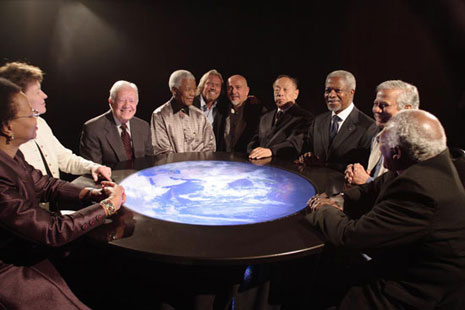
Elder statesmen: (from left) Peter Gabriel, Muhammad Yunus, Mary Robinson, Kofi Annan, Graca Machel, Nelson Mandela, Jimmy Carter, Li Zhaoxing, Desmond Tutu and Richard Branson

In tribal villages it is the elders to whom the people turn in times of crisis. Could a group of universally respected figures bring those same qualities of leadership and wisdom to bear on the global village? Just such an initiative has been launched by Nelson Mandela. In an exclusive report, Mick Brown charts the development of the Global Elders


On a cool South African autumn day in May, an extraordinary group of people assembled around a table in the great room at Ulusaba, the private game reserve owned by Sir Richard Branson. Among them were Nelson Mandela and his wife Graca Machel, Archbishop Desmond Tutu, the former American president Jimmy Carter, and the former president of Ireland and chair of the United Nations Human Rights Commission, Mary Robinson.

This was the first gathering of the Global Elders – the initiative created by Mandela, and formally announced by him in Johannesburg this week.

Ulusaba is one of the most luxurious private game reserves in Africa. Set in 13,500 hectares on the edge of the Kruger National Park, it was opened by Branson in 1989. Guests normally pay up to £1,000 a night to stay there, but for five days the lodge was closed to business as the gathering deliberated on what the Elders might achieve, and how they should present themselves to the world. Around the table, the core group and a circle of advisers including the Peruvian economist Hernando de Soto, the English parliamentarian Tony Benn and CS Kiang, founder of the College of Environmental Studies at Beijing University, listened to briefings from analysts and experts on a range of topics from Darfur to nuclear proliferation.

On one evening, as the gathering dined outside on the terrace, bandaged against the autumnal chill in borrowed fleeces and ponchos, they were addressed on the ­situation in Gaza by Yasser Abd Rabbo, a member of the PLO’s executive committee, widely recognised as a Palestinian 'dove’, and the Israeli peace activist and former justice minister Yossi Beilin, both instrumental in the Geneva Peace Accord. On another, they were entertained by a spontaneous performance by the musician Peter Gabriel, singing his composition, Biko, about the ANC activist Steve Biko, whose murder in police custody in 1977 made him a martyr of the anti-apartheid movement.

As well as those gathered around the table in May, the group that Nelson Mandela announced this week will also comprise the former Secretary General of the UN Kofi Annan; Muhammad Yunus, the Bangladeshi economist and so-called 'banker to the poor’, who devised the idea of microcredit – the extension of small loans to people too poor to qualify for bank loans; Li Zhaoxing, the former Foreign Minister of China; Ela Bhatt, the Indian women’s activist and founder of SEWA, the Self Employed Women’s Association; and Gro Harlen Bruntland, the former prime minister of Norway and director of the World Health Organisation. Five of the group are Nobel Peace laureates.

Two more names will be added in the coming months to bring the total to 12. And an invitation has also been extended to Aung San Suu Kyi, the democratically elected leader of Burma, who has spent much of the past 18 years detained under house arrest by the military junta that governs the country; a chair will be kept empty at all Elders meetings until such time as she is able to occupy it.

So what exactly are the Global Elders? A self-elected 'dream team’ for putative world government? An alternative to an increasingly divisive and moribund United Nations? The mission statement that accompanied this week’s announcement couches their objectives in deliberately moderate language. 'The Elders,’ it states, 'are coming together to contribute wisdom, independent leadership and moral courage to tackle some of the world’s most serious problems.’ It is said that they will seek to use their influence and experience to 'persuade and facilitate’ action on a broad range of issues, making themselves available to act as 'honest brokers’ in conflict resolution, serving as a 'megaphone’ to amplify the volume on crisis situations such as diminishing natural resources, Aids and malaria, and act as an independent voice of reason and wisdom on the shoulder of governments and other organisations.

What they will not do is execute on-the-ground ­programmes, or duplicate work being performed by the UN and other organisations. They will have no legislative or political power, no armies at their disposal, and no ­billion-dollar budgets. In short, they will be a test of how effective the weapons of wisdom, independence and moral authority can be to leverage global change.

For Branson and Gabriel, the gathering at Ulusuba held a particular sweetness – the culmination of a dream they have been nurturing for the past eight years. The pair have been good friends for many years, but it was in 1999 when they first began to talk in theoretical terms about how the tradition in indigenous cultures of tribal elders serving as the repository of wisdom, judgement and long-term thinking might be applied in the global village. The premise that Branson and Gabriel thrashed out was deceptively simple – there are any number of organisations and institutions, from the UN down, dedicated to solving the world’s ­myriad problems, but there is no single group that is totally independent, deriving its authority not from political, economic, military or religious power but from ­wisdom and experience. What might such a group achieve?

Each saw the possibilities in a different way. Branson envisaged a group of globally respected individuals who could use their influence to mobilise resources to combat the pandemics of Aids or malaria, and to prevent and resolve global conflicts. 'A group of Elders might be able to look at situations slightly differently than the United Nations does, or individual governments with their own vested interests do,’ he says. 'I know as a businessman that sometimes if you think you’re slightly ahead of the game, you become wedded to your position, and you may need someone to come in and help you save face in a climb-down position. There are occasions where both sides have got themselves into an impossible situation and it requires a completely disinterested party to see how they can extricate themselves from that.’

Gabriel saw it rather differently. A long-time supporter of human rights causes, he founded Witness, a grassroots organisation that puts cameras and video equipment into the hands of ordinary people to record human rights abuses around the world – a 'YouTube for human rights’, as he puts it. He envisaged a globally elected council of the wise, using the internet and mobile-phone technology to respond to grassroots problems in a way governments are unable to do. Both agreed only one man could ever bring such a project to fruition: Nelson Mandela.

'To me, and I think most others, there is nobody who epitomises a universally acclaimed moral authority more than Nelson Mandela,’ Branson says. 'Here was somebody who by rights ought to have been consumed by ­bitterness after years in prison, but he forgave his captors and welcomed them into government; he prevented a whole nation going down the precipice into conflagration. He’s a wonderful example to everyone.’ Through his ­philanthropic interests in South Africa, Branson had come to know Mandela well.

In autumn 2001, he was entertaining Mandela at his Holland Park home. Gabriel joined them, and over lunch he and Branson gently floated their idea of the Elders. Mandela’s response was guarded: the UN, he said, might look askance at a self-elected group presuming to step on their territory. But he could see the value of the idea. He remembered how in his mediations between the Tutsis and the Hutus both sides had said it was as if they were talking to a father advising them, rather than to someone with an agenda of his own. 'I think the success of that made Mandela see how 12 figures such as himself could be 12 times as powerful in certain situations,’ Branson says. Mandela told them he would give the idea serious thought.

Branson says he has never been interested in running for political or public office, but nor has he been shy of using his influence and resources in the service of causes he believes in. In 1990, when Iraq invaded Kuwait leading to the first Gulf War, at the request of his friend the late King Hussein of Jordan, Branson used Virgin aircraft to airlift supplies to refugees fleeing into Jordan and later mounted a mercy flight to bring home British citizens held hostage by Saddam Hussein.

In recent years, his growing friendships with Mandela, Bill Clinton and Al Gore have encouraged him to deepen his interest in the possibilities of what he describes as socially responsible entrepreneurialism. Last year he pledged to commit all the profits from his transportation businesses over the next 10 years – estimated at $3 billion – to Clinton’s global initiative to develop clean fuels. He has also offered a prize of $25 million of his own money to anyone who can devise a way of taking damaging carbon emissions from the atmosphere.

Branson has never been afraid to think big, or been deflected by obstacles others might regard as insurmountable. But nothing rivals in audacity his attempt unilaterally to avert the Gulf War in 2003. As America was preparing to invade Iraq, Branson, through intermediaries, explored the possibility of Saddam Hussein being assured of safe haven in Libya. He then approached Mandela asking if he would be prepared to fly to Iraq to persuade Saddam to step down. Mandela said he would if Kofi Annan, then Secretary General of the United Nations, and South Africa’s President Tabo Mbeki agreed to the plan. Branson sought, and was given, both their blessings. But before Mandela could board a private plane to fly from Johannesburg to Baghdad, America invaded. 'It may have come to nothing anyway,’ Branson says, 'but it was an example of a universally respected, individual elder, working outside the conventional political process, who might have made a difference.’

A few months later, in November 2003, Branson and Gabriel were both in South Africa for an all-star concert to launch Mandela’s 46664 Aids charity [46664 was Mandela’s prisoner number on Robben Island] which they had organised with the musician Dave Stewart. Afterwards, at Mandela’s home, they again broached the idea of a council of global Elders, asking whether Mandela and his wife Graca Machel would lead such a project and become the founding Elders. Warming to the idea, Mandela asked Branson to research the logistical feasibilities.

Branson now set up a team, led by Jean Oelwang, the chief executive of Virgin Unite, the independent charitable arm of the Virgin Group, with the objective of defining what a council of Elders would look like, what it might do and, as Oelwang says, 'bringing together the collective wisdom of some of the world’s most remarkable leaders with no other agenda but that of humanity.’

The first question was the most difficult: who should the Elders be? The number of figures who command not only universal recognition but universal respect can be counted on the fingers of one hand. How do you arrive at a group of 12 – the number had been decided by an unspoken consensus – that would equitably represent gender, ethnicity and cultural pluralism?

Mandela had already outlined a handful of names that he would like to join him; to research further candidates, Oelwang recruited Scilla Elworthy. She is the founder of the Oxford Research Group, which she established in 1982 to study ­global security issues and develop dialogue between nuclear-weapons policy makers and their critics. She is also the founder of Peace Direct, a grassroots organisation devoted to developing conflict resolution skills, and has herself been nominated three times for the Nobel Peace Prize.

Over the next 18 months, Elworthy consulted government figures, diplomats, civic leaders and Nobel Peace Prize winners throughout the world, assembling a long-list of individuals for consideration as possible Elders. At this point it was felt expedient to reveal as little of the project as ­possible. In her canvassing of names, Elworthy referred to the project simply as an initiative to influence decision-making on global issues.

'We felt we shouldn’t use Nelson Mandela’s name – we didn’t want it to get into the press in the wrong way. We simply said this was going to be something at the highest level, led by absolutely impeccable names with global moral authority. And it wasn’t going to be just a talking shop; it was going to be about direct action.’ 0

Through a process of discussion and elimination, a set of criteria began to emerge for prospective Elders. The first, and most important, was that they should not be currently involved in politics; they should have no personal agenda, vested interest or bias. They should have earned international trust, demonstrated outstanding integrity and built a reputation for non-coercive leadership.

'It was important to find people who had displayed moral courage,’ Elworthy says. 'In other words, they had been in some situation that had demanded them to stand up against oppressive forces, dictatorship or whatever.’ Aung San Suu Kyi is an outstanding example, she says.

'Secondly, they should have made a real difference to very large numbers of people in some way that had dramatically changed their lives.’ Muhammad Yunus was a good example. 'Here is somebody who has devised a replicable and massively important technique for lifting people out of poverty, surmounted all the difficulties and actually made it work,’ Elworthy says.

'Another criterion is the demonstration that they can move beyond their own fear in a significant way. Nelson Mandela would be the obvious example there, having put up with 27 years of incarceration and facing fear daily in the early days. Then there’s the ability to listen, which everybody involved in this considers terribly important. And the last thing was the realisation that all the truly great people have a sense of humour. Archbishop Tutu absolutely epitomises that. It wasn’t a criterion, but it emerged as a common characteristic.’

By the end of the process, Elworthy had drawn up a biographical databank of more than 300 ­people – human rights activists, scientists, economists, philosophers, spiritual and tribal leaders, social visionaries, specialists in health care, education and environmental issues – drawn from almost every corner and culture of the world. In time, this would be filtered down yet further to just 30 names, including a clutch of former presidents and prime ministers, an internationally acclaimed author and four renowned religious and spiritual leaders. Six of the 30 were Nobel Peace Prize winners.

In August 2006 a remarkable assortment of individuals gathered on Necker Island, Richard Branson’s private retreat in the Virgin Isles, to brainstorm the Elders concept. They included leading figures from the world of internet technology – Jimmy Wales, the founder of Wikipedia; Larry Page and Sergey Brin, the founders of Google; Steve Case, the chairman of AOL – representatives of global think tanks and philanthropic trusts. Also present were Archbishop Desmond Tutu, whom Mandela had already indicated he would like to see as chairman of the Elders, and ex-president Jimmy Carter – a key name on Mandela’s list.

Over the course of several days, in meetings conducted around the dining-table in Branson’s home, and more informally on blankets and chairs on the beach, the participants roamed far and wide over what the Elders should be doing and, more importantly, what they could realistically achieve that other organisations – notably the UN – could not. Should they be seeking to make personal interventions in crisis management and conflict resolution? Should they function as a sophisticated global intelligence resource, a repository of expertise and intelligence for tackling global pandemics?

Should they be seeking to make personal interventions in crisis management and conflict resolution? Should they function as a sophisticated global intelligence resource, a repository of expertise and intelligence for tackling global pandemics?

An advocacy group drawing attention to problems overlooked by the world’s governments and media, with an unrivalled capacity to focus global attention on a problem and project whatever message they chose? Archbishop Tutu stressed that he would see one of the fundamental roles of the group to act as a living example of the truth that 'human beings are made for goodness’. It is not the militarily powerful or even the economically prosperous that are held in univerally high regard, he said, but the peacemakers and the humanitarians, 'the ones who make people feel good about being human’.

'In South Africa we speak of Ubuntu, meaning we are not in isolation: I need you in order to be me… we exist in a delicate network of interdependence. And a part of what the Elders ought to be seeking to do is reminding people that you are ­fundamentally good, and that the aberrations are the bad. Why we are appalled by what is happening in Darfur, in Burma, or Zimbabwe is precisely because we are saying, “That’s not the norm.” One of the hopes for the world is precisely the fact that people are outraged by such ghastliness.’

Jimmy Carter had agreed to come to Necker purely in an exploratory capacity, reluctant to commit himself to the idea of the Elders. Addressing the group on the first day, he expressed his reservations, talking of the disparity between 'a dream of peace, love and sharing and caring’ and an organisation that could deliver the practical solutions to problems – 'the mundane thing of building a latrine, or putting a tablet in someone’s mouth, or putting up a [mosquito] screen. Bridging that wide chasm between dreams and practicalities, 'takes money and organisation,’ Carter pointed out.

But as the discussions went on, so his enthusiasm began to grow. If the Elders could evolve into a stature of global acceptance and respect, he said, it would be very difficult for others to reject their influence; their independence, lack of any agenda, and their global reputations as honest brokers would give them entree with individuals that might be denied to other organisations, and even governments, enabling them to exert influence in a way that even the UN could not do. What leader could resist an invitation to meet such a group?

'Even in the most controversial issues, the Elders could make themselves felt. Even though people on both sides may say they don’t want interference.’ The Elders, Carter suggested, might function as a first court of appeal in conflict resolution, 'a place where people can say as a first response, why don’t I go to the Elders to help prevent this war?’

Their unique position, he went on, would also mean they would be free to speak with 'pariahs' – the 'unsavoury leaders' who may be the real cause of the problem but are never included in the discussion of the solution. 'This group would have the collective stature to overcome the stigma of dealing with people whom the world may be condemning.'

But the potential for the group, he said, was ­limitless. 'We’re talking about alleviating suffering in the third world, women’s rights, the protection of human rights, dealing with diseases, the environment. I think the last thing this group wants to do is put any kind of limit on what they might address.’ After three days of meetings, Carter’s scepticism had given way to commitment. He left Necker indicating that if he were invited to become an Elder he would accept. The Elders, he said, could be 'the conscience to the world’.

For Peter Gabriel, one of the most exciting things about the Elders initiative is the opportunity ­presented by new technology for what he describes as 'user-generated politics’ to bypass the obstacles that exist in conventional political processes.

'All of the Elders individually have said that one of the main roles they would like to take is to listen,’ Gabriel says. 'And if we can provide a bridge between people at the bottom and those, if you like, in the clouds at the top that have the influence to do something, then the potential is enormous. If the right is open to everybody, whether they’re in Darfur or Iran or wherever, to have their stories told in an environment where they can be drawn to the attention of the Elders, then you have the possibility to tickle existing political systems in ways that could only help encourage change. It’s crazy to get too ambitious about what the Elders might achieve; but I think a phone call from that group would be very hard to ignore if you’re a world leader.’

The Elders will not be in the business of executing on-the-ground programmes; but in time, Gabriel says, the Elders’ website will create a global community, providing a platform for humanitarian projects, highlighting technological innovation and fostering on-line skills mentoring. 'We have this amazing resource of the retired community – our own elders – which is so untapped; we push them into homes or off to the seaside, and they have a lifetime of experience to use. In sub-Saharan Africa alone there are 12 million children without parents because of Aids who could connect with mentors one-on-one through the internet. This kind of ­revolution could all be harvested under the Elders’ auspices, and that is so exciting.’

It is anticipated that the Elders will meet at least twice a year at various locations throughout the world, while remaining in regular contact through video conferencing. 'We want this to be perceived very much as a global body, not linked to one ­continent’, Jean Oelwang says. They will receive no remuneration, but an extensive support structure is being put in place to facilitate their work, including an 'intelligence network’ of advisers who will be available to provide expert counsel and feedback on whatever issues the Elders choose to tackle, as and when required. A chief executive will be appointed in the next few months.

The initiative is being funded by a group of founders. As well as Branson and Gabriel, who are committing their own money to the project, these include the UN Foundation, which was created in 1998 by Ted Turner with a $1 billion bequest to support UN causes and activities; Humanity United, a philanthropic organisation started by the eBay founder Pierre Omidyar and his wife Pam; and the American businessman and philanthropist Raymond Chambers, the founder of Malaria No More and Millennium Promise. Oelwang estimates that funding over the next three years will be in the region of $20 million.

For Kathy Calvin, the executive vice-president and chief operating officer of the UN Foundation, the attraction of the Elders project as a funder lies in its potential to tackle intractable problems, especially where major global institutions can’t do so alone. 'It’s become increasingly clear over the last few years that multilateral institutions are essential but often limited by their multiple constituencies,’ she says.

'I think people really feel that politics is blocking our ability to solve big problems. So it’s a time when a different approach and methodology could come into play. In a way it’s kind of old-fashioned. It’s relying on relationships and moral standing and one-to-one quiet negotiation – it’s everything that is increasingly difficult to achieve on the world stage. Here are people who have no other agenda than to point out what is the right thing to do. Now it’s a big question whether that can be effective, but why wouldn’t you at least want to try? I also think that in this world of YouTube and the internet, the idea of a group of wise people and leaders who are listeners as well as talkers, and who would give voice to people who are never ­otherwise heard, is also very powerful.’

What is most compelling of all, Calvin says, is that the initiative is led by Nelson Mandela 'The notion that he has one last gift to the world, and that he would pull together the people he has in this way, is very inspiring. He has demonstrated a kind of leadership that is based on listening and consensus which can engage the next generation as well.’

Mandela is now 89 and in fragile health, yet he carries with him an air of palpable magnetism and authority – that rare and deeply affecting combination of greatness and humility. At the Ulusaba gathering he was last to take his place at the table. Word had spread of his coming. A crowd of local villagers, and every member of staff of the lodge, had gathered at the gate to greet him, his arrival heralded by the sound of ululations and praise-songs. As he made his way slowly into the room, leaning on Branson’s arm for support, the gathering rose as one in a round of spontaneous and prolonged applause – his newly found entourage of cooks, maids and drivers, joyfully ignoring privacy or protocol, crowding in behind him to hear him speak: the father of the nation with his children.

Talking of the major problems the world faces – violent conflict, climate change, disease – Mandela spoke of how the institutions of government are often tied down by political, economic or geographical constraints, and how the efforts of a small, dedicated group of leaders 'working objectively and without any vested personal interest in the outcome’ could help to solve what often seem like intractable problems.

The Elders, he went on, had the opportunity to be 'a real role model’ for the world, leading, guiding, creating their own initiatives and supporting others, speaking 'freely and boldly’, and working both publicly and behind the scenes on whatever actions needed to be taken.

Muhammad Yunus had been unable to join the group in South Africa, but that afternoon he pledged his commitment via satellite link in Bangladesh. Kofi Annan had also been unable to attend personally, but on the second day he addressed the gathering via satellite from Sweden. He had not yet formally committed himself to the project, but over the next 30 minutes as he Graca Machel, Archbishop Tutu and Carter engaged in a conversation about African politics that made one vividly aware of just how potent the Elders’ armoury of experience and personal connections could be, Annan’s enthusiasm was palpably evident.

At the end of the conversation, Archbishop Tutu addressed him. 'So, Kofi, can I take it you are with us?’ Annan answered him with a broad smile: 'I am with you,’ and the room rose in a round of thunderous applause.

Elders will serve a three-year term, with the potential to extend. They will also be overseeing the setting up of supporting groups of 'grassroots' Elders around the world – to be drawn from the existing databank of 300 names and from recommendations from the public through the internet. 'Mandela and Graca have said they want to have an open global debate about who else should join the Elders,' Branson says. 'The final choice will be theirs, and will have credibility for that reason. And Mandela will also be getting Nobel Peace laureates to vet his list. The important thing is not to rush and choose the wrong people.' A small number of prominent figures will also be invited to become 'Ambassadors' to the Elders, championing their work. Oprah Winfrey has agreed to become the first of these.

In mapping out a strategy at Ulusaba, it was agreed that the Elders would begin by ­concentrating on just one or two initiatives – at least one in the area of conflict resolution. But they are likely to be undertaken without fanfare or announcement. Indeed, Branson says, he expects much of the Elders’ work to be done behind the scenes. 'Some­times they will have to go public, but generally the feeling is that it would be much better, and more effective, to do things quietly. There will always be that threat that if people don’t sort things out then the Elders can go public. But once you lose that threat then you’ve lost your ammunition.’

Another item high on the agenda was the criticism that the initiative will almost inevitably receive. 'People will ask, who are these self-appointed ­"saviours",' Mandela cautioned the group. But the Elders, he said, should 'reach out to those detractors, convert them to this way of thinking'.

Branson is aware that one of the more likely targets for media scepticism will be his own involvemen. As much as he is admired by the public (in a BBC poll in 2005 to find the person most people would like to lead a global government, Branson came ninth – Mandela topped the list) there have always been sections of the media quick to accuse him of publicity-seeking.

'But there’s a simple answer to that sort of criticism’, Scilla Elworthy says. 'Does anybody honestly think people like Nelson Mandela, Archbishop Tutu and Jimmy Carter would get involved in this if they thought it was a businessman’s ego trip? There have been various global leadership initiatives in the past, but the big difference with this is that you have the combination of wisdom and resources to make it more than just a talking-shop. It has a real dynamism because it has Richard’s entrepreneurial muscle behind it. It won’t stop at wise declarations; it will actually put them into action.’

'There is cynicism about anything that happens in life,’ Branson says, 'but I’ve never thought that should stop you doing things. I see myself as a catalyst, and it’s very important that it’s no more than that. The job of Peter and myself is simply to help Nelson Mandela put this in place, make sure there is a fantastic team to back up the Elders, and then to step back.

'Mandela and Graca are both the most special people, and for them to be engaged in something like this is equally special. Even if the Elders do only one positive thing, that would justify their existence, but I’m sure that in the years and decades to come they’ll be able to do many good things. The world is crying out for more Nelson Mandelas and it would be wonderful if the Elders could become part of his legacy and live on through future generations.’

'We must give people the sense that solutions to the world’s problems are possible; that things might look intractable but it is our duty to believe that goodness and right will prevail,’ Archbishop Tutu says. 'But at the same time everyone is aware of the dangers of raising expectations too high.’

Buried in the briefing documents outlining the putative objectives of the Elders and their possible strategies, lies a cautionary note about what the Elders will not do, '… solve all the world’s problems…’ It is intended in a light-hearted way. Who after all would realistically expect them to? But it does raise the question – if they can’t, who can?

Information appearing on telegraph.co.uk