Articles review on the net, revue d'articles sur la toile


Inscription : feeds, flux :
(Atom) Gabriel Real World News

14 juin 2008

Thomas Brooman awarded

The Bath Chronicle :

Music festival supremo Thomas Brooman, of Corsham, has been awarded the CBE for services to music and charity. Mr Brooman is the co founder and more recently artistic director of the World of Music Arts and Dance Festival (WOMAD), which he set up with singer Peter Gabriel from a base in Box. The duo also co-founded Real World Records in 1987.

Video Reuters : Peter Gabriel launches 'The Filter'

Reuters Technology Correspondent Matt Cowan reports.

Jun. 3 - The content filtering service is billed as a unique discovery portal that cuts through internet clutter to deliver customized content. The Filter aims to help users discover new music, film and web videos based on their tastes and moods.

Video Thumbnail
(02:10) Report

13 juin 2008

Peter Gabriel: “In terms of quality, music has gone back”

by Tom Porter musicradar.com

Former Genesis frontman and digital music pioneer Peter Gabriel has spoken out about some of the negative aspects of the internet on the music industry - naming low quality MP3s and "too much choice" as the main offenders.

It's probably no coincidence that Gabriel is currently involved in two projects - The Filter (an online discovery tool that filters music and movies according to your tastes) and Lossless Sound - a joint venture with speaker makers Bowers & Wilkins to supply a CD-quality, uncompressed album every month online.

"I think everyone thought that it (the internet) was going to democratise the music business, but it's done less of that than we would have hoped. A lot of the artists are losing one of the central sources of their income, i.e. record sales, they need to become smarter in building their own database as a means of accessing their own fans and learning and getting the feedback from their fans", said Peter Gabriel to Reuters.

"An MP3 has become the sort of new standard and it's a giant step backwards. Whereas in television now most of us are getting used to wide screen or high definition, and that's gone forwards in terms of quality, music has certainly gone back".

"I think in a world in which we are drowning in choice and have access to everything, we are going to rely more and more on good filtering".

Reuters Entertainment

LONDON (Reuters) - Grammy-winning musician Peter Gabriel believes the Internet has drowned users with too much choice, failed to democratize the pop industry as much as was hoped and eroded the quality of what people listen to. The 58-year-old producer, former Genesis frontman, world music champion and digital technology pioneer is involved in two new ventures he hopes will address his concerns.

12 juin 2008

Just a Minute With: Peter Gabriel

By Mike Collett-White / Reuter UK


LONDON (Reuters) - Grammy-winning musician Peter Gabriel believes the Internet has drowned users with too much choice, failed to democratise the pop industry as much as was hoped and eroded the quality of what people listen to.

The 58-year-old producer, former Genesis frontman, world music champion and digital technology pioneer is involved in two new ventures he hopes will address his concerns.

The first is The Filter (www.thefilter.com), which aims to produce a blueprint of an individual's taste in music, movies, news and views by analysing what the person buys online.

Users can recommend songs and films to each other, and, further down the line, may be able to customise their profiles by selecting particular directors, artists and critics.

The second is a venture with speaker makers Bowers & Wilkins which offers an exclusive album each month recorded at his Real World Studios and available online as an uncompressed file, which should ensure CD-standard quality.

Gabriel, who helps organise the WOMAD world music festival which takes place this year from July 25 to 27, spoke to Reuters about his new projects.

Q: What is the main idea behind The Filter?

A: I think in a world in which we are drowning in choice and have access to everything, we are going to rely more and more on good filtering. I think one of the ways we are trying to do this a little differently is (to) integrate the best of expert systems - best of machine and best of man. There are living, breathing people whose tastes and guidance we trust whether they be friends, experts, musicians, film directors, critics, journalists. We're trying to integrate their parameters, if you like, with "you bought this therefore you might like this". That is part of the mixer idea and it's only in its first stage of implementation. Those people whose taste is available through The Filter, you can then allocate them to the mixer. That would be the aim ideally.

Q: Has the Internet been as much of a force for good in the music industry as you had hoped?

A: I think everyone thought that it was going to democratise the music business, but it's done less of that than we would have hoped. I think if you have good filtering then that is a tool to really level the playing field. If people are starting to really like what you do, and that enthusiasm and that sort of rating is getting in there, then that will make you more visible and accessible so it would then be based on passion and enthusiasm rather than just on dollars of merchandising and advertising.

Q: Are the kind of musicians you typically support, most of whom are not household names, benefiting from the digital revolution in music?

A: Not as much as I would like yet, and as a lot of the artists are losing one of the central sources of their income, i.e. record sales, they need to become smarter in building their own database as a means of accessing their own fans and learning and getting the feedback from their fans. That's a channel through which they can sell other stuff. We do need to democratise the process of discovery.

Q: Another negative aspect of the Internet you identified is the poor quality of downloaded music many people listen to?

A: The iPod, for example, does have the capacity to hold ... what they call "Apple Lossless" files, so it's built in and available, but very few people use it and an MP3 has become the sort of new standard and it's a giant step backwards. Whereas in television now most of us are getting used to wide screen or high definition, and that's gone forwards in terms of quality, music has certainly gone back. To get as small a number of digits taken up as possible something has to be sacrificed and it's unfortunately the music.... As good as CD, which I think should be the starting point. We're just trying that out with B & W (Bowers & Wilkins) and we have a small number of acts (to record the albums) but it would be great if a few more musicians would get involved and try and put stuff out in formats other than MP3.

Q: Will you be playing at the Nelson Mandela tribute concert in London on June 27?

A: I'm not going to play at this one. I've done four of the Mandela shows now and my wife is due a baby at this time so I didn't want to have a chance of missing that by being in rehearsal or playing. But I will be, I think, going to a private dinner for his birthday party.

(Editing by Paul Casciato)

Peter Gabriel To Spread Dengue Fever Around The World

by Paul Cashmere - June 12 2008 Undercover.com.au :


Peter Gabriel has signed Cambodian rock band Dengue Fever to his Real World label, for release outside North America.

Real World will pick up with the Dengue Fever catalogue at album number three, 'Venus on Earth'.

"We have Dengue Fever coming out on Real World Records outside the USA – it's really cool stuff with a small Cambodian singer and big American guys behind!" said Real World Records Founder and Musician Peter Gabriel. "They're California-based but have taken '60's Cambodian pop as their main source of inspiration and it's done with style. Its spirited, impassioned."

The Real World version for outside North America will include the unreleased live track 'One Thousand Tears of a Tarantula', recorded in March at World Café in Philadelphia.

11 juin 2008

Songwriter looks to earn way into club of heroes

By Richard O Jones, Journal-News


It seems like every contemporary singer/songwriter is in some way simply following in the footsteps of Bob Dylan. For a time anyway, Matthew Ryan took that literally. He took his cue from Dylan himself, who famously hounded legendary folk singer Woody Guthrie until he wheedled his way into the dying man's hospital room.

Ryan, however, never got that lucky. "It's funny that even though he harassed Woody Guthrie he's pretty good at not letting anyone harass him," Ryan said. "I didn't want to steal from him, I just want to measure myself by my heroes and not by my peers, and so when I was in my 20s, I wanted his attention."

He remains vague, however, when pressed as to exactly how he set about harassing Dylan or how close he ever got, except that for his first album he rented the recording studio of Albert Grossman, Dylan's first manager.

"It's kinda like, how close did you get to Santa Claus?" he said obliquely. "There's definitely a community above and you've got to earn your way in. I love what these guys have accomplished but it's definitely otherworldly. I did meet some of my heroes, and I didn't want them to be human, thought they turned out to be."

He tells the story of having dinner once with Peter Gabriel, and all he could think about was the enchantment of the potential of that kind of event, and how Gabriel's generosity and humility came as a surprise.

"Beyond ego and all that stuff, he was human, he was in touch and there was no celebrity," he said. "He was a smart, emotional, intellectual guy."

10 juin 2008

Tech Weekly: Peter Gabriel's Filter and the 3G iPhone

The Tech Weekly podcast: a warm bath of thought for your ears

This week's half-hour of ear massage is ready for you: we talk to Peter Gabriel, discuss the iPhone, and muse on broadband speeds

Launch audio player

This week in Tech Weekly we talk to Peter Gabriel about his new web recommendation service, The Filter. It's a kind of last.fm for the whole of your cultural life - and he explains how he got involved.

We couldn't pass up Apple's Worldwide Developers Conference, so we dissect the latest on the big 3G iPhone announcement. Was it as big as was expected? And is this a sign that Apple is changing its business approach.

Also in this week's show, more news of Microsoft's proxy Yahoo takeover, the BBC's moves to stream its archive live online, the phenomenon of advertising within Playstation 3 games, and whether broadband adverts will really change.

We'll also have your words of wisdom with comments from the blogs and our inbox too. Get in touch using any of the methods below, and don't forget to Skype us and join our new Twitter feed.

• Tell us what you think by calling our Skype voicemail or mail us at tech@guardian.co.uk
Post a message on the blog about this week's programme
Get our Twitter feed for updates on the programme across the week
Join our Facebook group

(Apologies. We wanted to find a Guardian picture of Peter Gabriel dressed as a flower, but couldn't. CC on Flickr, anyone?)

B&W Peter Gabriel's presentation and video

What’s the link between a recording studio in Wiltshire and a giant spaceship? “I was thinking about the film Close Encounters,” says Peter Gabriel, “and the way we make a connection with the aliens through melody. That may be a little fanciful. But at the Real World Studios we get musicians from all over the world, who often can’t talk to each other. We give them the technology to make noises, and they start making noises, and suddenly there’s a common language. That’s when things take off.”

see the presentation and the video !

B&W, Peter Gabriel Launch Music Club

Home Theater News By Mark Fleischmann


June 10, 2008 — British loudspeaker maker Bowers & Wilkins has teamed up with Peter Gabriel to offer subscribers exclusive music in DRM-free lossless surround.

The B&W Music Club launched last month. The online community commissions and records music in Gabriel's Real World Studios in Bath and then offers it online. It also offers blogs, feature stories, and video interviews with the likes of Gabriel, James Newton Howard, Cassandra Wilson, Dave Stewart (of the Eurythmics), and others.

This may be the most artist-friendly online venture ever. The Music Club foots the bill for studio time and mixing, but two months after the initial online Music Club distribution, the rights revert to the artists. They can then release their own CDs, set up their own download arrangements, or re-license to a record company. Initial recordings will feature Little Axe, Grindhouse, Gwyneth Herbert, Dub Colossus, and Tom Kerstens and G+.

The subscription fee is £23.95 for six months or £33.95 per year (that would be $42 or $67 at current exchange rates). That may seem a bit stiff, but we're talking about music never heard before, in lossless surround, and free of DRM, so you can convert it and use it on any device. Visit the site at www.bowers-wilkins.com/sos.

09 juin 2008

Viva la Vida Coldplay

Par Magali de Barrin Lords of rock :

Trois ans après l’excellent X&Y, Coldplay livre enfin son quatrième opus. Et autour de lui le mystère est entretenu. Si le premier single, "Violet Hill", a été offert en téléchargement gratuit sur leur site Internet pendant une semaine, le reste de l’album qui sort le 16 juin est ultraconfidentiel. Alors, est-ce qu’il en vaut la peine?

Triplement oui. D’abord parce que les producteurs sont Brian Eno et Markus Dravs. Un gage de qualité. Le premier a travaillé avec entre autres David Bowie, Peter Gabriel, Paul Simon. Le second est le producteur d’Arcade Fire. Ensuite, parce qu’après trois premiers albums qui se ressemblent et qui pourrait constituer une trilogie de la jeunesse, Viva La Vida est une sorte de nouvelle étape dans la musique de Coldplay.

Une sorte de remise en question, en fait. Chris Martin l’explique « le fait d’avoir écouté "Sing (To Me)", une chanson de Blur incroyable, alors que nous étions en tournée après la sortie de X&Y a constitué le point de départ de cet album. Je me souviens l’avoir écouté et m’être dit qu’il allait nous falloir devenir meilleurs en tant que groupe.»

Enfin, cet album, mélangeant de nombreuses influences - ils ont écouté aussi bien Rammstein que Tinariwen, Jay-Z, Gershwin, Radiohead, Delakota - ils offrent un set plus expérimental, dont 80% sont des live dans le studio The Bakery, qu’ils ont transformé à cette occasion. Plus expérimental, mais toujours aussi rock.

Ils explorent un nouvel univers pour le plus grand plaisir de nos oreilles. L’album s’ouvre avec un magistral instrumental intitulé "Life In Technicolor". Dès ces premières minutes, on ne peut qu’être impressionné par la nouvelle dimension que Chris Martin et ses acolytes abordent. Ils ont monté une marche supplémentaire.

Tout au long, cette impression d’ampleur se confirme, notamment dans "Lost!" introduit par un orgue d’église, et rythmé par un simple tambour. C’est mystique, presque émouvant. Avec "42" qui suit, on renoue avec un style plus avec les classiques de Coldplay, une ambiance plus intimiste, pour exploser ensuite avec une chevauchée fantastique dans "Lovers In Japan/ Reign Of Love", chanson en deux parties, au beat paradoxalement très lent, et des paroles débitées rapidement. "Yes" entre métal et cithare indienne. "Viva La Vida", plus rock malgré la profusion de cordes. "Violet Hill", le premier single, est un trait d’union entre le style initial de Coldplay et le rock expérimental qu’ils proposent dans cet album. Enfin, "Death And All His Friends" clôt comme un au-revoir ces qurante-six minutes fantastiques, comme un train qui s’éloigne lentement et qu’on refuse de voir partir.

On pouvait craindre que Coldplay ne se recycle jamais. Qu’ils conservent leur recette gagnante. Et force est de constater qu’ils se sont essayés brillamment à un genre nouveau. On ne peut qu’applaudir l’audace et le résultat.

08 juin 2008

1er Sommet Mondial des Etoiles pour la Terre

Sur Com4news

1er Sommet Mondial des Etoiles pour la Terre les 28, 29 et 30 novembre 2008 à Ouagadougou


Sauver la planete , des milliers de personnes en parlent , beaucoup essayent d'agir que ce soit en trouvant un carburant chocolat , en remplaçant les vaches par les kangourous , en évitant le gaspillage de l'eau pour une simple vaisselle , en triant ses déchets...

Rêves utopiques parfois , idées farfelues ou murement réfléchies d'autres , mais c'est en parlant que jaillissent parfois les initiatives. Croyez vous vraiment que celui qui a écrit le scénario de "retour vers le futur" et qui mettait des peaux de bananes dans le la voiture imaginait qu'un jours un paramoteur volerait vers la chine avec du carburant provenant de dechets ; pensez vous que Jules Verne croyait vraiment en son nautilus !

Alors une idée a été lancée , reunir les 100 stars élues par des votes d'hommes et de femmes du monde entier pour choisir le sportif , le chanteur , la star quoi qui représentera ce défi : se faire entendre pour que tout soit fait afin d'aider la planete

Ces stars, venues de tous les pays du monde, se réuniront à OUAGADOUGOU, capitale du Burkina Faso les 28, 29 et 30 novembre 2008 pour le Premier Sommet Mondial des Etoiles pour la Terre.

Ce ne sera pas simplement une rencontre entre artistes , experts , scientifiques mais ausi un sommet qui définira les mesures à prendre dans le monde(économiques, environnementales et sociétales)

En Clôture du Sommet, le Concert des Etoiles sera retransmis en mondovision.
Durant toute la nuit du 30 novembre 2008, 25 stars participeront à ce méga concert gratuit et en plein air, organisé par le chanteur Youssou N'Dour.

Sont invités: Bono, Diams, Peter Gabriel, Irene Grandi, Gilberto Gil, Wyclef Jean, Carlos Santana, Simon and Garfunkel, Sting, Rokia Traoré*...

*ROKIA TRAORé / chanteuse malienne que vous avez peut etre vu hier vers 23H dans le ZAP 8 de direct 8, une voix suave qui nous entraine vers les rives de l'afrique. Un morceau à écouter de cette artiste ici

Pakistan Panorama: French connection makes waves

by Kamran Rehmat -The Peninsula


Have the French taken a liking to Pakistani work of art?

There is considerable evidence if latest events are anything to go by. Recently, a book was launched at Alliance Française d’Islamabad depicting the life and works of music legend Nusrat Fateh Ali Khan.

It was like a breath of fresh air – given the connection, perhaps, French air!

Dr Pierre Alain Baud, the French author of Nusrat Fateh Ali Khan – Messenger of Qawwali is owed profound appreciation for his accomplishment.

For Islooites – a popular term to describe the citizens of Pakistan’s capital Islamabad – the event also helped change the current mood, which is frayed at the edges with a daily diet of political soap, power outages and shortage of one essential commodity or the other.

But to return to the subject, while taking a collective bow to Baud for his effort at giving Pakistanis the opportunity to get up, close and personal with the qawwali (devotional music of Sufis) icon, on reflection, it shows how the locals either don’t have the thirst for knowledge or simply lack the inclination to acknowledge their heroes.

Once again, it has taken a foreigner to bring them home to their own legend and that, too, in their backyard.

Even in his lifetime, Nusrat won his rightful place at home only after recognition in the West – an unusually reverse pattern for glory.

Nusrat’s first public performance was in 1965 but it wasn’t until his collaboration with Eddie Vedder on a soundtrack for the Hollywood hit Dead Man Walking that he began to make a global impact.

Soundtracks for The Last Temptation of Christ and Natural Born Killers took his pitch to a new high but it was the international celebrity Peter Gabriel, whose Real World label released five of Nusrat’s albums containing traditional qawwalis and experimental work with Mast Mast and Star Rise that propelled him as a fusion guru.

Baud’s tribute went beyond the book launch. It was quite a tour de force for the audience in Islamabad with anecdotes, docu-films, musical presentation and poster exhibition.

The French author’s love for the Pakistani qawwal’s mesmerizing work is abundantly clear with the various descriptions ascribed to him and reproduced in the book: "Singing Buddha’ in Japan, "Voice of Heaven’ in the US and "Pavarotti of The Orient’ in France.

The maestro also won plaudits from the French Ambassador in Islamabad, Regis de Belenet, who told the audience with some relish that one of Nusrat’s first concerts was in Théâtre de la Ville in Paris. The Paris rendezvous, Belenet felt, produced the electric effect that turned Nusrat into one of Pakistan’s finest ambassadors.

Thanks to the author’s keen interest in Sufi music, he developed a rapport with Nusrat, which soon turned into friendship, leading to his contribution in organizing global concerts. Subsequently, he produced articles, booklets and CDs exploring the genre of Sufi music and the contribution of Pakistani artistes.

A participant had a point when she said: “It makes you wonder if it is not something that we, Pakistanis should have done ourselves: to promote a soft image of their country.”

I recall with some vividness watching Bollywood flick Aur Pyaar Ho Gaya in Muscat’s Al Nasr cinema years ago in which Nusrat appeared as a guest star. The moment he adorned the screen, the audience broke into a rapturous applause that continued for nearly a minute.

What makes Nusrat’s music tick across cultures, even for those who do not understand the languages he sang in, is explained by one fan thus:

“His music invites us to eavesdrop on a man communing with his God, ever so eloquently. The deepest part of Nusrat’s magic lies in the fact that he is able to bring our hearts to resonate with the music, so deeply, that we ourselves become full partners in that offering.”

It has taken another Frenchman to highlight the value of prized Pakistani work – scripted by a giant luminary but lost to the gathering dust of history.

It took Film Director Philippe Jalladeau’s painstaking effort to locate the work of art – Jago Hua Savera (Day Shall Dawn) – penned by the inimitable Faiz Ahmed Faiz almost half a century ago.

Jalladeau, a passionate film buff, who has been running an international film festival in France based on documentaries and fiction films for four decades, was in Pakistan recently after he secured the only existing print of Jago Hua Savera – the country’s first feature film produced in 1959.

Praising its impressive execution, the French director told leading Pakistani daily Dawn in an interview that Jago Hua Savera was “the most beautiful film ever made in Pakistan” and that he had watched it three times.

The film was screened last month in Lahore at the auditorium of Human Rights Commission of Pakistan – an unusual platform to take a shot at reviving past glory but perhaps, apt given the maltreatment it has received.

Faiz’s daughter, Saleema Hashmi, revealed that the only print of Jago Hua Savera had been lost before being eventually found by the French director in a London archive.

Describing the film as a “piece of education”, Jalladeau lamented that Pakistan did not have a properly maintained archive, an example he said compared unfavourably with even war-torn Afghanistan!

For the discerning, Jago Hua Savera – set in a East Pakistani village – was declared the sixth best Pakistan film in a country list of top ten by the British Film Institute in 2001.

Jago Hua Savera is the story of a fisherman’s struggle to build a boat. The future income of his entire family depends on whether he succeeds or not.

It was Pakistan’s first realistic and experimental film. All pervasive poverty, deprivation, ill health and ignorance are the major obstacles the fisherman has inherited from his environment. The film won a prize at the Moscow film festival as it reflected socialist ideology through the struggle of the proletariat, viz., the fisherman.

This classic award-winning film originally premiered in London 50 years ago.

Momix Passion: A Review

Passion Photos copyrighted by Arnold Groeschel


by Carley Petesch Carley, dance editor for The Brooklyn Rail

The body is a vessel for sacrifice both literally and symbolically in Moses Pendleton’s Passion, the 17-year-old dance work that opened Momix’s run at The Joyce Theater in May. The episodic piece set to Peter Gabriel’s score for the film The Last Temptation of Christ is a visual feast with bodies that are pushed to extreme physical limits, but its substance does not fully match that of the music.

Despite this, it is obvious why international venues keep bringing Passion back; it has the palatable Momix recipe of sensuality, athleticism, beauty and illusion. Like magic shows, or Cirque du Soleil—to which Momix is now often compared—trickery is what drives the piece, the attempts to create moving sculptures with the body that are dazzling.

The work opens with the projection of a man’s face on a front scrim. That face morphs into a tree, and from behind that scrim, the dancers appear in nude-colored costumes and stocking caps. They are arranged in a line going up stage so that only the front body is seen, with limbs protruding out in a tree-like fashion. Flowing movements of the arms evoke a multi-limbed goddess, and two dancers are lifted and swung like pendulums with knees bent, feet flexed. The dancers then assemble in a tight circle, arms wrapped behind backs. A dancer initiates an up and down wave, and the group spins around the stage like an undulating top.

The projections continue to morph throughout the 75-minute piece. From the tree, to Chinese tomb sculptures, to a brain, to Renaissance paintings, the only connecting thread between the images is that they are the motivation for the movement that follows. At times this formula works, as when there is an angular, flying statue projection and two male dancers jump into the air and literally suspend in the same position as the image for longer than one would think possible. Their strength and power are seemingly beyond human. At other times, the formula feels disconnected because the images are so disparate, like when a portrait of soldiers is projected onto the screen, eventually morphing into the projection of a Mayan-looking sculpture. The movement that follows involves a male dancer on all fours, spastically circling his head.

Passion relies on creative body concepts, not necessarily innovative movement patterns. But some of the so-called illusions are a bit watered down, like when a female dancer sits on a male counterpart and pretends his legs are hers. Other concepts are absolutely breathtaking. The strongest and most mesmerizing section of Passion comes toward the end, when a male dancer hangs from the ceiling, surrounded by women who look as though they had been hanged and covered in red velvet hoods. The lighting makes it look as if they are suspended in the heavens. With incredible precision and tenacity, the male dancer moves through sacrificial motions on the ropes.

Then a large pyramid-like projection serves as scenery for three female dancers. They emerge from the wings with white glowing veils covering their topless bodies, a long train following. The brilliant lighting design makes them look like ghosts floating around the tomb, and as they manipulate the veils with exacting throws, wraps and bundles, it looks as if they are moving metallic liquid around the stage. It is haunting and beautiful.

Such images leave a lasting impression. The triumph of Passion lies in the eery and otherworldly mood it creates. Momix continues performing another Pendleton favorite, Lunar Sea, at The Joyce Theater through June 8.

07 juin 2008

Angelique Kidjo Comes to the Harmony Festival


I first wrote about Angelique Kidjo in May of '04, having first heard her during one of my visits to Montreal's annual Festival d'Afrique. Here musicians from Africa, the Carribean, and the Americas, converge and for one week, every style imaginable, from Techno to Morroco can be heard. Kidjo, a fabulous singer from Benin, has attempted to prove that the world is "much smaller and far more culturally connected than it may appear". Her music has been said to "glorify individual cultures while also underlining their universal similarities". Kidjo returns to the Bay area this Sunday, along with incredible line-ups like Mickey Hart, Parliament Funkadelic, Jefferson Starship, Paula Cole, Sol Horizon, among others at the 30th Harmony Festival, June 6th-8th in Santa Rosa.

With Djin Djin, her new release on Razor & Tie/Starbucks Entertainment, Kidjo comes home. The four-time Grammy-nominated, much-celebrated singer, composer, and performer began in the Beninese port village of Cotonou, where she launched her career at the age of six. The political turmoil in her country led her to relocate to Paris, the capital of world music, and then ultimately to New York City, where she now resides. Her striking voice, stage presence and her fluency in multiple cultures and languages won respect from her peers and expanded her following across national borders. It also earned her access to humanitarians who sensed the passion in the words of her songs, resulting in her long-term dedication to global charity work.

Kidjo has traveled far and mesmerized audiences on countless stages, speaking out on behalf of the children in her capacity as a UNICEF goodwill ambassador. Now with Djin Djin and the return to her musical roots, Kidjo has truly closed the circle in her life as she brings international artists to the musical world of her native country. As a child, Kidjo was mesmerized by an iconic album cover of Jimi Hendrix, which led her to follow the African roots of music from the United States, Brazil and the Carribean. The results were the Grammy-nominated trilogy of albums, OREMI, BLACK IVORY SOUL and OYAYA. With Djin Djin (pronounced “gin gin”), Angelique Kidjo returns to the soul of Benin – and, for the first time, shares it with a cast of all-star guests, in a marriage of cultures that has significance far beyond music alone. Inspired by the traditions and culture of Kidjo’s native Benin in West Africa, the title of the album refers to the sound of the bell that greets the beginning of a new day for Africa.

The diversity represented by Alicia Keys, Peter Gabriel, Josh Groban, Carlos Santana, Joss Stone, Branford Marsalis, producer Tony Visconti, and the others who contribute to Djin Djin speaks to the lesson of this project: For all the differences in the music of our time, the river of Africa flows through it all. The key was to build Djin Djin on a Beninese foundation. The heartbeat, then, comes from percussionists Crespin Kpitiki and Benoit Avihoue, both members of Benin’s Gangbé Brass Band. Details of their country’s rhythmic heritage, specific in some cases to individual villages, feed the rhythms they lay down throughout the album.

To this mix Kidjo welcomes players whose backgrounds complement the idea of Djin Djin: drummer Poogie Bell, known for his work with Erykah Badu and Chaka Khan; funk keyboard wizard Amp Fiddler, whose credits include Prince and George Clinton; Larry Campbell, whose multi-instrumental work has adorned the music of Bob Dylan, Emmylou Harris, and Paul Simon; Senegalese bass giant Habib Faye, a fixture with Youssou N’Dour; guitarists Lionel Loueke, from jazz legend Herbie Hancock’s band; Romero Lubambo, a Brazilian wonder whose credits include Diana Krall and Dianne Reeves; Joao Mota, from Guinea-Bissau and kora master Mamadou Diabate.

Each player is a virtuoso but, more important, is open to taking creative chances. “It was important to me that all of these great musicians come with me back to my roots,” Kidjo says. “I’ve never compromised those roots because I know my identity, and I’ve learned that in order to give through music, you have to position yourself among other individuals who may be from different cultures and background and then find ways to discover that we’re actually not different at all "

Kidjo set some of the new material on Djin Djin into the languages of Benin, Nigeria, and Togo. She has written and sung extensively in French and English as well, but for this mission the lyrics came to her from further back in her history. The title track, “Djin Djin,” is a reminder to live each fleeting moment as fully as possible. Her songs embrace the joys and sorrows of life: the magic of birth (“Salala”), the uniqueness of each person even on this crowded planet (“Arouna”), the temptations of violence (“Mama Golo Papa”), the healing and learning potential of music (“Awan N’La”), the lessons offered as youth yields to age (“Sedjedo”) and isolation deepens in modern society (“Emma”).

But Kidjo doesn’t hold back her anger, expressed here toward wealthy classes enslaved by love of money (“Senamou (C’Est L’amour)”). She also looks forward to the day when leaving Africa to seek fortune far from home won't be the only solution for a desperate youth (“AE AE”). On her rendition of Sade’s “Pearls,” she extols women who are strong, yet suppressed and unable to escape the pain of existence. On another cover, a brilliant a cappella arrangement of Ravel’s Bolero entitled “Lonlon”, she illuminates the bridge that stretches from European classical music to the wellspring of northern Africa. And on “Gimme Shelter,” Kidjo transforms the Stones classic into an exuberant pan-national performance that nonetheless translates into a warning.

“This song means a lot to me,” she says. “Look at what’s going on: Fire is burning in our streets. Terrorists, in the name of God, are coming to destroy what we’ve worked for. If you don’t give shelter to the people who most need it, if you don’t treat them as your brothers and sisters, then what hope do we have?” The contributions of stellar guest artists illuminate Kidjo’s concept. By finding a place for their distinctive talents within the marriage of African and Western influences, Djin Djin celebrates the beauty of diversity as well as the unity of cultures that Kidjo achieves through her music.

These giants include Peter Gabriel on “Salala” (“He’s done so much for African music; in fact, there’s something African in his way of singing, moving, and writing his songs”); Alicia Keys on “Djin Djin” (“When she heard the Beninese drums in the studio, she said, ‘Wow, this is hip-hop!’ She understood it perfectly – and she sang so beautifully”); Joss Stone on “Gimme Shelter” (“We’re friends, so when I played her what we were doing in the studio, and she insisted on being a part of it, I was so happy that we could make this happen”); Josh Groban on “Pearls” (“He sings so effortlessly,” Kidjo says, “and yet you know that it isn’t easy to sing at that level of virtuosity”); Ziggy Marley on “Sedjedo” (“He understands so well the connections between the music of Jamaica and the rhythm of Africa – especially the gogbahoun rhythm that comes from my village”), Carlos Santana on “Pearls” (“He’s not only a guitar player: With his guitar he sings, he dances, he swings, he cries – and he has huge respect for Africa”); Branford Marsalis on “Djin Djin” (“He’s my brother! When he plays, you never know what you’re going to hear or where his wonderful ideas will take the music”); and Amadou and Mariam on “Senamou” (“We go so far back as friends; it was a special blessing and a gift to have them on the album.”)

Producer Tony Visconti (David Bowie, Morrissey) helps to bring each track on Djin Djin to full sonic bloom. Recorded at Electric Lady Studio in New York, with participants gathered in a studio made intimate by carpets, couches, and home-like accoutrements, these performances testify to the power of music to simultaneously unify and free those who make it and hear it.

“When we had finished our recording, we were all so sad because we had come together as a family, all within just two weeks,” Kidjo recalls. “Music brings us together, but after the music is over, you go back to your home, to your neighborhood, knowing that you can make a difference. You have to be proud of who you are. Whether you were born in America or Africa, you can celebrate life.”

Kidjo’s point is as simple as it is profound: The celebration only begins with Djin Djin and will last as long as you want it to after that.

The 30th Annual Harmony Festival
Santa Rosa, Sonoma County Fairgrounds
June 6th-8th
http://harmonyfestival.com/


E. "Doc" Smith is a musician and recording engineer who has worked with the likes of Brian Eno, Madonna, Warren Zevon, Mickey Hart, Jack DeJohnette, and John Mayall among others. He is also the inventor of the musical instrument, the Drummstick. He can be reached at myspace.com/edoctorsmith

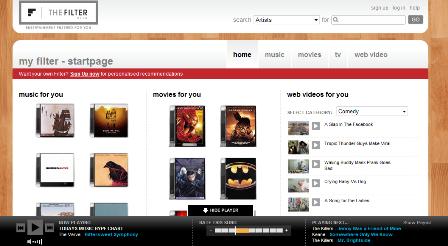
Site review: The Filter

On E-consultancy :

The Filter
, Peter Gabriel's new online music, movies and video recommendation service launched this week. As with Last.fm, it aims to provide users with recommendations based on their preferences and listening habits, but is it as good?

Profiles

Users need to sign up and give some basic information on their tastes before they can get started. In the case of music, you are asked to tick your three favourite music genres from the list. Then you need to rate a number of artists/bands from the music styles you have selected, and repeat the procedure for your favourite movies

This isn't much information to be able to determine your musical preferences, but The Filter does have some other ways to improve this. You can import information on your listening habits from your Last.fm account, and the service will use this to build up your profile. Also, you can download The Filter for Windows. This is an application that tracks what you listen to through Windows Media Player, WinAmp or iTunes, and uses this to improve the accuracy of its recommendations.

Recommendations

The approach to recommending music is interesting, combining the preferences you enter manually, with your listening and purchasing habits. The Filter recommends six albums at a time, and users can click on the album covers and listen to excerpts from a number of tracks on the album before asking you to rate it

If you already own an album you can mark it and it will not be recommended to you again, which is useful, while you can ask for more albums if you don't find one you like. Having used the service for a day or so, the recommendations were pretty relevant, and improved once I had imported my information from Last.fm. Once you have a recommendation you like, you can choose to buy it from Amazon, We7, Nokia, or the iTunes Store. The site uses the same process for rating movies and videos though, since it cannot plugin to iTunes or Last.fm, the recommendations aren't as accurate as with music so far.

Social features

There is a social network element to the site, you can see other users that are listening to the music you like and ask them to be your friend, Once you have done this, you can email people via the site, as well as writing on their wall, Facebook-style.

Conclusion

The Filter is an appealing and easy to use website which provides some very good recommendations, which will surely improve over time once it has had time to learn your tasted via iTunes and Last.fm. The main problem for me is that Last.fm already does much of this while offering more for users. For example, you can only listen to short extracts of tracks on The Filter, via a player at the bottom of the page

The Filter music player

This is useful to get a quick idea of songs, but is no match for Last.fm, which will recommend and play you whole tracks. In addition, once you have set up Last.fm and linked it to iTunes, it makes recommendations and slips songs into your radio without you having to make the effort, whereas with The Filter you need to put more work in to get results.

06 juin 2008

New Ideas New Nominations

Peter Gabriel's Filter Hall Of Fame nominees

Since Genesis, Peter Gabriel has been an innovator and pioneer, utilising the then-clumsy and expensive Fairlight computer on his solo albums; he was one of the first to utilise digital recording, established WOMAD, Real World studios and Real World record label, developed CD ROM technology, (creating the acclaimed Xplora, the world's largest selling music CD-ROM), invested in online advertising-supported free music download site (We7.com), was one of the founders of On Demand Distribution (OD2) one of the first online music download services, as well as numerous humanitarian projects.

Peter's latest venture is the newly launched The Filter. It's been said that the internet needs a good editor, the amount of information available can often be overwhelming, finding what you know is out there can be difficult, but finding relevant material that you don't even know exists can be time-consuming and frustrating. As an avid user of the internet Peter feels the same way, his new enterprise narrows the choices of music and makes suggestions based on your personal music preferences. The user can filter music based on mood and interest and find music unknown or forgotten by them. "The internet, which I think is an amazing creation, provides access to an ocean of limitless information, but without filtering it's easy to drown," Gabriel, 58, told The Press Association. "But if you have this little friend on your shoulder, that can pick out music to listen to and films to look it, it's something I would use provided I could steer it a little." It is a bold experiment that may make music that is seen as too obscure, or fringe, by current search engines more accessible and user-access friendly, which can only be a good thing, especially for the time poor punter.

Former Sudan child soldier Emmanuel Jal raps his message of peace

NEW YORK - After spending his youth mired in harrowing brutality and poverty as a child soldier in Sudan's ethnic conflict, Emmanuel Jal was rescued by aid workers who pushed to give him a new start at life in a different country.

But there were times when he didn't want it.

"When I was in Kenya I hated myself, I even cursed the day I was born. I hated it. I wanted to commit suicide. I went to England, when there was a car coming I would want to stop and the car to hit me," says Jal, a slight, soft-spoken man whose gentle demeanour belies his past. "I was trying to look for death."

Inspiration for a better life would come in an unusual form - the violent, crime-plagued rhymes of rappers in the United States.

"What made me brave is American hip-hop," says Jal in his heavily accented English. "Someone come and say to me, 'They have to rob for them to eat. So I would try and picture, how does America look like because I've never been there. So for me when I look at it and look at my situation - I was a child soldier, we never had food, we raid villages and we take the food and we eat . . . So I said, 'OK, let me testify.' "

Jal's testimony came in the form of his own raps - and now, through his music, he is hoping to heal not only the wounds of his own people but to promote peace while inspiring others.

"I lost my childhood, yes. My country is a war. People are dying now. What could I do with what I have?" asks Jal, who last month released his third international CD, "WARchild," and is the subject of a new documentary of the same name.

"It cause me nothing if I just go and talk about my story, but the impact that will do will be amazing, so let me sacrifice my pride. Because before I used to hide, I didn't even want to be called a Sudanese because of what I see on TV. . . . But I say this country, this is me, this is my responsibility, I have survived, I'm here, let me use it."

Karim Chrobog, the director of the award-winning "War Child" film, says Jal's story shows that "you can really survive horrible, horrible things and come out of them and really make a difference . . . he has put all the bitter things in life aside, his sense of revenge, his sense of the war and how it's affected him personally."

The dreadlocked Jal, who doesn't know his age but believes he is in his twenties, was about seven when the Sudanese civil war, which pitted Muslims against non-Muslims, tore apart his family and led to his life as a child warrior for the Sudanese People's Liberation Army.

His pregnant mother was killed, and his father, a member of the SPLA, allowed his son to be trained as a soldier for the anti-Muslim faction. Bands of children were taught how to use machine guns and put on the front lines as the militia carried out attacks against government loyalists.

One of the more sombre parts of the "War Child" film shows video of Jal as a young boy carrying a weapon, while another features the now-adult Jal talking to school children and solemnly acknowledging that he took part in killings as a child.

Jal and hundreds of other children were forced to fend for themselves. At one point, they were so hungry Jal admits he considered eating the flesh of a dying child comrade. After an attempted escape, he and 150 others were rescued by aid worker Emma McCune and taken to Kenya. McCune adopted Jal, but she died in a car accident a year later. Her friends helped bring Jal to London to start anew.

He managed to finish high school in England, but when he tried to extend his visa to stay for college he was rejected, and sent to Kenya.

"My life crushed, I had no hope. So that's when I started doing music. I was just doing it to encourage myself and have fun," he says.

Jal, who says he is still growing as a rapper, recalls participating in verbal battles in the Sudan before the violence, much like playing the dozens in the United States, though he says he was never any good: "(It's like) maybe telling somebody like, your sister is so skinny that she can shoot through a straw," he says, laughing.

But as he grew older and started writing lyrics, his music struck a chord not only in Kenya, where his song "Gua" (which means peace) became a hit, but internationally. He was invited to perform at 2005's Live Aid concert in London, collaborated with the likes of Peter Gabriel and Moby, and realized that his rhymes were not only therapeutic for himself but others as well.

The lyrics on "WARchild" are not only inspirational and spiritual, but also political. One song talks about Africa being financially raped by the outside world, while "Forced to Sin" talks about his life as a soldier.

And while he was once inspired by American rap, he uses the CD to also criticize some rappers' glorification of violence, sex and crime, most notably on the song "50 Cent," which urges the multiplatinum rapper to stop promoting songs that might encourage black-on-black crime. The chorus: "Now 50 Cent I ain't hating on you, still I think it's my civic duty to warn you, you're being played brother man, you're being played by the man."

"I sometimes ask myself, you say you're a gangster, you deal drugs, you kill people," Jal says of 50 and other rappers of his ilk. "If you're a real killer, it's not fun talking about killing people. It's hard ... participating in killing someone is hard because human life; it doesn't matter who you are, there's no one can say, 'I'm hardcore, I kill people.' Somehow, someday it will burst in you."

"You can't be a gangster until you die," adds Jal. "(50) should do something different, and maybe going back to the community because if we don't do that, if we don't save this generation then it's going to be a genocide, especially on black people."

Jal is trying to help those afflicted by the violence with the Gua Africa foundation, designed to aid war survivors rebuild their lives. With Sudan still in turmoil with the violent Darfur conflict, Jal is trying to solve the problem the best way he can: with his musical contributions.

"For any person who struggle in something, (this is) to show that if you are in this world you are here for a reason, and every person has a purpose," he says. "It took me long time to actually say I believe that I survived for a reason."

On the Net: http://www.emmanueljal.com

from Brandon Sun

Peter Gabriel launches taste-making guide for entertainment

While the internet may be a great place for entertainment, not everyone has the tech savvy - or the patience - to search seemingly infinite websites to discover something new.

But rocker Peter Gabriel thinks he has found a way to help with his site, appropriately titled The Filter.

"The internet, which I think is an amazing creation, provides access to an ocean of limitless information, but without filtering it's easy to drown," Gabriel, 58, said. "But if you have this little friend on your shoulder, that can pick out music to listen to and films to look it, it's something I would use provided I could steer it a little."

The site, which will provide users with daily recommendations, was founded by Gabriel and Martin Hopkins, a huge jazz fan. Hopkins first came up with the notion of filtering content to discover new or forgotten music according to one's individual mood.

Users who visit The Filter will initially be asked to fill out basic information and rate different genres of music and film, and also different acts and movies as well. The filter uses that information to figure out what kind of suggestions to make, and the more a fan uses the site, the more accurate the recommendations, according to the site's developers.

Gabriel recently had soul music and Nick Drake on his own Filter page. He also likes Radiohead and Icelandic band Sigur Ros.

"It's the attraction of being still in touch with interesting and new things without having to make the effort to research them all the time," said Gabriel, laughingly pointing out the "inherent laziness in my nature."

"I'm a tired thumb person, I'm a channel clicker. Maybe it's a male thing. I know there's good stuff I'd love to watch out there but I don't want to search all the time," Gabriel added.

He also doesn't have the time, in general.

The singer has a 6-year-old son and another son on the way with his second wife. He also has two adult daughters.

"I'm very fascist about family time nowadays. I don't work weekends. That's very important," Gabriel said. "Being a dad is still the thing that has given me the most pleasure in life."

Gabriel has also been multitasking projects, from a song for the Pixar-Disney animation movie Wall-E to recording at his expansive Real World Studios a few hours from London. He has also been working on a web site to be called TheMemory.com that he dubs "the first social network for the dead," a way to store memories and remember loved ones.

But he still loves touring, although he says he won't do yearlong tours anymore because of family.

"It's balancing life with any other life. Nothing beats the experience of playing live music with great musicians," Gabriel said.

The Filter is not the former Genesis frontman's first foray into technology. He also founded Real World, a group of companies including a multimedia outlet. In 2000, he co-founded online British music distributor On Demand Distribution (OD2), which sold for millions to a Seattle company in 2004.

Peter Gabriel, Unfiltered

Back in the day, I was a rabid Peter Gabriel fan. Through his Genesis days and his first five solo albums, he ruled; his concerts were a transcendent experience. His music tailed off after that, as did my interest, though his Oscar-nominated collaboration with Randy (I Write A Song For Every Second Movie) Newman on That’ll Do still gives me chills. Look, I’m a big enough fan to absolve him of the responsibility in the creation of the tribute to the paucity of taste in the world that is Phil Collins.

So I was thrilled to get an excuse to write about him in the form of the launch of The Filter, his online project that uses complex algorithms and your input to recommend music, movies and television programs that’ll appeal to your taste.

(Although, I’m sure an interview would have gone badly:

“Peter Gabriel here.”
“Peter Gabriel? You’re really Peter Gabriel?”
“Yes. Mr. Webb, I understand you wanted to learn a little more ab-”
“OMIGOD!!! IT’S PETER GABRIEL!!!”
“Yes. Now, let me tell you a little bit about Bayesian mathe-”
“EVERYBODY!!! PETER GABRIEL’S ON THE PHONE!!!”)

The Filter, as Mr. Gabriel was tring to tell us before he was so rudely interrupted, uses Bayesian mathematics to sort through the tripe and find the stuff you’ll like. According to the Web site, “the engine uses an evidence model (which includes purchase, consumption and browsing data) to derive the similarity of items.” Given an item of interest, it produces a pick-list of that are relevant.

As you rate the recommendations, the engine has more and more information from which to derive its lists, ultimately, in theory, knowing what you’ll like before you even know it exists. Once you’re signed up, you can fine-tune by rating other genres and artists.

All good in theory (even if the theory is a little beyond me). In practice, though …

The sign-up process is quick and painless (although the simulated parquet background on the home page shocked my monkey): Choose three genres of music. You’re then presented with three artists in each genre to rate; a handy preview function lets you have a listen if you’re not familiar. Do the same for movies (or don’t). And you’re away.

The recommendations, on the whole, were spot-on to a degree. I’m a picky eater when it comes to music (no Phil Collins, please; I’m allergic). Many of the CDs recommended were already in my collection. Most of the preview music I heard suited me fine. And over time, one supposes, as I rated more and more tracks, the recommendation would have been even more finely honed. With the optional downloadable program that tracks what you’ve played in iTunes or Windows Media Player, the results should be even more relevant, unless you like listening to music that you don’t, um, like.

But then what? The Filter has no record company deals, so it can’t sell you music online. The previews are 15- to 20-second clips; by the time you’ve heard enough to rate the song, it’s moved on to the next. The streaming quality was iffy (probably high traffic in the wake of the launch) and the sound quality and volume varied wildly (but then again, you have to use the volume control on any stereo when switching from Bill Evans to The Killers). And I can’t abide the privacy implications of the download — though the company promises they don’t do anything else with the information, that’s no promise that a court order couldn’t break.

If it actually functioned as a streaming radio player that tunes itself to your taste, it would be worth the buzz. But as it stands right now, it’s not terribly useful. While it’s a different (and arguably more accurate) engine to play arbiter of your musical taste from the “other-people-who-like-what-you-like-liked-this) model of, say, Yahoo Radio, at least that plays full songs.

Sorry, Mr. Gabriel. I wanted to like it.

But to be fair, it is in beta, and surely more features are coming. Keep it on the radar.