Articles review on the net, revue d'articles sur la toile


Inscription : feeds, flux :
(Atom) Gabriel Real World News

07 décembre 2008

1960s Cambodian rock alive and well in America

By VANESSA FRANKO, The Press-Enterprise, 12-3-08
Few American indie bands are playing 1960s-style Cambodian rock these days. And Dengue Fever is the only one to have a documentary made about it. You can check out both the band and the film tonight at Garrison Theater, Scripps College Performing Arts Center, in Claremont, when Dengue Fever performs and the documentary is screened. The film "Sleepwalking Through the Mekong" follows the band on a tour to Cambodia.

Dengue Fever has been climbing the buzzmeter with shows across the U.S. and a recent tour of Europe. The band was signed by Peter Gabriel's Real World Records to release its newest album, "Venus On Earth," outside the U.S. and Canada.

"I thought when the band was starting, I was optimistic locally -- like in Los Angeles and the music scene there. I knew it'd be a lot of fun to play this style at the local clubs where my brother and I live in Echo Park and Silver Lake. ... I knew it would go over well there," keyboardist Ethan Holtzman said. "I didn't know it was going to become our careers."

He and brother Zac Holtzman, who plays guitar, started the band in 2001 after discovering their mutual interest in Cambodian music from the 1960s.

Ethan traveled throughout Southeast Asia about 10 years ago and got into Cambodian pop music and bought cassettes. Around the same time, Zac was living in San Francisco, working at a record store where a colleague turned him onto the music. The brothers were staying together in Los Angeles and Ethan heard some of the music in Zac's collection.

"That's crazy -- I know that stuff," Ethan remembered thinking.

They decided it would be fun to play the music, which has psychedelic rock tones blended with traditional Cambodian music and sometimes lyrics, and formed the band. Saxophone player David Ralicke, drummer Paul Smith and bassist Senon Williams joined and they looked for a Cambodian singer, finding Chhom Nimol singing karaoke in Long Beach.

Nimol, who is from Cambodia, was known around the country and had performed for the king and queen.

Nimol's homecoming is documented in "Sleepwalking Through the Mekong," directed by John Pirozzi, which follows the band on their tour of Cambodia. It was filmed over 10 days in 2005. Tonight, Pirozzi will be on hand for a Q&A after the film.

"We'll remember it for the rest of our lives," Ethan said of the tour.

Some people knew the band before they toured Cambodia. Other recognized them from a television program and spoke to them as they traveled the country. Shows were packed, including one at a bar on a swamp. The owner was afraid would fall into the water.

"It went down in Cambodian history," Ethan said.

Kyte - Two Sparks, Two Stars EP (Kids)

by Sam Shepherd, www.musicomh.com

UK release date: 1 December 2008

Kyte - Two Sparks, Two Stars EP (Kids)


If there is any justice in this world, then by this time next year Kyte will be flying high, and will be the band that is on everyone's lips.

Having impressed greatly on the live circuit, not least with their stunning support sets with iLikeTrains earlier in the year, it's great to see that Kyte have returned with a simply stunning EP.

If their debut single on Sonic Cathedral promised much and their self titled mini album hinted at greatness, then this EP represents a further step towards becoming recognised as one of the UK's most exciting new bands.

There are of course different kinds of exciting, and if it's jumping about in a mosh pit you're after then stop reading now. If on the other hand you enjoy having your heartstrings plucked by vast soundscapes, gentle vocals and soaring melodies, then Kyte have a treat in store for you.

There's no getting away from the fact that they sound a little bit like Sigur Ros here and there, particularly on the opening track Eyes Lose Their Fire. A slow build of guitar noise builds into a chiming epic, given a warm edge by the vocals of Nick Moon. If your eyes lose their fire by the end of the track it's because they're welling with tears.

Bridges in The Sky is a more electronic take on Kyte's sound, which is far from surprising given the banks of keyboards they hunch over in a live setting. It does set them apart from that particular Icelandic benchmark though hinting more at a Krautrock approach.

Ordinarily cover versions are a bad idea, but with their take on Peter Gabriel's Solsbury Hill Kyte pull off something quite spectacular. Tender, heartbreaking, and utterly compelling from first bar to last, Gabriel's tale of his departure from Genesis finds a safe place to call home in Kyte's re-interpretation.

They wrap things up with the suitable indulgent, but equally fabulous Lights Outside Here which blends their post-rock approach with looped drum beats and showcases both sides of Kyte's raison d'être perfectly.

For a band to suddenly break all it takes is a spark, Kyte have two, and they should be on the way to the stars.

Yeasayer's music bridges cultural gaps

Andrew Leahey, washingtontimes.com, Friday, November 28, 2008

RIFFS: Globe-trotting pop

Yeasayer's music bridges cultural gaps

In the 1980s, songwriting veterans like Peter Gabriel and David Byrne began augmenting their craft with elements of world music. Sounds were borrowed from indigenous cultures and molded into something palatable to Western pop audiences, eventually giving rise to a genre known as "worldbeat." Championed by everyone from Paul Simon to Mickey Hart, worldbeat promoted a multicultural perspective while fueling some of the decade's biggest hits.

The worldbeat label is rarely applied to emerging bands these days, and the four members of Yeasayer do not list Mr. Gabriel as a chief influence. Nevertheless, Yeasayer's genre-bending music is similarly global in scope, from its use of Middle Eastern scales to the prevalence of tribal percussion. What differentiates Yeasayer from its worldbeat ancestors, however, is the band's use of contemporary tools, including computer gadgetry and looped keyboard patterns. Blended with organic instrumentation and pop-oriented songwriting, the band makes a delightful racket that owes as much to Cape Town as to metropolitan New York.

"People think we're 'freak folk' or something like Crosby, Stills, Nash and Young, which is totally not what we are," says frontman Chris Keating. "It's funny to see the varying degrees in which people interpret your music. I welcome it."

Yeasayer's roots date to Mr. Keating's childhood, when he performed in theater productions and school choirs with classmate Anand Wilder. After internalizing the importance of vocal harmony, the two launched an indie-rock band in high school. Attending different colleges split them apart for several years, but an eventual reunion in New York City found the musicians crafting a new style of music.

With bassist Ira Wolf Tuton and percussionist Luke Fasano rounding out the lineup, Yeasayer began melding barbershop harmonies with pop melodies and experimental sounds. Sitars found their way into the mix. Hand-claps and bongos augmented the standard drum kit. Synthesizers situated the songs in a modern context, while chants and clannish vocals conveyed a neo-tribal aura.

"Brooklyn almost feels like Seattle in 1992," says Mr. Keating of his band's current home. "It's like all the pathetic dredges from the major labels are wanting to sign bands that are coming out of Brooklyn."

Yeasayer did get signed, but not to a major label's roster. Rather, the musicians joined forces with Jason Foster, co-founder of Baltimore-based Monitor Records. Impressed with Yeasayer's homemade recordings, the label executive formed a new company to handle his newest clients.

"We had absolutely no money to do our debut album, but I was fine with that," Mr. Keating remembers. "Jason had a very good take on the industry and decided to start his own label over the course of the year. He's remarkable in the way he handles things."

"All Hour Cymbals," Yeasayer's debut album of globetrotting pop/rock, was issued in late 2007. Songs like "2080" and "Sunrise" had already enjoyed a healthy Internet buzz before the album's release, and Mr. Foster promoted the album in unique ways, eschewing traditional advertising in favor of a grass-roots approach.

Audio Clip

"Sunrise," Yeasayer

"After you witness this collapse of the major label system, it opens up more opportunities for the small businessman," says Mr. Keating. "It enables you to finagle more deals. We were able to get to Europe seven times this year; previously, all of that would've been impossible on such a tiny label."

It's been a long 12 months for Yeasayer, whose upcoming shows will mark the band's final tour for several months. After that, it'll be time to work on a new record.
"We're going to rent a house in upstate New York or Connecticut, and we're going to build a temporary recording studio there," Mr. Keating says excitedly.

Not too late to help Amnesty

By KAREN BLISS -- For JAM! Music, November 27, 2008

Amnesty International Canada's Small Places campaign has seen dozens of Canadian musicians banding around the cause since its September 10 launch, and it's not too late to participate.

The global campaign ends December 10, which marks International Human Rights Day and the 60th anniversary of the Universal Declaration of Human Rights.

"The ask at this time is to hold a Small Places designated concert between now and December 10 in support of Amnesty," says Ottawa-based Tatiana Nemchin, Amnesty's musician liaison. "We're trying to have as many events between now and then and to raise much needed funds. Amnesty is funded entirely by donations and membership. We receive no government funding and so this campaign is a crucial time for raising awareness and funds, and for recruiting and engaging more human rights activists. It's sort of a passing of the torch from Peter Gabriel and the Edge to a younger generation of musician activists and to increase membership and involvement."

Amnesty is a worldwide movement of close to 2 million people who help protect individuals and communities around the world whose human rights have been violated. Small Places is named after a passage in Eleanor Roosevelt's 1958 speech in which she spoke about human rights as beginning in "small places close to home." Amnesty International invited all musicians to raise their voices for human rights and stage benefit and awareness concerts around the world.

On the international front, Nemchin says REM, Michael Franti, Joan Baez, and many more have participated in Small Places. Here in Canada, she rattles of a huge list of artists from every genre, who designated a tour or a show to the cause, have chosen a particular Amnesty case to champion, auctioned tickets, started blogs, and other creative things.

Broken Social Scene donated the song "Major Label Debut" for the soundtrack to Small Places PSAs. Jason Collett had tabling at his shows and is drawing awareness to the case of Toronto's Omar Khadr imprisoned in Guantanamo Bay; Alanis Morissette had tabling at her shows; Six Shooter Records donated tickets for shows by Martin Tielli with Jenn Grant, Christine Fellows, Shout Out Out Out Out with Stereo Image, and Hawksley Workman; and Wintersleep gathered petition signatures for WOZA & Kimy Pernia.

David Usher had tabling on his six-week tour and chose to get behind the case of U Gambira. Stars will be tabling at several upcoming shows including Montreal, Ottawa and Toronto. Holy F*ck tabled and provided petitions in support of Kimy Pernia, U Gambira, Hu Jia, and Omar Khadr. Wide Mouth Mason has links and a blog on its web site; Eve Goldberg is playing in support of U Gambira and is donating proceeds from her song "Streets of Burma" and Kim Barlow performed an awareness concert.

There is also great support for Alberta's Lubicon Cree, whose rights have been violated by the Canadian government (article 27 from the International Covenant on Civil and Political Rights) according to the United Nations Commission on Human Rights. Lynn Miles, The Surgents, Kinnie Starr, and Chin Injeti are all raising awareness for the Lubicon Cree through fundraising, petitions, PSA and other awareness strategies.

"And some exciting news," Nemchin adds. "Friends of the Lubicon has been asked by Neil Young's management whether they could organize tabling at his upcoming concerts in Canada. Friends of the Lubicon has asked, in turn, if Amnesty could arrange this and of course we are. This is a very crucial time for the Lubicon and having Neil Young's support will no doubt raise awareness of the human rights violations taking place and hopefully garner hundreds, maybe thousands of petition signatures to help this campaign."

Go to www.smallplaces.ca for more information on the campaign, the causes, how to sign up or get involved.

The new wave of cross-culture

Written by Jody Prewett, Sevenglobal,Thursday, 27 November


Not so long ago, the very utterance of the term “world music” to the proverbial indie kid or NME reader would be greeted with an onslaught of chortling and sneering. Rather like the new age genre, we’ve come to associate it with saccharine compilation albums called Sacred Spirit or the earthy ethnic hymns of Enya. The genre itself is something of a misnomer; all music should fall under the banner of world music. I’d like to think that music is a universal language that transcends cultural boundaries; surely it is a language that speaks to everyone alike?

However, it has been some time since modern pop really embraced the music of multiple cultures. Not since Peter Gabriel’s flirtations with African percussion or Paul Simon’s epochal Graceland have we been exposed to a true mingling of musical cultures. Recently, though, the tide seems to be turning with a clutch of new guitar bands being directly influenced by the music of Africa.

In recent times, indie has remained stationary and landlocked inside its own hemisphere. In the last year, there has been a new wave of bands far more at ease with the idea of world music, looking towards the primal rhythms of Africa for inspiration. This latest incarnation of guitar music has as much in common with Fela Kuti as it does with The Beatles; there is a sense of cultural crossover in pop that hasn’t been heard since The Clash collided head on with reggae.

For those unfamiliar with the genre, Afrobeat is a style that became popular in Africa during the Seventies and was spearheaded by Kuti. The music is a celebratory melting pot of African folk, funk and jazz with political undercurrents; Kuti, in particular, was compelled to react to the unsteady political climate of most African countries during the Sixties through his music. For Kuti, music is an impetus for social change, both a celebration of African folk traditions and a desire for human unity. The rich combination of primitive folk with modern electric sounds certainly seems to reflect this.

Two of the hottest new bands currently coming from the States are Brooklyn’s Yeasayer and Vampire Weekend. Both can be loosely referred to as guitar bands, but something sets them apart: they have a desire to go beyond simply being referred to as alternative rock. The debut album from Yeasayer, All Hour Symbols, is characterised by an emphasis on percussiveness combined with a sense of struggle and protest in the lyrics that echoes the great Kuti. On “2080” they sing, “I can’t sleep when I think about the future I’ve been born into” over a wash of guitar scales reminiscent of Thomas Mapfumo. This sounds unusually spiritual for a white guitar band, the kind of statement you would normally associate with the struggle against injustice of Africans during the Sixties. Perhaps this desire for universality and multi-culture in the music is symptomatic of the times we are in and represents a yearning for change in a separatist America and divided international community.

It is important to note that, on the surface, Vampire Weekend is a guitar band in the mould of Arctic Monkeys. But listen closer and there is something decidedly African in the spangling sun-soaked guitars and danceable rhythms. Both of these bands are injecting a sense of colour into the traditionally white indie alternative arena, seduced by the exoticism and splendour of the music of Africa.

Also from New York is Antibalas, an Afrobeat orchestra whose brass section forms an integral part of Foals’ Antidotes. As an album, it bypasses traditional song craft in favour of a reliance on infectious polyrhythms and repetition. The guitars, in particular, are peculiarly alien to ears trained to the established conventions of alternative music. Their two guitarists play cyclic staccato riffs, recalling the playing style of many Senegalese guitarists. In their music, you can hear the same carnivalesque sense of energy and repetition that is prevalent in African music. The Oxford-based band is regarded as one of the most progressive bands of the moment and is a front-runner in British music right now. Yet they hardly fit the stereotype of British guitar bands we’ve grown accustomed to. While the likes of The Enemy and Kaiser Chiefs are synonymous with the North of England, Foals sound like a truly international group.

It seems as though our audiences are becoming more open and accepting of more unfamiliar sounds. This wouldn’t seem so relevant if it were some underground phenomenon, but this bringing together of styles is taking place well within the radar of the mainstream press. It promises the kind of step forward that has previously been stunted by the regressive Britpop boom and the consciously retro “New Rock Revolution”.

In the 1980s, Talking Heads were heavily influenced by Afrobeat and very reactionary to the grit and grime of punk rock. Their sound was built on a funk groove that celebrated the concept of a large group of musicians singing and dancing in a kind of musical celebration of unity. In many ways, Talking Heads embody the idea of diversity and seem driven to distance themselves from the mono-culture of hard rock and punk of the 1970s. At the same time in Britain, The Clash played a politicised amalgamation of punk and reggae while The Specials were at the front of the ska movement. The current resurgence seems to mirror what happened during the Eighties in the borrowing of sounds from beyond the realms of recognised pop culture.

In dance music, Afrobeat is also thriving, with DJs Giles Peterson and Laurent Garnier regularly mixing Kuti or Ethiopia’s Mulata Astatke into their sets. Certainly, African music lends itself more directly to the dance floor, yet it is hugely symbolic that audiences are embracing Afrobeat to such an extent that it is beginning to influence our own popular music. It doesn’t seem to be a conscious source of influence either, more a subconscious gradual change in how people are approaching music-making.

Looking back to the 1990s and the turn of the millennium, pop culture seems to have its own distinct regional identity. From Britpop to grunge through to nu-metal and nu-rave, the mainstream has had a traditionally Anglo-American soundtrack and pop music hasn’t really made any great leaps across cultural boundaries. The renewed sense of openness displayed by the likes of Vampire Weekend and Yeasayer is an indication that universal divisions in the music world are narrowing once more. Perhaps today’s bands are tiring of the same reference points or are simply fed up with being conveniently categorized and thrown into a whirlpool of multiple genres and sub-genres. The timing is almost perfect. In the wake of Barack Obama’s vote of confidence from America, could this be the opening to a new dawn of truly multicultural music?

Peter Gabriel on download project We7: "Throw it at the wall and see what sticks"


Photograph: Felix Clay

John Plunket, guardian.co.uk, Tuesday November 25 2008

Peter Gabriel: 'Twenty years ago, the thought of encouraging advertising with music would be like offering your daughter to the devil.'

It is emblematic of the challenges facing the music industry today that Peter Gabriel earned more money from a compilation CD given away free with the Mail on Sunday than he did from the sales of his last record, the million-selling Up.

"It was given away to charity," said Gabriel of the proceeds from last year's Mail on Sunday giveaway. His pained expression suggests he is not a regular reader of Peter Wright's paper. "No, I won't make a comment about the newspaper involved."

It was also the Mail on Sunday that infuriated the beleaguered record industry - but wowed marketers - by giving away nearly 3m copies of the latest Prince album, Planet Earth. Did it worry Gabriel? "No, I think everyone should try all sorts of stuff. Throw it against the wall and see what sticks."

The former Genesis singer has thrown a portion of his own fortune into a new online venture that will also give content away for free.

We7, which launched earlier this month, positions itself as an "easier and better alternative to piracy", is an advertising-funded service that allows users to download songs for free. The catch is that each song has an advert tagged to the front of it.

Ads are both the bane of commercial radio and its lifeline, with listeners preferring the clutter free BBC. So how will users cope with the prospect of ads interrupting their iPod?

"It's a big hurdle," admitted Gabriel. "Twenty years ago, the thought of encouraging advertising with music would be like offering your daughter to the devil, but I think the reality is that people have got used to free music, and this is one of the few ways that musicians can still earn in a free music environment."

Technology has moved on in the 22 years since novelty "cyberpunk" band Sigue Sigue Sputnik put ads for L'Oreal and i-D magazine in the gaps between tracks on their album, Flaunt It!.

We7 will offer targeted ads based on information volunteered by its users, with an average of two minutes of ads per hour of music.

Around half of We7's 2 million songs are available for free download. The other half - the ones licensed by the four major record labels - have to be paid for. But users can stream all the songs for free - again, with ads attached. "People hate ads but they love free better," said the We7 chief executive, Steve Purdham.

Gabriel has long pioneered new digital music technology, from the Eve and Xplora interactive CD-roms in the 1990s - hilariously clunky-looking today but ground-breaking at the time - to OD2, one of the first online music download services which he co-founded with Charles Grimsdale, who is also a backer of We7.

However, his enthusiasm for all things digital - not to mention the Womad music festival, his Real World studio and record label and the Elders, the group of 12 statesmen and women that Gabriel convened to help deal with global problems - means there is little time left for his own recording career.

Gabriel's next record has been funded by Patrick McKenna, the chairman of the Ingenious Media Group and Gabriel's former financial adviser. But he may have to wait a while to see a return. Next year, perhaps? "Hopefully there's something," smiles Gabriel. "But who knows?"

He is an investor, not an inventor, he pointed out, unlike his father. "My dad was an inventor, an electrical engineer, so I'm attracted to it and I am fortunate enough to work with some very smart people," said Gabriel.
"I watched my dad trying to sell something called dial-a-programme for about 10 years, a cable-based, entertainment on-demand electronic democracy home shopping [service]. But it was 1971 and he got nowhere. He was stuck with one English company who didn't think people would ever pay for television." How times change.


The Big Question: Who are the Elders, and can they do anything to resolve world crises?


Elders Kofi Annan, Jimmy Carter and Graca Michel discuss their ban from Zimbabwe at a press conference on Saturday

By Archie Bland, the Independent, Tuesday, 25 November 2008


Why are we asking this now?

The political and humanitarian crisis in Zimbabwe has dropped off the news agenda in recent months, as events there have stagnated and reverted to the deeply depressing status quo. In an attempt to change that, a group of influential world leaders who have now left their public offices arranged a visit.

The group – known as the Global Elders – had intended to draw attention to food shortages and a cholera outbreak. But on Saturday, just when the visit was supposed to begin, the delegation issued a statement saying that it had been barred from Zimbabwe by the Mugabe regime, which refused to issue them visas. That snub has led to questions about the nature of their influence in world affairs – and what good, if any, they can do.

Who are the Elders?

The Elders are a kind of political dream team, a dozen of the most widely respected world leaders alive today, whose glittering CVs and unimpeachable commitment to human rights are supposed to open doors that would remain closed to less feted figures. Their figurehead is secular saint Nelson Mandela; the group also includes Jimmy Carter, Kofi Annan, Archbishop Desmond Tutu, former Irish president and UN Commissioner for Human Rights Mary Robinson, and, in absentia, Burmese democracy activist Aung Sun Suu Kyi. The group may well have the highest concentration of Nobel prize-winners in the world, with five of its 12 members recipients of the honour.

What are they for?

The idea is that they can exert influence and bring attention to humanitarian crises that might otherwise go unnoticed or unsolved. Between the 12 of them, they command access to an unrivalled network of leaders that, in theory, means that they can make a difference in contexts where other means like governmental interventions might have failed.

The whole group meets twice a year, and smaller delegations travel to crisis-ridden areas in the hope of finding solutions. Jimmy Carter argues that the group can "fill an existing void in the world community." "Almost impervious to the consequences of outside criticism," he says, they have "opportunities for unrestrained analysis of important and complex issues, the evolution of suggestions, and for sharing our ideas with the general public and with others who might take action to resolve problems."

How did the Elders come together?

By the good offices of supreme entrepreneur Richard Branson and music pioneer Peter Gabriel. In 1999, the two men had a conversation about the potential benefit of an organisation that followed the "village elders" model of influence, whereby the wisdom of the most senior members of a community carries great weight.

Branson, who had got to know Mandela, broached the idea to him in 2001; and the group formally launched in April last year, with $18m in initial funding that Branson and Gabriel helped to raise. Since then they have worked in Cyprus, Sudan, Kenya, and the Middle East.

Can the model work?

The jury is still out: the group, unlike its members, is very young. It is hard to draw firm conclusions when the Elders' work is always bound to be most effective in the margins, in ways that may not always be obvious to the external observer. "I think their influence could be limited," says Josephine Osikena, Democracy and Development programme manager at the Foreign Policy Centre. "But because they're international elder statespeople, there is some kind of effect. Perhaps they can intervene and discuss in ways that the UK government, for example, can't, because it would be seen as antagonistic."

What evidence of their effectiveness is there?

The relative success of the group's mission to Kenya might be seen as an example of how they can function effectively. The arrival of Kofi Annan et al in January this year was by no means a panacea after violent clashes followed the last election there, and the group could not offer any incentives beyond the weight of their names and experience to the negotiating parties. But, says Sally Healy, Associate Fellow of the Africa Programme at Chatham House, their sheer presence had a calming effect. "They helped to 'freeze' the situation," she says, "and they created a sense that stuff was happening, and so you didn't have to go and fight today."

Their influence, adds Healy, can be particularly powerful in Africa, where government is much more reliant on personal relationships than the kind of systematic approach more prevalent in the West, and where the village elders model is culturally significant. "Someone we might regard as an old has-been might be seen in a different context in Kenya or Zimbabwe," she says. "It's partly to do with tradition, and it's partly weak institutions."

And can they have a negative impact?

Possibly. Many are sceptical of what one newspaper editorial said might be referred to as a "makework scheme for ex-leaders who cannot let go". In Israel, some saw their role as a distraction: "This is not a conflict where people lack heroic leadership," said Robert Satloff, executive director of the Washington Institute for Near East Policy. "These are not issues that tend to lend themselves to whatever these otherwise distinguished stastesmen can contribute."

Earlier this year the Israeli government turned down an offer to mediate a ceasefire with Hamas, with the country's UN ambassador Dan Gillerman saying that "nothing good could come out of this initiative". And, according to Sally Healy, "it would be very foolish to put your eggs in the old boys' mediating network basket without the hard-edged government diplomacy as well."

What happened in Zimbabwe?

Zanu-PF seems to have made a calculation that the negative PR that will result from denying the Elders' access will be less damaging to the regime than letting them in to observe and condemn the government's failure to help people who are starving to death. Mugabe has attempted to cast the group as Western stooges lacking the moral authority to cast judgement in Zimbabwe. (The Zimbabwean government also says that they are only postponing the trip, and that it will take place at a later date, though few believe it.) The Elders' argument that they are not coming to Zimbabwe with a political purpose but a humanitarian one has fallen on stony ground – particularly in the light of previous condemnation of the Mugabe regime by Desmond Tutu, among others.

So can the Elders still have an influence there?

Paradoxically, it may be that Mugabe's decision will actually increase their long-term influence. It confers a sense that the group are capable of meaningful action – why ban anyone whose words would have no consequences? – and raises the profile of the situation in Zimbabwe in a way that might otherwise have been impossible.

The Elders are continuing to work in neighbouring South Africa, and their statements in the aftermath of their ban have emphasised the non-partisan, humanitarian good that they seek to do." "We need no red-carpet treatment from the government of Zimbabwe," said Mr Annan. "We seek no permission other than permission to help the poor and the desperate."

Can the Elders succeed in changing things for the better?

Yes...

*Their connections are remarkable. They can probably get any politician in the world on the phone

*There's nothing like Nelson Mandela making his feelings known about an issue to turn the spotlight on it

*Their separation from governments allows them to pursue what they believe is right

No...

*Past ties to institutions like the UN means they can be dismissed as agents of Western influence

*The temporary blast of publicity they can bring doesn't necessarily lead to tangible results

*The levers available to national governments – like trade sanctions – are far more influential in the end

06 décembre 2008

60ème anniversaire de la Déclaration universelle des droits de l’Homme

Presidence de la République française, Publié le 05-12-08 à 18:26

A l’occasion du 60ème anniversaire de la Déclaration universelle des droits de l’Homme, le Président de la République prononcera un discours lundi 8 décembre 2008 à 12h30 au Palais de l’Élysée.

Le Chef de l’Etat a souhaité associer à cette célébration le groupe des "Elders". Lancé par Nelson MANDELA lors de son 89ème anniversaire en 2007 à l’initiative de Richard BRANSON et Peter GABRIEL, le groupe des "Elders" réunit douze personnalités d’influence qui contribuent à la réflexion sur les grands défis mondiaux.

Avant de prononcer son discours, il s’entretiendra avec sept d’entre eux : Jimmy CARTER, Kofi ANNAN, Mary ROBINSON, Gro BRUNDTLAND, Fernando Henrique CARDOSO, Ela BHATT et Lakhdar BRAHIMI ainsi que ses fondateurs, Richard BRANSON et Peter GABRIEL.

Peter Gabriel et We7

Alain Brunet, Chroniqueur à La Presse, Le Mercredi 26 Novembre 2008

Selon The Guardian, Peter Gabriel a investi une grosse somme sur le site de téléchargement légal We7. Mis en ligne récemment, cette plate-forme se veut «une alternative au piratage».

On peut y télécharger gratuitement des chansons… auxquelles on a collé une pub. Cela compte pour la moitié du répertoire de We7, on doit quand même payer pour les chansons sans pub.

Pour plusieurs observateurs, la voie des revenus publicitaires serait le dernier retranchement de la vente directe de musique en ligne. Rien, jusqu’à maintenant, n’a démontré aux créateurs la viabilité du modèle fondé sur des revenus publicitaires. Si ça ne fonctionne pas à moyen terme (ce que je crois personnellement), on devra se tourner vers d’autres solutions pour rétribuer équitablement ceux qui composent, écrivent et chantent - et je ne parle surtout pas des plus gros, une infime minorité au sein de la communauté artistique.

« C’est un véritable obstacle», a concédé Gabriel au journaliste du Guardian qui s’interrogeait sur l’accueil des fans de chansons gratuites téléchargées avec de la pub imposée - comme à la FM commerciale.

«Il y a 20 ans, l’idée de soutenir la publicité avec de la musique originale revenait à offrir sa fille au diable », ajoute le fameux chanteur britannique.

Nous sommes en 2008, 20 ans plus tard… Et l’on n’arrive toujours pas à rétribuer la création musicale avec la vente en ligne. Ce modèle fondé sur la pub a-t-il un avenir ?

Essayez We7 et livrez vos commentaires.

30 novembre 2008

LOREENA MCKENNITT Pour réchauffer l'hiver

Philippe Meilleur, Le Journal de Montréal, 23-11-2008


On connaissait déjà le Winter Garden, ce mini-album de cinq pièces hivernales lancé il y a une douzaine d’années par l’ambassadrice de la musique celtique Loreena McKennitt. Voici que la reine de la harpe en propose une version allongée, question de mettre un peu de chaleur dans la saison morte qui approche.

McKennitt se souvient très clairement de l’émerveillement qui l’a envahie quand elle s’est mise à la création de A Winter Garden: Five Songs for the Season, en 1995.

«Nous étions en studio, mes musiciens et moi, et nous voulions explorer différentes sonorités et instruments, nous raconte-t-elle au bout du fil. Je voulais identifier certaines chansons traditionnelles, celles que nous avons finalement enregistrées sur le disque. Au départ, il n’y en avait que deux ou trois, mais nous avons décidé de prolonger un peu notre travail pour faire de notre recherche un mini-album. Les pièces étaient si belles que ça en valait la peine.»

Les choses seraient restées ainsi n’eût été l’insistance des amateurs, qui, au fil des années, ont souvent demandé d’avoir une version allongée du mini-album. «Les gens en voulaient davantage», dit Loreena McKennitt.

CONNECTÉE À LA NATURE

Profitant d’un récent passage en Europe, où elle était en tournée avec ses musiciens habituels, l’artiste s’est replongée dans ses études pour enfin mener à terme ce projet amorcé plus d’une décennie plus tôt.

«C’était une décision plutôt pragmatique, j’en conviens. Je voulais maximiser ma présence et celle de mes musiciens en Europe. En plus, nous n’avions besoin que de quatre ou cinq jours pour compléter le travail et faire un nouvel album.»

La chanteuse s’est donc remise à la lecture de l’Oxford Book of Carols, une anthologie qui recense les cantiques traditionnels.

«Je voulais cerner le contexte d’écriture de ces cantiques pour m’inspirer, dit-elle. Étant créées pour le temps des fêtes, ces chansons sont naturellement liées à l’hiver ou à la fin de l’automne. Le lien avec Winter Garden est venu de lui-même.»

Au bout du processus, huit nouvelles chansons se sont ajoutées aux cinq anciennes pour devenir A Midwinter Night’s Dream.

Toutes ont été enregistrées au studio Real World, qui appartient au rockeur Peter Gabriel. Situé dans un tout petit village du sud de l’Angleterre, l’endroit profite de la tranquillité et d’un lien privilégié avec la nature.

«Cela fait presque quinze ans que j’enregistre tout mon matériel là-bas, dit McKennitt. Il est hors de la ville, donc loin de toutes les distractions. Ça permet à mon équipe et à moi de nous concentrer uniquement sur la musique, d’autant plus qu’on y rencontre de nombreux autres artistes. Nous enregistrons dans une grande pièce dont la fenêtre donne sur un boisé. Vous ne pouvez pas savoir à quel point cela est inspirant et facile de travailler ainsi! Nous sommes connectés à l’énergie naturelle du moment, que l’on soit tôt le matin ou tard l’après-midi. C’est le genre de détail très important pour moi.»

Annan, Machel, Carter denied entry into Zimbabwe

allAfrica.com, Sat, 22 Nov 2008

President Robert Mugabe has barred the former United Nations Secretary-General, Kofi Annan, the former United States President, Jimmy Carter, and the advocate for the rights of women and children, Graça Machel, from entering Zimbabwe.

The three were due to arrive in Zimbabwe on Saturday to assess the country's growing humanitarian crisis. Millions of Zimbabweans are facing food shortages, the country's educational and health systems are grinding to a halt and there have been outbreaks of cholera.

But news agencies reported that the group had been denied travel visas. The organizers of the visit, the group of former leaders calling themselves "The Elders," said in a statement on Saturday that "the government of Zimbabwe has refused to cooperate in any way to make the visit possible."

Delegations of "Elders" from the group, including Carter and Archbishop Desmond Tutu of South Africa, have in the past visited other areas of conflict, including Darfur, with the co-operation of the governments concerned.

Annan said in Saturday's statement that he had prepared for the visit by speaking to "many regional leaders" in southern Africa, who welcomed the proposed visit.

"Millions of people are in need of help in Zimbabwe," Annan said in the statement. "We want to use our influence to increase the flow of assistance, immediately and in the longer term, to stop the terrible suffering. We are here to show solidarity with the people of Zimbabwe and to assure them that they are not alone."

Machel - also the wife of Nelson Mandela and the widow of former Mozambican president and Mugabe ally Samora Machel - said the Zimbabwean government's ban on the visit was "deeply regrettable."

"People are dying from hunger every day... and hospitals are unable to treat the sick. With schools struggling to stay open, children are missing out on an education. One in four children has lost one or both parents... We want to talk to the people and hear their stories directly"

The delegation is already in South Africa. Carter said the group would remain in the region to learn as much as it could about the situation in Zimbabwe. The Elders was formed in response to an initiative by British businessman Richard Branson and musician Peter Gabriel.

29 novembre 2008

Legendary Drummers Kits And Grooves

Sonic Reality Announces the Release of Drum Masters Silver, Gold & Platinum Editions

19-Nov-08

Sonic Reality, the sound development company that co-created the Ocean Way Drums and Miroslav Philharmonik has announced the release of the Studio ProFiles "Drum Masters" Silver, Gold and Platinum Editions featuring legendary drummer's kits and grooves.

Here's all the details in their own words....

For the first time, multi-track drum kits and multi-track Rex 2 grooves are playable from one virtual instrument plug-in for creating the most realistic drum tracks ever. Bundled with Sonic Reality's new Infinite Player powered by Native Instruments Kontakt, the Drum Masters range of products offers the authentic sound of legendary session drummers recorded in some of the best studios in the world.
Drum Masters Silver Edition

Featuring legendary drummer's drum kits and grooves in 24 bit Stereo Rex 2 format mapped in beat mode across the keyboard and as playable kits in the supplied "Infinite Player" plug-in. It includes sample material from Bill Bruford (Yes, King Crimson), Steve Gadd (Paul Simon, Steely Dan), Danny Gottlieb (Pat Metheny Group), Jerry Marotta (Peter Gabriel), John Blackwell (Prince, Diddy), Nick D'Virgilio (Genesis, TFF, Spock's Beard), Bun E. Carlos (Cheap Trick) and Ed Greene (Barry White, Steely Dan).

Users will be able to continually expand their bundled Infinite Player with additional stereo and multi-track drum kits, and grooves.

Drum Masters Gold Edition

The Drum Masters Gold Editon includes everything from the Silver Edition plus a variety of multi-track drum kits and grooves.. From the powerful 3 snare Yamaha kit of Jerry Marotta with world pop rhythms in the style of Peter Gabriel to the R&B pop sound of John Blackwell to the classic funk rock sound of Ed Greene to progressive rock drumming with Nick D'Virgilio and modern jazz with master cymbalist Danny Gottlieb, the Gold Edition offers a wide variety of killer drum sounds for every need. With 150 multi-track grooves from each drummer and the associated drum kit from the session you can build a drum track with seamless transitions between the midi playable kit and the original audio grooves all while having full discrete mix control of the mic channels in both. Stick, brush, blastick/hot rods and mallet played kits are also included.

Drum Masters Platinum Edition

The Drum Masters Platinum Edition includes everything from the Silver and Gold Editions plus additional multi-track and stereo grooves and more stellar sounding studio drum kits with discrete control of the mics. Special additions include samples of a 6-tom Gretsch® kit in a large room modeled after the famous Town House studio in London as well as a vintage Premier kit with the addition of Roto Toms and Timbales as toms similar to those played by drummers Bill Bruford, Phil Collins, Nick Mason, Neil Peart and other great drummers. Includes extra drum sampling sessions done with the help of the "Drum Doctor" Ross Garfield and recorded at the esoteric Lawnmower Studio in Pasadena where Nick D'Virgiilio and Dave Kerzner of Sonic Reality used to record with Kevin Gilbert.

The Platinum Edition includes over 2,000 multi-track drum grooves plus additional midi grooves will be made available for all three versions.

Notes:

* *Stereo Kits : Multi velocity stereo drum kits sampled at the same session as the loops. These kits have been mixed in stereo for use with the matching grooves and have been mapped in both GM and IMAP formats.

* **Multitrack Kits : These multi velocity multi-track drum kits have entirely discrete mix control. They were recorded along side the grooves for seamless integration and can be played in both GM and IMAP formats.

* **Stereo Grooves : Artist grooves menu mapped in Kontakt for easy use. These grooves are Rex2 format and adjust to your host tempo. Use these grooves with the matching drum kit for the ultimate drum sequencing experience.

* **Multitrack Grooves : Multi-track drum grooves in Rex2 format. These grooves are menu mapped for easy use with your midi controller. They are the same grooves as the Stereo version but with fully discrete mix control between microphones. (HH, BD, SD,Toms, Percussion, etc...)

Pricing and Availability:
Availablilty: November 2008
Drum Masters Silver Edition MSRP $299.
Drum Masters Gold Edition MSRP $499. (or "Kits Only" for $399)
Drum Masters Platinum Edition MSRP $995.

More information:

Hector Zazou & Swara

by Deanne Sole, popmatters

Hector Zazou & Swara In the House of Mirrors (Crammed)

US release date: 18 November 2008
UK release date: 22 September 2008


Hector Zazou died in early September at the age of 60. “[A] legendary figure in contemporary French music,” mourned World Music Central. Jon Lusk at The Independent called him “an adventurous, eclectic and prolific musician.” Zazou, he wrote, “made an international name for himself with his sensitive and accessible world music fusions.” In Lusk’s obituary there is a translated quote from the French journalist Jean-François Bizot: “In England they have Peter Gabriel, in America they have David Byrne, in France we have Hector Zazou.” (“Les anglais ont Peter Gabriel, les américains David Byrne, les français Hector Zazou”)

Idolator admired Zazou’s “well-loved body of work,” which accommodates collaborations with Värttinä, Björk, Siouxie Sioux, Laurie Anderson, various Inuits, Nanai, and Ainu, the Zairian singer Bony Bikaye, and Uzbekistan’s Sevara Nazarkhan. “[O]ne of world music’s great adventurers,” reported RFI Musique. He “travelled to the four corners of the globe, bringing his musical finds back to Paris. Here, he would reconstruct, rebuild, rework and remix his raw material into albums that proved to be both innovative and timeless.” His discography is not only innovative, it is also large. Between 1976 and his death, he released 20 albums and worked as a producer on nine others. In the House of Mirrors was the last. This is album 21. There will be no more.

Zazou was an eager cross-cultural collaborator. It seems right that his final album should be a cross-cultural collaboration. For Mirrors, he travelled to India where he worked with a core group consisting of three Indians and an Uzbek. The guest musicians come from Spain, Hungary, and Norway. There is an oud, a violin, a Gaelic-sounding pipe. Zazou was never timid in his choice of instruments. He liked music that flowed and engulfed: swimmy washes of sound, veils and curtains of it, miasma like scented candlesmoke. I sometimes found him cloying. When I heard the backing he provided for Sevara Nazarkhan on Yol Bolsin, I wished that she had worked with someone else. Other people thought differently. “It’s a difficult trick, to protect a distinctive regional style while rendering it accessible to a more general audience, but French studio wizard Hector Zazou has pulled it off here,” wrote Charlie Gillet, reviewing Yol Bolsin for the BBC.

House of Mirrors is India-themed. The swimmy washes have a raga sound, but declassicalised and shortened. The spaciousness of this music is an Indian spaciousness, the sound of notes plucked and left to linger and be contemplated. The first noise we hear is the sound of slide guitar strings being struck. They are allowed to fade slowly. Little murmuring electronic effects nose their way in. The guitar goes on: more strings are struck, there are more long, lingering die-aways, more electronic murmurs, and the noise of tiny insectoid electronic peeping. Eventually the guest musicians make their appearances. None of them stay for very long. Diego Amador and his piano arrive, vamp for a while, spar with a flute, then go away. The piano is too loud. A gong sounds. Why a gong? Why the piano? There’s a war going on here between the simplicity of the composer’s evocative soundscape ambition and the obstacles he keeps throwing in to make it more complicated, these pianos and gongs. They are distractions. They’re in the music for a little too long, or they leave before we have a chance to relax into them and soak them up. (This is an album made for soaking and wallowing.)

In Debashish Bhattacharya’s Calcutta Chronicles, which was released earlier this year, you had two men, one with a guitar, one with a tabla, also working with the idea of raga spaciousness. With only two instruments to draw on they had to be ingenious. The opposite seems to have happened in House of Mirrors. With a larger stable of instruments and a library of electronic noises, Mirror sounds lazier. It might have been better if they had left the three Indians and the Uzbek to provide all of the acoustic instrumentation, and limited the ornamentation to a controlled palette of Zazou’s electronics. A more delicate contrast between roominess and precision might have stopped this itch of mine, this longing for something less cushiony, less flumpy and spreading and soft.

However. If Zazou is your man there’s nothing here you won’t like. In the House of Mirrors is a roomy, enveloping, generous work. This is probably the way he would have imagined his last album sounding, if he had thought at all, years and years ago, of death—if he had imagined that he would have to stop making music as regrettably soon as he did.

28 novembre 2008

U2 producer Daniel Lanois hits Boston with his own tunes

By Jed Gottlieb | Saturday, November 15, 2008 | http://www.bostonherald.com | Music News Photo

Daniel Lanois was the Phil Spector of the ’80s (minus the murder charge).

A rare producer with a distinctive, recognizable style, Lanois stamped Bob Dylan, Peter Gabriel and Neville Brothers records with his dreamy atmospherics and wall of white noise. With mentor Brian Eno, he’s helmed six U2 albums, including “The Unforgettable Fire” and “The Joshua Tree.” The latest Lanois/U2 collaboration will be released early next year.

Between making other people’s masterpieces, he’s recorded solo records and toured the world - he plays the Berklee Performance Center tomorrow to kick off his stint as a Berklee artist-in-residence.

Herald: As a producer, your longest association has been with U2. What’s kept that relationship going for so long?

Lanois: I like those people for their appetite for innovation. They want things to be new and fresh, and they never get stuck on how the band should sound. They’re very smart people. And Eno and I just have a lot of fun with them, especially for the first 20 or 30 percent of the record. During those first sessions, it’s no-holds-barred, we take on anything that comes our way. I also think Bono’s lyrics get better with every record.

What’s U2’s new stuff like?
The president of the company is singing better than ever and the tracks are wildly innovative. I would never have thought things would have gone this way. I believe, well, rock ’n’ roll has been reinvented one more time. (Laughs)

You, Eno and U2 have worked together for 25 years. How do you avoid falling into old habits or old patterns?

Nobody wants repetition within this group of folks. We want to grow as artists and innovators and people. Life is not dull to us (Laughs). So I can’t imagine that we’d ever get stuck in our ways.

Have you ever encountered any kind of resistance with the people you’ve worked with? You’ve had to corral some legendary personalities from Bono to Dylan.

I’ve never encountered any resistance in the production arena because I use a very simple technique. I let ideas be brought to fruit. Once you’ve given a person an opportunity to do that there will never be any resentment. After a few days go by, egos fall by the wayside.

Where did this dreamy aesthetic come from?

I had a liking for melancholy pretty early on. I like it on David Bowie’s “Heroes” and I like it when David Byrne sings “Take a look at these hands” (on the Eno-produced “Born Under Punches”). No matter how celebratory a song is I like a hint of melancholy in it.

You didn’t begin a solo career until your 30s.

I didn’t want to jump into anything without my own voice. That’s what I noticed from the people I worked with. They had their own voice, and that’s what allowed them to stand out. Even embracing their own limitations put them on a road to discover what was unique in their music. All my favorite artists that I’ve worked with can’t do everything. Instead they do certain things very well and that’s what we love them for. I decided to follow through with philosophy. I embraced my bilingualness and mixed my French-Canadian side into my songs and didn’t try to copy anyone.

You also have a unique spin on New Orleans that touches your sound. Did that come from working with the Neville Brothers on “Yellow Moon”?

Growing up in French-speaking Canada, I was very much aware of the Acadia movement to Louisiana. The music that exists in rural Louisiana, the Cajun music, the zydeco music, a lot of that comes from up north when the Brits drove the French-speakers out of Canada. I wanted to trace that exodus and went to Louisiana looking for a reliable source of roots to draw upon. Then of course working with the Neville Brothers introduced me to a lot of rhythms that I had not been hip to. To be in an environment where music lives in the neighborhoods was really great for me because that’s how I remember it in Quebec as a kid. I don’t look to schools to get my music, I look to neighborhoods.

At first your pairing with the Neville Brothers seemed odd, but “Yellow Moon” may be their greatest achievement as a group. How did you approach working with them?

What got me through the Neville Brothers’ door was wanting to build a masterpiece. One thing we Canadians are good at is observing. I spent a lot of time going through the Neville Brothers’ archives try to understand where they came from and what they were about. I wasn’t looking to presuppose anything on the Brothers, I was looking to enhance something they already had.

What do you consider your best work?

I’ve always liked (Dylan’s) “Time Out of Mind.” I always thought that record to have an emotional depth and a depth of field in terms of sonics. I think it’s a tour de force. Especially for ’90s records when technology had pushed things to a place where sounds were so similar. I believe “Time Out of Mind” was the opposite of that. The characters and the placements of the ingredients create a picture you can keep looking at for a long time and still find interesting.

You don’t work with a lot of people and you take your time between producing albums. Is that because you work slow or because you’ve spent a lot of time on your solo career?

I’ve made some fast records. I made a record with Willie Nelson in four days called “Teatro” and it’s a beautiful record. I made a jazz record with Brian Blade in five days.

Your solo career must limit you from producing more often.

I am busy. I’ve got a Web site, Red Floor Records, that I just created for people to download my music. And I’m doing regular episodes on the site that pair music and images. I did a film last year called “Here’s What Is,” essentially a music documentary, a secret window into the recording studio, and there are some great exchanges with Brian Eno. And it’s not always easy to write. Sometimes I’m jealous of people like Bob Dylan or Ron Sexsmith. They’re not connected to technology and don’t necessarily know how to make records, but they pour all their creative energy into their songwriting and as a consequence are very prolific. There are times when I think it would be fascinating to see what I’d come up with if I didn’t burn all those hours in the studio and instead burned them in the songwriter’s chair.

How did you and Brian Eno become such good friends and working partners?
It started out in an innocent way. He booked some time in my studio and we hit it off. First we made some ambient records together in the early ’80s and thought we were a great team. Brian is a great innovator and a great catalyst. He can have a full track pouring out of the studio speakers in 30 minutes. But there are some disciplines that I grew up with that help Brian demystify some of his arrangements. We found that we got quick results together.

24 novembre 2008

Metropolitan Opera: The Auteur of Opera

By Elena Park, playbillarts,14 Nov 2008

With his new production of La Damnation de Faust - running at the Met through Dec. 4 - Robert Lepage creates a cinematic vision of Berlioz’s groundbreaking work. But, he tells the Met’s Elena Park, the state-of-the-art technology is at the service of the singers.

Robert Lepage’s new production of La Damnation de Faust is an inventive marriage of traditional stagecraft and visionary technology. The creative wizard behind visually stunning shows for artists and companies ranging from Peter Gabriel to Cirque du Soleil to Seiji Ozawa, Lepage is at heart a master storyteller with the gift of being able to develop and harness technology to serve his intimate, human stories. In his hands, state-of-the-art video techniques are used to intensify the essence of a story, its emotional impact, and the work’s theatricality. Lepage brings his visionary style to the Met for Berlioz’s “dramatic legend” (last heard here in 1907), which will be conducted by Music Director James Levine.

Read the interview here

IT’S TIME TURKEY, USA AND ENGLAND RECOGNIZE THE ARMENIAN GENOCIDE

AZG Armenian Daily #211, 14/11/2008

Armenian Genocide

Famous musicians Jivan Gasparian and Peter Gabriel visited the memorial to the victims of the Armenian Genocide and laid a wreath at the memorial in commemoration of 1,5 mln innocent victims. "We should go on raising the question of the Armenian Genocide in order the whole world recognizes the Armenian Genocide", J. Gasparian told "Armenpress". Peter Gabriel mentioned that he is aware of the first genocide of the 20th century. "It is important and it’s time Turkey, United States of America and England recognize the Armenian Genocide", underlined the well-known musician.

23 novembre 2008

Tribute: Maestro Jivan Gasparyan welcomes friends in Yerevan as he turns 80


By Marianna Grigoryan, ArmeniaNow reporter, 12 November, 2008


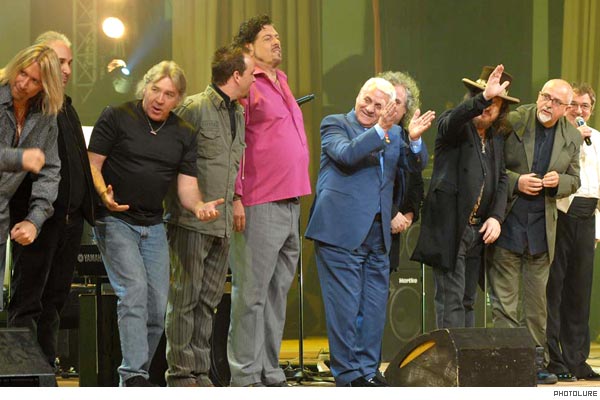
With a long red carpet and stepped up security measures, a series of tribute concerts marking the 80th anniversary of prominent Armenian duduk player Jivan Gasparyan opened at the Sports and Concert Complex Tuesday night. Both Armenian artists and internationally renowned musicians took part in the event.

“All have come here without any fee or remuneration, all are my friends,” the Maestro said from the stage. “And I am thankful to all.”

Despite chilly November weather and a high price of tickets (between 10,000 and 50,000 drams, which is about $30 to $165), the concert hall was full of local fans and guests who have come to honor the man who made Armenian music known worldwide with plaintive melodies of the duduk.

“I am fascinated. I don’t know when I will come to Armenia next time. But Armenia is in my heart and I hope to come back here again. I am grateful to him [Jivan Gasparyan] who allowed me to be his pupil. He is like father to me and I am proud to have known him,” Pedro Eustache, who astounded the audience with his skill of playing different wind instruments during the concert, told ArmeniaNow.

Such well-known musicians as Peter Gabriel, Andreas Vollenweider, Grammy winner Alan Parsons, Zucchero, as well as celebrated guests from other spheres had come to honor the great duduk player.

“Happy birthday, Maestro. You give us strength to score victories,” said unbeaten International Boxing Federation middleweight champion Arthur Abraham, who came to Yerevan after a signal title defense on Saturday. Yuri Vardanyan, a famous Armenian weightlifter who held numerous world records in his sport, gifted one of his records to Gasparyan. “I flew for 16 hours to reach Yerevan and congratulate you,” he said addressing the Maestro. “Now you are also a sport champion.”

The Maestro’s grandson, his full namesake Jivan Gasparyan, also performed during the evening. Jivan Gasparyan, the Master of the Duduk, the winner of four world-wide gold Medal UNESCO competitions (1959, 1962, 1973, and 1980) and the WOMEX (World Music Expo) lifetime achievement award in 2002 embarked on his “champion” career many years ago. (See more on the artist’s official website www.gasparyanjivan.com)

He says that he had given numerous concerts, played for famous people, made friends all over the world. And in 1947 he received an award from Stalin, which he had to sell to make ends meet.“I had a difficult childhood. I lost my parents early on and lived in an orphanage,” Gasparyan told ArmeniaNow in a short interview before the concert. “Since I was a child I had to go through so many hardships that later I could overcome the challenges of life.”

Gasparyan says that he did everything for the duduk to get worldwide recognition so that “people love and feel the sorrow of the duduk.” But he says he feels there is something unfinished. The Maestro says that he wants to set up a school first of all for orphaned children. “I caught a cold a week ago and have not recuperated yet. We will celebrate my 100th birthday anniversary as well,” he smiles. “I still have a lot to do.”

David Byrne & Brian Eno : Everything that happens will happen today

Hugo Cassavetti, Telerama n° 3070 - 15 novembre 2008


La dernière fois que David Byrne et Brian Eno ont enregistré en tandem remonte à 1981. A l'époque, le révolutionnaire My life in the bush of ghosts, avec ses rythmes afrobeat concassés et ses samples avant l'heure de chants ethniques, a posé les jalons du crossover world, qui allait irriguer tout un pan du rock des années 80, de Peter Gabriel à Sting. Sans oublier, bien sûr, Paul Simon et son impérial Graceland.

Dans un curieux mais peut-être logique retour des choses, ce nouveau projet semble partir des derniers travaux de Simon - dont le Surprise fut coproduit par Brian Eno - pour chercher un point d'équilibre entre les habillages sonores du cofondateur de Roxy Music (Eno) et la facette crooner de l'ancien leader des Talking Heads (Byrne). Car Everything that happens... est d'abord un disque de chansons, avec ses envoûtantes mélopées qui rappellent autant la veine mélodique d'un Here she comes (Before and after science) que d'un Heaven (Fear of music).

Eno, on a tendance à l'oublier, n'est pas qu'un sorcier du son mais aussi un amoureux éperdu de la voix. Il a conçu ici un somptueux écrin « gospel folk électronique » pour celle clairement stimulée de Byrne. Bercé par les mélodies hypnotiques, on découvre progressivement les subtils échafaudages rythmiques et paysages sonores élaborés par le plus instinctif des producteurs et compositeurs intellos.


Peter Gabriel 'free' music service launches today (Nov 11)

NME, Nov 11, 2008

A new music service that allows fans to listen to songs and albums in their entirety for free has been launched today. Peter Gabriel co-founded the venture called We7 - a free advertising-funded music streaming service which will have music from four major labels and hundreds of indies available to listen to.

While fans get to listen to tracks in full for free before they buy, rights owners and artists will get paid by We7 from audio and digital advertising revenue. Website goers can create their own playlists, share favourites with friends and also buy music at the download store. There are millions of tracks available now from acts including Kings Of Leon, Pink, Nickelback and Estelle. For more information go to We7.com.

We7 Challenges Piracy With Biggest Ever Free Music Giveaway

LONDON, November 11 /PRNewswire/

Listen Free and Buy What You Love at We7's Big Listen

Today is great news for music fans and bad news for piracy, as millions of tracks from artists including Kings of Leon, Pink, Nickelback, and Estelle will be legally and instantly accessible on http://www.we7.com/, as We7 launches its full music service.

We7's 'Big Listen' Launch Campaign delivers:- - On-demand, unlimited and Instant access to full tracks and Albums - FREE - "Search, Click & Play"- an easier and better alternative to piracy - A 'Celestial Jukebox' of millions of great tracks - 'Play Anywhere' - new link and play system empowering blogs and websites - Rights Owners and Artists get PAID

As an easier and better alternative to piracy, We7 gives music fans unlimited access to millions of great tracks from major record labels and Independents across all genres, to listen to for FREE and on-demand. The We7 difference is that while fans get free music , rights owners and artists get paid by We7 utilising both audio and digital advertising, so it's a win-win situation for all.

Whatever their music taste, all music lovers have to do at We7.com is 'Search, Click and Play' and they can listen to full tracks and albums of their favourites artists instantly, We7 also delivers the choice music fans have come to expect, by adding up to 30,000 tracks a day to its outstanding 'celestial jukebox' of over 3 million licensed tracks, including many new releases as they become available.

Music fans can create personal playlists, share their favourites with their friends and buy the music they love at We7's download store, where they can download high quality mp3 downloads which are compatible with iPods and most other digital players.

We7 introduces its 'Play Anywhere' dream, where any web reference to music, tracks, albums or artists in any article, blog or website can be played instantly, wherever you are online. This will allow music fans, websites and bloggers to share and play music anywhere on the web via We7 widgets and links.

We7 CEO, Steve Purdham, said: "It was just 18 months ago that we had the dream of delivering great music that's free and legal for consumers and where artists and rights owners get paid. Today that dream's a reality. We7 has great music and that builds great audiences which will be highly valuable to brands and advertisers. We're hugely proud of our great service and very excited to be delivering it to the benefit of music fans, artists and brands alike".

Geoff Taylor, Chief Executive at the BPI commented: "Record labels are licensing a wide variety of new business models so music fans can access the music they want, when, how and where they want it, while respecting the rights of artists. We7 is a very good example of how the music business is leading the digital content revolution. But for digital entrepreneurs like We7 to continue innovating and investing in new services for consumers, we must tackle illegal downloading, which undermines the business case for all legal services. The BPI's new partnerships with Government and internet providers aim to ensure that digital Britain can realise the enormous value that music and other creative works offer, if their value is respected."