Articles review on the net, revue d'articles sur la toile


Inscription : feeds, flux :
(Atom) Gabriel Real World News

Affichage des articles dont le libellé est Womad. Afficher tous les articles

08 février 2009

A world of music

Philippa Kennedy, The National.ae , February 01. 2009


Along with acclaimed acts from across the globe, Womad’s festival director, Chris Smith, hopes to highlight Arabic music. Jaime Puebla for The National

The unmistakable sound of Peter Gabriel’s Steinway grand piano reverberated through the floors of the studios of Real World Records, in the English village of Box, Wiltshire. Staff returning from lunch were intrigued and followed the music to the “big room”, as they call it. There, sitting at the piano, totally absorbed, was a young musician from a reggae group comprised of the British producer Nick Page and a troupe of musicians from the Ethiopian city of Addis Ababa.
“He was in awe of the sound and oblivious to everyone else. About five or six people stood there in amazement, listening to him playing. Luckily, an engineer had the presence of mind to flick the switch and it was all recorded,” says Chris Smith, the 46-year-old festival director of Womad, the world music event co-founded by Real World’s boss, Peter Gabriel.

As he relates the story of Samuel Yirga from Dub Colossus, Smith’s joy is clear to see. This is exactly the kind of moment for which Womad and Real World exist. Already holding annual festivals in various locations around the globe – including the UK, Spain, New Zealand and Australia – Womad has set its sights on the UAE. In fact, Smith is here in connection with the organisation’s plans to hold an event in the capital in conjunction with the Abu Dhabi Authority for Culture and Heritage (Adach).

“So many people have remarkable talents and we are able to give them a platform. That’s what makes Womad unique,” he says. “If you go to see George Michael in a football stadium you kind of know what you’re going to get, but if you come to a Womad festival you may be familiar with some of the artists, but most of them you will not have heard of before. You get the chance to learn something about music.”

Scheduled for the end of April, headline acts for the Abu Dhabi Womad have not yet been named, but Smith reveals that he is already in talks with major international artists and a list of regional favourites for what promises to be a “magical” first concert at the Jahili Fort in Al Ain.

From the way he talks, it is obvious that Smith is taken with the region. “The first time we walked in to the Jahili Fort, the call to prayer started and it was incredible,” he recalls. “When you hear that in a place like Al Ain it’s just amazing.”

He then moves on to talk of the music that drives Womad events. “We are a multi-stage festival but we will open in Abu Dhabi with a single stage and a big-name headline performer. That is what we always do because we need names that people are familiar with to draw audiences in. Then we programme those well-known artists with people that nobody has heard of before. The plan is that we draw people in with the main acts but that they will leave talking about the others.”

Previous Womads have included artists as diverse as the Touareg guitar group Tinariwen, Egypt’s Bedouin Jerrycan Band, Konono No1 from the Democratic Republic of Congo, the Algerian-born rai artist Rachid Taha and the acclaimed Jamaican reggae producer Lee “Scratch” Perry. However, says Smith: “It is important that we also get other artists from the Middle East, especially the Emirates.”

Unfortunately, thanks to touring commitments, Peter Gabriel, the former Genesis singer and solo artist, is unlikely to perform in Abu Dhabi. However, his initial vision for the festival will remain an inspiration.

“Womad came about through a shared passion for music from other cultures,” Smith says. “There is still an international obsession with western music, but Womad’s founders knew that there were thousands of artists around the world who were performing work of enormously high quality but who weren’t getting the audiences and recognition they deserved. The idea was to give them a platform and, following on from that, to provide an opportunity for them to collaborate with western artists. Real World Records was set up to record this music and its primary catalogue is of world artists. Very often an artist who plays at Womad will go on to record for Real World,” says Smith.

For instance, the label’s output includes Soul Science, a CD by Justin Adams and Juldeh Camara. Adams is a UK-based guitarist, while Camara is a ritti (African fiddle) player and vocalist from the Gambia. Both artists met while performing for Womad and now record and tour together.

Gabriel’s idea for Womad – along with co-founders Thomas Brooman and Bob Hooton – was to give audiences an insight into different cultures through the enjoyment of music. Since the first festival in the UK in 1982, the organisation has held more than 160 events in 27 countries.

Over the years Womad line-ups have featured a wealth of global artists, many of whom have gone on to achieve significant international success. Among its most famous performers are the Senegalese vocalist Youssou N’Dour and the late Pakistani qawwali singer Nusrat Fateh Ali Khan.

Talks between Adach and Womad started just over a year ago. By way of research Abdulla Salim al Amri, the director of arts and culture at Adach, attended Womad’s concert in the Spanish city of Cáceres in May, where he met Smith.

“What I tuned into in my conversations with Abdulla was that Abu Dhabi wanted to celebrate culture,” says Smith. “That’s what developments such as the Guggenheim and Louvre museums are all about. It’s not about entertainment for its own sake, but the depth and richness of world culture. That’s a very good fit for what we do.
“We discussed the role of world music in Abu Dhabi and its ambitions, as a cultural centre, to celebrate Arabic music. We also talked about another important aspect: the role of the festival in developing indigenous culture as opposed to the commercial aspect of some of the events that have happened in the Gulf in the past. Now we have a date in the diary and a great deal of excitement for the project.”

Following the Jahili Fort concert will come two free beach shows on the Abu Dhabi Corniche. Two massive stages will be built, interlinked by a structure containing areas where children’s workshops will be held. Both sites will be decorated with more than 1,000 distinctive Womad flags and animated projections will be beamed onto the surrounding buildings.

The next few weeks will be a frenetic round of activity as organisers begin to source fencing, Portakabins, lighting and sound equipment, air-conditioning units, generators and plan the festival’s logistics.

“One of my staff will be based here for the next month, identifying what needs to be done and getting the infrastructure in place,” Smith explains. “It’s a bit like the proverbial swan that glides along the river, but under the water its feet are paddling like mad. This visit has been very reassuring as there is much more here than we thought. The events industry is growing and we will source as much as we can here.”

In between shuttling between Abu Dhabi and the UK, Smith is also masterminding Womad’s other events: Australia and New Zealand in March, Spain in May, Sicily in June and the organisation’s biggest date, held in Wiltshire’s Charlton Park in July.
“We’re also doing the Tower of London in September and Las Palmas in the Canary Islands in November. I may well be divorced by then,” he jokes.

Organisers are expecting the Abu Dhabi Womad to bring a number of visitors to the city, many of whom will be drawn by the music on offer. However, Smith emphasises that Womad is about much more than just sound.

“Womad stands for World of Music and Dance and the focus is very much on the music, but we are keen to reclaim the art and dance elements in the future. Because of the time scale, it is unlikely that a massive amount of dance or art will be commissioned for Abu Dhabi this year, but next year we will be in a position where we can do something truly unique.

“We would look to work with artists from the region. Events are only successful when you have strong partners in the place where you are working. You can’t just land from the UK and produce a festival of the type that we do. We want access to schools and the community and to make sure that the audience is representative of the population – not just the population that can afford to buy tickets. We also expect our featured artists to get involved with projects and workshops involving local children.”

The issue of involving children is of key importance to Smith. Indeed, his own family – daughters Olivia, 13, Imogen, nine, Tara, seven, and their mother Arleen – are all looking forward to visiting Abu Dhabi. “They don’t come to every Womad festival but they are definitely coming to this one,” he says.

A novel aspect of recent festivals has been the introduction of onstage cooking by the musicians performing at the festivals. Billed as Taste the World, in this Womad event artists talk the audience through the process of cooking a dish from their native country. In Cáceres, Miriam Hassan, a Sahrawi singer from western Sahara prepared a meal that required camel meat.

“She cooked the sort of dish you would have at desert camp. The ingredients gave us a few problems in Spain. We hope to bring her here, where it won’t be an issue at all,” says Smith. “It’s a great part of the festival. We get the artists on stage and they talk and share aspects of their own cultures. Food, like all other parts of a culture, is central to what society is about. We like to think that this is representative of what we do as well.”

01 février 2009

Womad's horizon expands

Monday, January 26, 2009


Rock legend Peter Gabriel's world music festival is expanding into a new location – Abu Dhabi.

Womad, based at Gabriel's studios in Box, is to team up with the oil-rich sheiks of the United Arab Emirates to stage a world music festival in the Arabian desert.

The event, which is to take place in April, will be the first Womad festival in Asia.

The name is already well-established in Spain, the Canary Islands and Adelaide in Australia, with other Womad festivals recently springing up in New Zealand and Italy.

Two years ago, the team brought the original version of the festival back to the West Country with a move to Charlton Park in north Wiltshire.

The new event will be held for three days in the open air at several locations in Abu Dhabi, and Womad is working with the Abu Dhabi Authority for Culture and Heritage.

Womad director Chris Smith said: "The event will bring a whole new cultural experience to the people of Abu Dhabi and will attract an audience from across the Gulf region and beyond."

24 janvier 2009

Abu Dhabi to Host 
Ethnic Music Festival Womad

Silvia Radan, Khaleej Times, 23 January 2009

ABU DHABI - One of the largest ethnic music festivals in the world will be held in Abu Dhabi in April. The three-day presentation will mark the festival’s debut in the Middle East.

Spectators enjoy one of the WOMAD concerts.—Supplied PhotoAn agreement to this effect was recently signed by the World of Music Arts and Dance (WOMAD) and the Abu Dhabi Authority for Culture and Heritage (ADACH). According to the ADACH, the dates and list of musicians have not been finalised, but the festival will take place in the open, most likely in three locations in Abu Dhabi. “There will be performances from North Africa, ME, India, Pakistan, as well as other parts of the world,” said Isadora Papadrakakis, from the Arts and Culture Department of ADACH.

Founded as an organisation in 1980 in England to promote music of other cultures, the first WOMAD festival took place in 1982 and saw the reunion of Rock star Peter Gabriel, founder and chairman of WOMAD with Genesis, his former band in order to raise additional funds for the first 1982 festival.

14 décembre 2008

Womad : The Line-Up’s Getting Better All The Time

Monday, 8 December 2008, 12:11 pm

Press Release: Womad

NEWS RELEASE – FOR IMMEDIATE RELEASE MONDAY 8 DECEMBER 2008

The Weather’s Getting Hotter Womad’s Getting Closer And The Line-Up’s Getting Better All The Time
Hot on the heels of last week’s announcement that Malian Rokia Traore will join the WOMAD 2009 bill, comes the confirmation of Kiwi audience favourites Anika Moa & band, The Sami Sisters and Andrew White to the line-up.

Anika Moa’s honest and heart wrenching voice, her energy and cheeky wit bring together a live show that is a myriad of beautiful melodies and amazing musicianship. Moa has clearly become one of New Zealand’s best-loved troubadours and this is a not-to-be-missed experience to see her live in the unique WOMAD atmosphere.

The Sami Sisters are a singing, guitar-playing, gorgeous coffee-coloured trio of Irish and Indian descent, reigning from Auckland’s Onehunga. Madeleine, Anji and Priya Sami are each accomplished entertainers in music & film and were met with high expectations when they decided to merge their collective talents to form the Sami Sisters. Their shows are sell-out and they live up to what’s expected, and then some.

Andrew White was once busking the streets of Auckland. But fate had other plans for him and concert and festival audiences across Canada, Europe and the South Pacific have been amazed by his technically brilliant finger-style guitar playing and soulful songs. This year White has toured Canada and the UK coast to coast with the critically acclaimed production International Guitar Night and has just recorded his tenth album to date, ‘Traces of Silver.’

WOMAD THE FESTIVAL

WOMAD is an international festival created by Peter Gabriel and Thomas Brooman 24 years ago. Since then 21 countries have hosted the festival and entertained millions of festival-goers.

New Zealand’s pre-eminent celebration of music, arts & dance takes place at New Plymouth’s Brooklands Park and TSB Bowl 13-15th March 2009. The Festival also features a new Sustainable Village, which showcases sustainable practices and merchandise. This adds to the already hugely successful Global Village (international food, arts & craft) and Kidszone.

WOMAD Earlybird three-day passes have sold out. Standard tickets are now available from Ticketek - www.ticketek.co.nz.

3 day pass - $209

3 day pass & camping - $259

3 day pass & Marae-style accommodation - $279

1 day tickets are also available.

For more information on WOMAD09, check out www.womad.co.nz

--

THE ARTISTS

International

Arte Kanela (Australia / Spain) – the most dynamic force in Australian flamenco dance.

Bedouin Jerry Can Band (Egypt) – musicians, poets, storytellers and coffee grinders tell their tales from the Egyptian Sinai desert.

Dengue Fever (Cambodia / USA) – psychedelic Cambodian / LA pop.

Dona Rosa (Portugal) – blind world-travelled songstress discovered on the streets of Portugal.

Geoffrey Gurrumal Yunupingu (Australia) – formerly with band Yothu Yindi, the most revered voice in Aboriginal music.

The Gyuto Monks (Tibet / Australia) – The monks conduct tantric arts programmes around the world showcasing the intense colour, beauty & complexity of their endangered rituals & traditions.

Justin Adams & Juldeh Camara Trio (UK) - With an encyclopaedic knowledge of Blues & African music, Adams has been referred to as ‘the Ry Cooder of the UK’ and with the Trio play an electrifying set. Adams is also the Musical Director of the All Stars Gala for WOMAD 2009.

Lo Cor De La Plana (France) – six male voices combine harmonies with boisterous percussion.

Mikidache (Mayotte, near Madagasgar / Paris) – one of the hottest new singer/guitarist talents from this tiny country, Mikidache has made a name for himself in Paris by holding tight to his roots, believing “Madagascan music is complete in terms of its harmonies and rhythms.

The Mobile Sewing Company (Netherlands) – travelling ‘ateliers,’ audience members take off their clothes & allow the ladies to customise, decorate and revolutionise them, each vintage machine powered by bicycles pedalled by the audience!

Natacha Atlas (Egypt / UK) – chanteuse bridging Egyptian & Western R&B & pop styles with her soaring voice.

People In Your Neighbourhood featuring Urban Soul (UK/NZ) - a British Council-led project, featuring a line up of musicians from diverse Kiwi communities and members of UK's acclaimed string collective Urban Soul Orchestra to create a dynamic collaboration of live electronic soul. Expect Korean rap, Maori taonga puoro, Fijian percussion, Niuean soul, Chinese strings and more.

Rachel Unthank & The Winterset (UK) – one of the Britain’s newest shining lights in the folk scene.

* NEW ADDITION - Rokia Traore (Mali) – Arguably Africa’s most experimental singer-songwriter, her latest album collecting searing hot media reviews; 5 Stars, The Guardian; 4 Stars The Observer, The Times & Mojo.

Russ Jones – the hackney globe trotter (UK) – DJ with a uniquely eclectic mash-up of cultural styles.

Sa Dingding (China) – the first Chinese artist to sing in Sanscrit, boldly combining traditional Chinese folk with Western electronica.

Seckou Keita SKQ (Senegal) – hailed as ‘the Hendrix of kora,’ the rocking repertoire of southern Senegal, its members bring their roots to the mix from Senegal, Italy, Egypt and The Gambia.

Seun Kuti & Egypt 80 (Nigeria) – Fiery & frenetic Nigerian Seun Kuti and his family has stood opposed to the murderous and corruptive regimes in Africa for generations and brings his uniquely resolute, defiant and historic music to the stage. Together with Egypt 80, the legendary big-band of his late father Fela, Kuti brings an explosive brew of Afrobeat for the 21st century to WOMAD 2009. Fans include Barack Obama, who notoriously helped the band gain visas to play in the US. http://www.myspace.com/seunkuti

Ska Cubano (Cuba / UK) – an irresistible, fanciful combination of Jamaican ska & Cuban mambo.

Speed Caravan (Algeria / France) – amping up the ancient fretless lute, making traditional Arabic music rock.

U Shrinivas & U Rajesh (India) – using the electric mandolin to offer a dazzling blending of Western jazz and sophisticated classical Indian music.

New Zealand

Fat Freddy’s Drop – Fat Freddy’s have won an obscene number of Tuis (NZ Music Awards), awarded the People’s Choice award 2 years in a row. Debut album ‘Based On A True Story’ was #1 for 11 weeks (a record for a NZ album) & NZ’s highest selling album of 2006, now 8 x Platinum. Their highly anticipated second album is due for release late 2008. Live, Fat Freddy’s present a hybrid of dub/reggae, soul, funk, hip-hop and techno, marinated in jazz and served on Island Time.

Brendan Power – acknowledged as one of the most creative & skilled harmonica players in the world, lending his talents to the recordings of Sting, Van Morrison, Paul Young & many more, WOMAD welcomes this outstanding Kiwi to the lineup.

Shona Laing – her songs have become part of the fabric of New Zealand’s growing up, an essential part of our sense of place. Her piercingly insightful music will be right at home on the WOMAD stage.

Hinemoa Baker – published & celebrated poet, fiction writer, playwright and performer of song & spoken word, with a voice some have compared to Joan Baez and Cleo Laine. Those who love language - in particular Te Reo - and the impactful, no-waste language of poetry will love her performance. Winner APRA Silver Scroll Award (Maioha category, 2005) & NZ Music Awards finalist (2004).

Mihirangi – the sheer strength of her a capella vocal performance “absolutely blew us away” (Beat Magazine, 2006). Mihirangi takes soulful world roots to a new level, layering & looping her voice with ska chops, sensuous jazzy riffs & strong bass beat.

Moana & the Tribe – ancient yet timely messages, fusing taonga puoro, haka, chants with soul, reggae and classical, respectfully and gracefully blending the traditional with the contemporary. Moana draws on her identity as a Maori woman, with a background in traditional performing arts, to write songs that resonate with global audiences.

Little Bushman - four jazz school grads, influenced by Pink Floyd, Jimi Hendrix and The Who, with some seriously bent psychadelic sonic sounds, a 5-Star review in the Dominion Post and a magnificent live show.

* NEW ADDITION – The Sami Sisters – with influences from country artists of yesteryear Dolly Parton and Patsy Cline to 50s girl bands, classic motown & 80s hit stars Kate Bush and The Smiths this Indian/Irish sibling trio from Onehunga come from a short yet illustrious history of sold-out shows and a hip young following.

* NEW ADDITION - Anika Moa & band – one of NZ’s most gifted and popular artists, Moa’s heartbreakingly honest and soulful songs make her live performances immensely popular.

* NEW ADDITION - Andrew White – now residing in Nova Scotia, White has been wowing audiences across Europe and Canada with his incredible finger- style guitar playing of technical brilliance.

23 novembre 2008

Womad 08

Written by Reporter Thursday, 06 November 2008

Tony Allen

If you wanted to attend the UK WOMAD Festival (held in July) it would have set you back 125 of your English pounds for a weekend ticket. WOMAD Las Palmas de Gran Canaria (6th-9th November), however, is an altogether cheaper affair as entrance is entirely free; good news in these credit-crunch times, I’m sure you’ll agree.

WOMAD stands for World of Music, Arts and Dance. First held in 1982, it’s a festival pioneered by Peter Gabriel and other lovers of global beats and grooves. The venue for the Gran Canarian version, as for the past nine years, will be the Parque de Santa Cantalina. As well as performances from artists from all over the world, you’ll be able to enjoy DJ sessions and creative workshops for both adults and children. The childrens’ procession on Sunday is a highlight, with kids displaying what they have made over the weekend (last year’s parade included kites, flags, and a veritable orchestra of musical instruments) to a wider audience.

Although stage times have yet to be confirmed, major draws include Femi (son of Fela) Kuti & The Positive Force. The finest living exponent of Afrobeat, Kuti never fails to work a crowd up into a frenzy. That genre’s co-creator, Tony Allen, the funky drummer himself, likewise makes an appearance. Originally Fela’s sticksman, Allen has also collaborated with the likes of Damon Albarn and Art Blakey. For the benefit of the many ex-pats who enjoy WOMAD Las Palmas de Gran Canaria each year, the UK music scene does not go under-represented. Delivering a big shout from the Bristol Massive are DJ Mr Benn and MC Souls Liberation. Marrying the beats of hip-hop to the booming bass of reggae, this is music to shake your booty to.

Another master turntablist making his way from British shores comes in the shape of DJ Yoda. Billed as one of the ‘top 10 DJs you must see before you die’ by Q Magazine, Yoda is the king of the cut and the paste. There are few other DJs, one would imagine, who could get away with splicing the Indiana Jones theme tune with dubstep. And Canarian artists feature prominently too. From the traditional El Guincho, to the new, The FEOS (The Funky Experience Orgasmic Sound), there’s something for everyone. Although special mention must be reserved for Tenerife’s The Good Company, a gutsier version of Coldplay, who sing their emotional rock songs entirely in English.

Although you may not quite feel like the WOMAD goer who wrote “Someone, please take me back to last Friday and put the weekend on loop!” after returning from this year’s UK festival, you’re bound to have heartily enjoyed yourself by the time Sunday evening comes around. Good times are here again; for all.

M for Montreal hits the ground running

Jamie O'Meara, hour.ca,November 6th, 2008


M for Montreal pulls on Winter Gloves

The third instalment of popular Montreal music showcase M for Montreal has announced its dates for 2008: Nov. 20 to 22. Founded by Glastonbury Festival programmer Martin Elbourne (who also co-founded the long-running WOMAD Festival with Peter Gabriel) and Sébastien Nasra of Avalanche Productions, M for Montreal describes itself as an "export and network" showcase that brings together about 50 hand-picked international delegates representing buyers, journalists and other music industry players for the purpose of promoting Montreal music and artists. It also has a talent for selecting the best and brightest of Montreal's expansive independent music scene for its live music showcases.

The final lineup of bands selected to play at this year's M for Montreal is as follows: Winter Gloves, Duchess Says, Beast, Pas Chic Chic, Radio Radio, Chinatown, The National Parcs, Les Dales Hawerchuk, Arkells, Woodhands, CLAASS, Gatineau and Red Mass. Also, playing at the closing party titled M for Métropolis are big names Karkwa, We Are Wolves and Pierre Lapointe (with still others to be named soon).

Delegates representing NME, XFM, The Guardian, Spiegel Online, Dour Festival, Central Park Summer Stage and the Coachella and Glastonbury Festivals, among many others, will be invited to two industry panels: one "exploring the work of music supervisors," and the other "discussing the state of the French live show industry." Ticket and other information may be found at www.mformontreal.com.

11 novembre 2008

Womad NZ line-up announced

NZherald, Thursday Oct 30, 2008


Natacha Atlas will be entertaining at New Plymouth's Womad festival.

The line up for Womad has been announced and a renowned Nigerian musical family make another headlining appearance at the annual three-day world music festival in New Plymouth in March.

This time round it's saxophonist, singer and band leader Seun Kuti who plays the March 13-15 event at New Plymouth's Brooklands Bowl, following in the footsteps of older brother Femi who played the festival in 2007. The pair's father, Fela, was the pioneer of Afro-beat and Seun now leads his dad's former band Egypt 80 (whom he first played with aged 8). So expect some psychedelic, arse-shaking African jazz and funk.

The big local name on the bill is Fat Freddy's Drop who - all going well - should have the follow-up to their multi-platinum-selling debut, Based On A True Story, out before the festival.

Elsewhere the line-up is a lolly scramble of bands and musicians from countries and cultures around the world. Belgian-born belly dancer and chanteuse Natacha Atlas, who mixes Arabic and North African music with Western electronica and pop, will be one to see, as will Dengue Fever, who conjure up Cambodian psychedelic pop via the lusty streets of Los Angeles, and former Yothu Yindi member Geoffrey Gurrumal is also on the bill. Then there's Egyptian storytellers Bedouin Jerry Can Band, blind Portuguese singer Dona Rosa, The Gyuto Monks from Tibet and Australia, and Ska Cubano who, as the name suggest, fuse Jamaican ska and Cuban mambo.

Other locals include Shona Laing, Little Bushman, harmonica player Brendan Power, and Moana and the Tribe.

Womad, which stands for World of Music, Arts and Dance, was started 24 years ago by musician and former Genesis singer Peter Gabriel and while it has visited other venues in New Zealand it has been held in New Plymouth since 2005.

Tickets to the festival are available from Ticketek with 3-day passes $179 and there are also camping ($229) and marae-style ($249) accommodation passes on sale.

For more information and full line-up go to womad.co.nz

23 octobre 2008

M pour Montréal dévoile la programmation de sa troisième édition

Le 21 octobre 2008, Julie Rhéaume, Branchez-vous

Karkwa participera au spectacle M pour Métropolis le 22 novembre.


La troisième édition du Festival M pour Montréal se déroulera du 20 au 22 novembre. Plusieurs délégués internationaux seront à nouveau de la partie afin de découvrir les talents montréalais. Cette année, on proposera également une plate-forme appelée T pour Toronto, qui permettra de présenter quelques artistes originaires de la Ville-Reine.

Une quinzaine de groupes montréalais joueront sur les scènes du Cabaret, du Studio Juste pour rire et des Foufounes électriques. Duchess Says, Beast, Pas Chic Chic, Radio Radio, Chinatown, Winter Gloves, The National Parcs et Les Dales Hawerchuk y présenteront notamment des prestations de type «showcase». Les noms d'autres artistes devraient s'ajouter à l'alignement musical au cours des prochains jours.

Le 20 et 21 novembre, les organisateurs présenteront également la plate-forme T pour Toronto. Woodhands, The Mark Inside et Arkells partageront notamment la scène avec les groupes de Montréal.

Le 22, on aura également droit au concert M pour Métropolis, qui aura lieu dans la salle du même nom. Karkwa, We Are Wolves, Pierre Lapointe ainsi que des invités surprises seront de la partie.

Une cinquantaine de délégués internationaux seront présents au Festival. Les organisateurs mentionnent que des représentants du Glastonbury Festival; du magazine NME; de Xfm et du journal The Guardian (Angleterre); du Coachella Valley Music and Arts Festival; The Windish Agency et du Central Park Summerstage (États-Unis); du Festival de Rock les Eurockéennes de Belfort; du Printemps de Bourges et des Inrockuptibles (France); du Paradiso (Pays-Bas); du Sziget Festival (Hongrie); du Festival Primavera Sound (Espagne); du Dour Festival (Belgique); du Spiegel Online (Allemagne); du Provinssirock (Finlande) et de DF Concerts (Écosse) ont déjà confirmé leur présence.

Les billets pour les spectacles seront disponibles à compter du vendredi 24 octobre, à midi, sur les réseaux Admission et Ticketpro. Un nombre limité de passeports pour les 3 jours sera disponible pour le public à prix spécial.

M pour Montréal est une initiative d'exportation et de réseautage fondée en 2006 par Sébastien Nasra (Avalanche Productions) en consultation avec le légendaire programmateur anglais Martin Elbourne (Glastonbury Festival, The Great Escape et cofondateur avec Peter Gabriel du WOMAD Festival), peut-on lire dans un communiqué.

17 octobre 2008

Her eccentric Highness

Kenny Chee, Asia One, Tue, Oct 14, 2008


Chinese artiste Sa Ding Ding is poised to crack the Western market

By her own admission, Mongolian-born Chinese singer Sa Ding Ding can come across as a tad eccentric. "Even I think I'm a bit strange," the singer, who was born in Mongolia, told my paper. "That's because I tend to be very focused when I'm doing something and I'm apt to forget what's happening around me." To that end, she has shown up at recording sessions dressed in winter clothes in summer, oblivious to the fact until someone pointed it out.

Sa - who was in town recently to perform at the Esplanade Outdoor Theatre as part of the Formula One Singapore Grand Prix's entertainment programme - has been billed by some as Asia's answer to Icelandic singer Bjork. Sa fuses electronica with Chinese folk music, and this melange is topped by her warbly vocals.

She is also inspired by ancient Chinese texts such as the Materia Medica, a Ming Dynasty encyclopaedia of Chinese herbs written by naturalist Li Shizhen. She sings in Mandarin, Tibetan and Sanskrit, as well as a self-created language. Born to a Mongolian doctor mother and a Chinese government- official father, Sa was raised by her grandmother in the grasslands of northern China.

Her upbringing influenced her ear for ethnic music, and Sa later moved to Beijing to study philosophy and music at the Central Conservatory of Music. She released a debut album in 2001, followed by her sophomore release, Alive, last year. It caught the ears of the Western media, winning the British Broadcasting Corporation Radio 3 World Music Award for the Asia-Pacific region in April.

That win led to Sa performing at London's Royal Albert Hall and the World of Music, Arts and Dance (Womad) festival, where she enjoyed four encores. After her performance, she was approached backstage by many who told her that she "completed (their) music experiences", she said.

"I was incredibly moved; I treasure that much more than fame or fortune," she added. And what did she think of the world's first night race, which she was here to support? "I've watched F1 races on television, but this is the first time I've seen it so up-close and it's very exciting," she enthused. "I sometimes ask why the cars need to be so fast. But maybe I ask that because I'm a girl."

06 octobre 2008

Gardens to be eco friendly for Womad

By Felicity Rookes,Taranaki Daily News, Monday, 06 October 2008


Kunming Gardens will be transformed into an eco wonderland for Womad next year. The new Sustainable Village will take over Brooklands Park's Chinese garden during the March festival as extension of its Zero Waste Project. The area will house stalls focusing on environmentally sustainable products and services.

Taranaki Arts Festival Trust CEO Suzanne Porter says a lot of businesses would like to be a part of the village. "There was a lot of interest in the Zero Waste Project so we decided this year to move it forward," Ms Porter says.

One stall will be selling environmentally friendly coffins made with bamboo from Thailand and beads made with recycled paper by women in African villages. "The coffins are amazing and are like works of art," Ms Porter says. There will be displays featuring the women on their journey to develop these sustainable businesses in their village.

"We also imagine stalls featuring worm farms, solar power and organic products like creams and medicines filling the village," Taft global village manager Donna Hutton says. Another new feature, which will be part of the village, are the Chill Out Lounges.
"It will be like an actual lounge with couches and bean bags. It will be a place people can go and relax - just grab a glass of wine and and escape the bustle of Womad for a bit." Some features will still remain at the Kunming Gardens, such as Taste of the World and the charity stalls.

Taft came runner-up for Best Environmentally Sustainable Event at the 2008 New Zealand Association of Event Professionals Industry Awards for the Zero Waste Project at Womad 2008.

05 octobre 2008

Festival promps new music academy


By Tina Robins, Thursday 2nd October 2008

A new Fame Academy has opened its doors in Malmesbury.

Triggered by a huge surge of interest in music and dance caused by the arrival of WOMAD last year, the Saturday morning sessions already have a waiting list of youngsters keen to make it in the music industry. Choirs, a dance group, a samba band and tuition in everything from drums and guitar to violin are on the programme for up to 100 children every Saturday morning at Malmesbury Primary School’s new building. There are even vocal coaching sessions for potential X-Factor 2018 contestants.

Founders, teacher Angelique Martin and music tutor Steph Kenny have won backing from the WOMAD Foundation and attracted a commercial sponsor for the project. Angelique explained: "We aim to inspire children to explore their creativity by providing musical opportunities that suit their specific wants and needs. Both Steph and I come from a musical background. Both of us attended music summer schools and the memories of musical groups we attended have stayed with us over the years.

The women both play in various groups and choirs. "The idea of the academy came from that and also as a result of the huge amount of enthusiasm and talent in the children – we could not fit any more music in the school week, so it has burst out on Saturdays." Much of the enthusiasm has come from participation in the last two WOMAD festivals at Charlton Park.

Annie Menter from the foundation said: "It was a fantastic sight to see 140 children from the north Wiltshire area on stage, opening the festival with Siyaya. We are delighted to have been able to strengthen our links with the local community and are already starting to plan our next project with the schools for 2009," she added. "And we hope very much to be able to assist in contributing to a global music programme throughout the year."

Malmesbury Music Academy is for children aged between seven and 13 who live in the town or surrounding villages.

WOMAD prompts new music academy

Saturday 27th September 2008, By Standard reporter

Youngsters can take their first steps to stardom when Malmesbury’s new music academy is showcased today. Inspired by participation in the last two WOMAD festivals, children have been so keen to take up music, signing and dance that demand for provision in the area has rocketed. As a result teachers have set up the academy, which meets on Saturdays at the new primary school building. Within two weeks of term starting courses are already over-subscribed and waiting lists have been formed.

28 septembre 2008

Le grand retour de Rossy

Rossy. (photo Sécyl)
Sophie Périabe 27 septembre 2008


MANAPANY SURF FESTIVAL

Le grand retour de Rossy


Toute la magie traditionnelle malgache débarque sur le Manapany Surf Festival 2008 avec un artiste hors normes, qui porte haut les couleurs musicales de la Grande Ile : Rossy, véritable légende dans son pays.

Cela fait maintenant 29 ans que le groupe Rossy existe. Après une période sombre dans son île natale qui l’oblige, avec la moitié de ses musiciens, à s’exiler en France, Rossy revient en force.

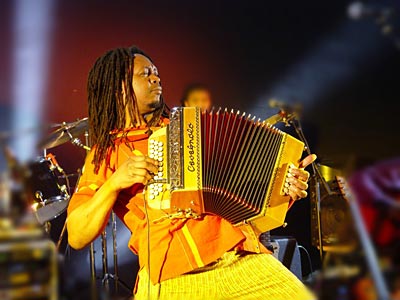
« Mon retour à Madagascar s’est très bien passé, nous avons rempli les stades », raconte fièrement l’artiste malgache. Porteur des valeurs ancestrales, imprégné de sa culture orale et d’une joie de vivre indéfectible, il s’est produit au sein du “Womad” (groupe world de Peter Gabriel) et a conquis le monde avec les rythmes festifs du “Vakisôva” issus du “Hira-Gasy”.

Armé de son seul accordéon diatonique, il est aujourd’hui tête d’affiche dans tout l’océan Indien, bât des records d’affluence et ses concerts fédèrent facilement 50.000 personnes.

Sur la scène du Manapany, ils seront dix, l’ossature des musiciens est restée la même depuis la création de Rossy. « Nous attendons deux trompettistes et une choriste qui doivent venir de Madagascar, mais la question des Visas est toujours d’actualité, explique Rossy, on ne sait pas s’ils vont pouvoir arriver à temps »...

En tout cas, Rossy à Manapany, c’est un évènement qui va, à coup sûr, secouer les cocotiers de la scène Ti Coin Charmant.


17 septembre 2008

Mariza, fado star

From The Sunday Times, September 14, 2008

Photo : Clive Davis

Listen to Mariza

Mariza has taken fado from Lisbon’s backstreets to Womad and beyond

How wrong can you be? The first time I saw Mariza in the flesh, five or six years ago, she was serenading a small crowd in the DJ Charlie Gillett’s cosy marquee at Womad, some distance from the main stage. Her singing was spirited, her audience rapt, yet I had no inkling that I was watching a star in the making. After all, fado - the traditional music of Portugal - has always been an acquired taste. In contrast to the sensuous cadences of the great Brazilian performers of our times, fado (which means “fate”) sounds harsh, austere and guttural. The lyrics, too, can seem as melancholy as the darkest and dankest of blues songs.

So, for all Gillett’s enthusiasm, there seemed to be limited opportunities for the newcomer, at least outside her native land. Fortunately, she was determined to prove the sceptics wrong. In next to no time, she was playing the QEH; by the end of 2006, she had outstripped most of her world-music rivals with a magnificent show at the Albert Hall, no less. The diva had landed.

This summer, in her home town, Lisbon, she was the centre of attention once again, at a concert to launch her elegant new album, Terra. Amid the crush of wellwishers and reporters in the foyer, we could catch a glimpse of some of fado’s leading song-writers and performers - including the stately, white-haired Carlos do Carmo. As ever, Mariza delivered an impeccable performance, dancing across the stage and indulging in occasional duets with the diminutive Cape Verdean singer Tito Paris and the Spanish “nu-flamenco” singer known simply as Buika (who came close to stealing the show on the impassioned Pequenas Verdades).

A triumphant night, all in all. If Mariza’s early albums gave ample clues to her potential, her most recent discs have been nothing short of triumphant. Transparente, released three years ago, created a memorable fusion of Portuguese and Brazilian styles, supervised by perhaps the most intelligent arranger-producer of our times, the cellist Jaques Morelenbaum. Concerto em Lisboa - again with Morelenbaum at the helm - provided a beguiling snapshot of her live show.

Now, with Terra, she digs a little deeper again, in a thoughtfully varied collection that ranges from slow-burning laments to a buoyant, folksy encounter with the towering Cuban jazz pianist Chucho Valdes. One of the most memorable tracks, Alfama, pays homage to the Lisbon neighbourhood that has long been a nerve centre of the fado tradition, while is a stylish excursion into Beijo de SaudadeCape Verdeanmorna, the music made famous by Cesaria Evora. Mariza is not in the business of serving up undemanding pop hooks; these are allusive, poetic miniatures interpreted with almost operatic verve.

“I had the idea for this album when I was doing the Transparente tour,” she says the day after the Lisbon show, sitting serenely in her hotel suite. “I was walking in Sydney. We’d been to so many places - Bangkok, Singapore, China - and I thought, ‘I’m seeing so many different things, and hearing so many different musicians and rhythms, but I miss my roots so much.’ So I decided the next album would be about ‘terra’ - my country, my land. It’s the heartbeat of a country. I’m respecting my language, my culture, but at the same time I’m bringing forward what I’ve seen in seven years of touring and recording.”

Away from the concert stage, Mariza cuts a poised figure, even in jeans. Without the gigantic heels and billowing dresses that she wears on stage, she looks rather more fragile, although those large, dark eyes and precise gestures still dominate the room. At first glance, you might take her for a classical actress. As she proved with Morelenbaum, she has a sharp eye for collaborators. For this project, she struck up a partnership with the Spanish producer and musician Javier Limon, who happens to be mentor to the aforementioned Buika. Mariza got to know him during a visit to Spain, then invited him to Lisbon to discuss her ideas.

“I wanted to see how he would respond to my kind of music,” she says, “so I put him in the middle of traditional fado singers, then showed him what I had in mind. Later, when we were about to record at his studio, he asked me to go to Madrid by car. It turned out that he had gone out and bought every Portuguese percussion instrument he could find. He wanted me to take them back for him. We had to pack in these huge bombo drums. We were like gypsies.”

The idea of blending cultures comes naturally to an artist who was born far from the metropolitan heart of her country, and whose ancestry includes German, Spanish, French, African and Indian forebears. She spent the first three years of her life in Mozambique. As the curtain came down on the Portuguese empire, her family moved to Lisbon, where they ran a taverna in a compact, traditional neighbourhood in the heart of that beautiful capital. Mariza was singing fado by the time she was five. In her late teens, peer pressure temporarily drew her away from folk melodies to more conventional fare, but she eventually returned to her first love. From her African mother, she also acquired a taste for more exotic artists, from Miriam Makeba to Cesaria Evora and Nina Simone. In her early twenties, her yearning to travel - inherited, it seems, from her footloose father - briefly took her to Brazil, where she immersed herself in the varied cultural landscape and made some money from singing.

At home, many younger listeners assumed that fado - dominated by the stark rhythms of the lute-like Portuguese guitar - was a symbol of Portugal’s long predemocratic slumber. Rightly or wrongly, its fatalistic strain was regarded as a throwback to an era many of the postrevolutionary generation regarded as hopelessly backward.

“Things were different then,” Mariza says. “It was unusual to sing fado outside your own neighbourhood. Intellectual people would come to hear the music, but they wouldn’t talk about it much. Now we have eclectic audiences, and you can hear fado in different places - restaurants and clubs. There’s a new generation learning the music. You realise this culture is not going to die.”

When her first albums began to attract attention abroad, there were mutterings - in Portugal and beyond - that Mariza was merely the result of clever marketing. Some traditionalists frowned at her theatrical style, a marked contrast to the static, pared-down approach of the pioneers. Others complained she was overshadowing more substantial talents. Over the course of five years, however, she has proved that she is no mere elegantly dressed mannequin. When she plays in Britain, it’s doubtful that many in her audience understand the meaning of the words she is singing. But they don’t need to: the voice tells them everything.

07 septembre 2008

Nomads unite in Etran Finatawa

By Siddhartha Mitter, Globe Correspondent | September 7, 2008


Banding together

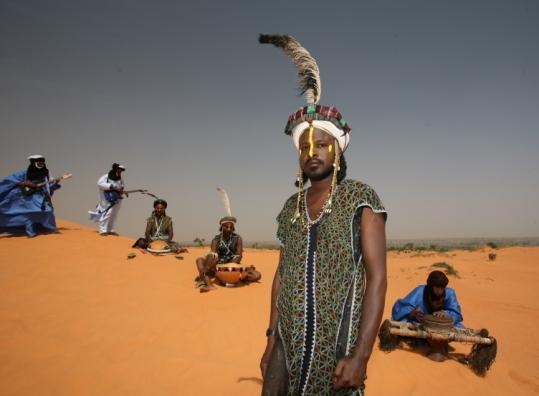
Their name means "Stars of Tradition," but the members of Etran Finatawa are just as much cultural pioneers, melding long-separate ethnic traditions of their native Niger in the service of nationhood - and in the process, producing one of the most fascinating recent hybrids on the African music scene.

The band, which visits the MFA on Oct. 8, has successfully merged the trancey guitar-driven "desert blues" of the Tuareg ethnic group with the polyphonic vocals and spare percussion of the Wodaabé. It features three members from each community. Their new CD, "Desert Crossroads," is an exciting record of songs in both Tuareg and Wodaabé languages that possesses a deep feeling of roots while never feeling obscure or monotonous.

Etran Finatawa formed only recently, joining members of two separate traditional groups that were invited to perform at the 2004 edition of the Festival in the Desert - a key event on the world-music circuit, held in Timbuktu, Mali, and crucially, an outlet for musicians from impoverished nations of the Sahara desert region.

The idea of playing a song or two together germinated at the home of Sandra van Edig, a German expatriate and onetime anthropologist who was living with her husband, a development worker, in Niamey, Niger's capital.

As van Edig, who became Etran Finatawa's manager, recalls on the phone from Bujumbura, Burundi, where she now lives, the success of the joint finale at the festival revealed the potential for something that had never been done before: combining the music of these two nomadic cultures, ones that shared a broad swath of grazing lands but virtually no cultural collaboration.

"Nomads are very proud of their culture, and very individual," van Edig says. "And the Wodaabé were never very instrument oriented. It's totally new to find a guitar melody for a Wodaabé song. It had never been done before."

Nor was there much precedent for professional musicians other than griots, the traditional praise singers. "Maybe people would stick some money on their forehead, but they were not really paid," van Edig says. Indeed, until recently the Etran Finatawa members maintained a semi-nomadic life. "They'd just stay in the capital for a few months of the year, doing small jobs. Then the rainy season starts and they're off with their cattle in the grasslands."
In just four years, the band members have become a different type of nomad - full-time musicians who tour worldwide. A demo tape recorded on the terrace of van Edig's house under primitive conditions turned into a first album on the World Music Network label. Then came an invitation to the prestigious WOMAD festival in the UK. "Things really started to speed up then," van Edig says.

In separate phone conversations from Niamey, Alhousseini Anivolla and Bagui Bouga, de facto spokesmen for the Tuareg and Wodaabé sides of the band respectively, describe the challenge the band faced at the beginning.

"It was very complicated because we don't speak the same language and we don't have the same traditional rhythms," says Bouga. "We had Wodaabé songs and it was difficult to match them with the Tuareg scales."
"We're all nomads, yes, but from very different cultures," says Anivolla. "But everyone understood that even though we could do things alone, it was better to do it together, because we are people who live in the same country and share experiences."

In Niger, a country with a small and dispersed population, and a small and poorly funded cultural infrastructure, the opportunity to convey through music a sense of nationhood and shared struggle was one that the members of Etran Finatawa felt they had to seize - even at the risk of alienating traditionalists by crossing ethnic and stylistic barriers. As Bouga puts it, all they are doing is expressing what's happening in people's lives.

"We're not changing Wodaabé culture," he says. "We dress Wodaabé, we sing Wodaabé. But we're modernizing it by singing with the Tuaregs and their guitars. We're composing songs to talk about the way life is changing. That's reality."

Etran Finatawa performs at the Museum of Fine Arts Oct. 8 at 7:30 p.m. Tickets $25; members, seniors, and students $20. 617-369-3306, www.mfa.org

27 août 2008

M for Montréal Comes to the Quays of the Old Port

MONTREAL, Aug. 27 /CNW Telbec

Sirius Canada, in co-operation with Astral Média, presents M for Montréal "Special Edition" on the Quays of the Old Port. The free event in Place des Vestiges at the Old Port of Montréal, from 5 to 11 p.m. on Saturday, September 6, will feature six of today's top bands: Socalled, Karkwa, Alfa Rococo, Radio Radio, Misteur Valaire and Torngat. Hosts Geneviève Borne and Anne-Marie Withenshaw will go head-to-head in a friendly DJ contest during a schmoozing BBQ kicking off the event.

The six bands taking part in this special edition of M for Montréal will be lighting up the two stages across from each other in Place des Vestiges, at the Jacques Cartier Quay entrance. "With M pour Montréal, we wanted to introduce the many alternative artists on the Montréal scene to people in the industry around the world," says Sébastien Nasra, founder of the event. M for Montréal on the Quays will allow the general public to attend one of these events and discover the incredible musical talent that's developing in our city and has a great chance of making it big on the international scene."

An enchanting setting

What better place than to host these artists than the Quays of the Old Port, an enchanting setting between downtown Montréal and the River? "Our vision for the Quays of the Old Port is that they should showcase emerging Montréal culture, both summer and winter," says Claude Benoit, President and CEO of the Old Port Corporation. "It made sense for us to be partners in this event, which will introduce the general public to some talented local artists."

A schmoozing BB Q

M is also taking advantage of the superb outdoor venue on the Quays of the Old Port to kick off the event with a schmoozing BBQ. Guest DJettes Geneviève Borne and Anne-Marie Withenshaw, both well known for their musical tastes, will face off in a no-holds-barred battle of the DJs.

All these artists, popular on the Montréal alternative scene and gaining broader public recognition, are ready to launch on international careers. The M for Montréal on the Quays event is committed to serving as a showcase for them and offering Montrealers some amazing musical discoveries. Don't miss this fabulous event!

About M for Montréal

M for Montreal is an export and networking platform founded in 2006 by Sébastien Nasra (Avalanche Productions) and the legendary British festival programmer Martin Elbourne (Glastonbury Festival, The Great Escape and co-founder with Peter Gabriel of the WOMAD Festival). In addition to bringing together an international delegation of buyers, journalists and other influential music industry players in Montréal, "M" is a unique, exciting concert experience for music and event fans alike. This year's international showcase will take place from November 20 to 22. Watch for further details!

About the Old Port of Montréal Corporation

For the past 25 years, the Old Port of Montréal Corporation has pursued the mandate assigned to it by the federal government, of promoting and developing the Old Port. As manager of the Quays of the Old Port, one of the most popular attractions in Quebec, the Montréal Science Centre and the IMAX(C) Telus Theatre, and by planning and offering a varied program of activities throughout the Old Port, the Corporation is a major player in the city's economic development.

For further information: and/or artist interviews: Clarah Germain, Media Relations, Quays of the Old Port of Montréal, (514) 283-8085, cgermain@vieuxportdemontreal.com; Source: M for Montréal

22 août 2008

WOMAD foundation and the Musical Elder's Archive

by JillTurner, World Music Central, Monday, August 18 2008


Over the years, the WOMAD foundation, has worked with many talented musicians world wide. In addition to running workshops and summer schools the foundation are developing an invaluable new initiative.

Annie Menter a foundation executive told me, "We intend to create an archive of 'musical elders' who have shaped our musical landscape and who's music may well be lost once they have gone".

In July, whilst in England to perform at the WOMAD festival, Madosini Maqina, became the first elder to be documented, making the most of her time here, which in itself was a fortuitous booking that followed on from an invitation to participate at the Le Reve de L'Aborigene, a mouth bow festival in France.

Madosini has been making her own style of music and imparting social commentary for eighty years. Revered for her skills with three instruments, the isitolotolo ( jew's harp), the uhadi ( bow with calabash ) and the umrumbhe ( mouth bow), it is the latter instrument that invokes the most passion.

Madosini's name means pride and this is evident in the way she talks to me about the umrumbhe, the instrument her mother taught her to play in a darkened house. With no TV or radio it became her sole source of entertainment as she recovered from a leg injury. To this day, Madosini continues to make the mouth bow herself, fashioned from a particular type of wood she finds lying in the bush near her home in the Eastern Cape of South Africa. There is equal delight in recounting the times as young girls they would play the umrumbhe, to announce fights over love interests. As we chat, the highlights of her stories are punctuated with excited flicks on my knee from her bow.

Decades on, listening to her recent WOMAD UK performance, she announces, "there is no-one playing this instrument now except for me and my friend" , in reference to Mantombi Matotiyana. Perceived as an achievement and applauded by the audience, a frustrated Madosini tells me later, " I want the instrument to live, not to die with me. Children are too busy with school, they love to listen to the umrhubhe, I wish they would teach it in the schools" .

If the children of the schools in the Eastern Cape are too busy with their academic studies to spare time for music, they may well be able to benefit from Musical Elders Archives which will be curated by the WOMAD foundation the and made available on line for educational purposes around the world.

Madosini was the first elder to be documented in a series of films and interviews but Annie is keen to stress that it was because she happened to be in England this summer and "this project will be as much about the little known musicians who have brought music into communities around the world, as about those who have reached an international audience" as she also recounts the music of Bernard Kabanda, for whom the project has come too late. He was discovered in the bars of Kampala performing "kadongo kamu", delivering a mix of social comment and humor whilst accompanying himself on a hand made guitar built from scrap with brake cables for strings. He recorded his first and only album Olugendo, on the WOMAD select label and with their help was on the brink of an international career, for many he was the highlight of the 1999 WOMAD festivals in England and the US. He wasn't in the best of health on the tour and after returning to Uganda his health deteriorated he died two months later from an AIDS related illness.

………..it's a cliché to say the music lives on but it will if it is researched and documented. "This is a subject close to my heart, says Outerglobe's DJ Debbie Golt, "I'm pleased someone is making it happen".

At the time of writing, the WOMAD Foundation are actively seeking the resources to ensure their Musical Elders Archive achieves its aims.

Jill Turner for World Music Central

Photo credit : Paul Tomlins
Translator: Cecilia

Madosini has released an album in 1998 Power to the Women on the M.E.L.T. 2000 label.

Madosini playing the uhadi can be seen here on Youtube

Bernard Kabanda released an album in 1999 Olugendo, on the WOMAD Select label in 1999. Three of his tracks also appear on, Music from Uganda, Vol. 2 - Modern Traditional from the Swedish Caprice label.

20 août 2008

Oil company renews Womad sponsorship

By ROB MAETZIG, Taranaki Daily News, Saturday, 09 August 2008


Conditions were freezing - but the mood was warm on stage at New Plymouth's Bowl of Brooklands yesterday.

That's because the more than 100 invited guests who huddled under gas heaters on the stage had just heard the news that the biggest corporate sponsor of Womad was renewing its sponsorship for another two years.

As the wind howled and the rain fell on the Womad site, Shell New Zealand's country chairman Rob Jager used the shelter of the Bowl stage to make the announcement.

He told the guests the sponsorship of Taranaki's premier music, arts and dance event was part of Shell's ongoing efforts to be a good neighbour.

"By partnering with Womad, we believe we are helping build a thriving community in Taranaki - one that our employees will want to live and work in, one that meets our skill requirements, one that encourages creativity and new ideas, and that benefits the whole community," he said.

"And of course there's the bit we all enjoy - attending Womad."

Taranaki Arts Festival Trust member Lynn Bublitz told the gathering Shell had been a corporate partner of the Taranaki Womad since its inception.

"Frankly, Womad would not have been possible without Shell's assistance," he said.
"It costs around $2 million to put Womad on, and half of that cost comes from our sponsorship. Simply put, if we had no sponsorship, people would have to pay double to go - and fewer would attend."

Mr Bublitz reminded the audience that more than 150,000 people had so far attended Womad, with more than 70% of them coming from outside Taranaki.

"And so far the event has been worth $6.5 million to our economy. So you can see that thanks to Womad's ongoing partnership with Shell, everyone benefits."

19 août 2008

Sounds of summer: Womad

Akin Ojumu, The Observer, Sunday August 3 2008


Charlton Park, Wiltshire

Womad has had a bit of a facelift. Last year the festival moved to a new venue and a quick glance at this year's line-up showed a shift towards mainstream pop. With so many festivals these days boasting eclectic lists of Western and 'world' acts, is this such a good idea?

But after last year's mudfest, Womad 2008 delivered three days of glorious sunshine. One of the most appealing things about this particular festival is the chance to hear new music, but on the opening night it was the retro disco of Chic, orchestrated by sole surviving member Nile Rodgers, that got the easy-going crowd on their feet.

Elsewhere, the French-Algerian punk Rachid Taha brought his beguiling mix of influences to an appreciative crowd, including a thrilling version of the Clash's 'Rock the Casbah'. Veterans such as Senegal's Orchestra Baobab and the gospel singer Mavis Staples also shone, and on Saturday afternoon there was a treat from Kenyan Luo band Kenge Kenge who delivered a fabulously lively set that included a tribute to Barack Obama, the man of the moment and son of a Kenyan Luo.

Martha Wainwright provided a touch of class, while Roni Size raised the bpm level for those who could handle it. On Sunday, Squeeze rolled out the hits and reminded us that they were once a pretty good singles band. By then most people's spirits were as sunny as the weather.

Best performance Chic - Nile Rodgers and co brought back the 'Good Times'.

Best discovery Kenge Kenge - irresistible Luo and Benga tunes.

Overheard 'Ernest Ranglin? Yeah, he is famous actually. He does Jamaican jazz or something... '

Womad Festival, Wiltshire, UK

By David Honigmann, Financial Times, August 2, 2008


The first person on Womad’s main stage this year was Johnny Kalsi. Generally, the worst that can be said of the amiable frontman of the Dhol Foundation is that his drumming forces fellow musicians to wear earplugs. But for many in the audience, the last time they had seen him was when he announced from the stage last year that their cars, having been hauled from the mud by tractors, were being towed away by the police.

Kalsi made only uneasy allusion to the shambolic mudbath that was Womad 2007: “Don’t mention the m-word”. But it was surely no accident that the act he introduced, the monks of the Tashi Lhunpo Monastery, are regularly invited into homes to clear bad energy. As they sounded their 12ft horns, residual bad energy started to shift. But then they paraded round the stage with a giant umbrella, the Womad equivalent of talking of rope in the house of the hanged.

Chris Smith, Womad’s new events director, explicitly saw the role of this year’s festival as “rebuilding trust”. Lots of things went his way including the weather. On Saturday afternoon, serendipitously, the RAF’s Red Arrows aerobatics team flew fighter jets low over the site. “We didn’t organise that but it was pretty impressive,” says Smith. When not scorching, Womad was bucolic. Giant inflatable sculptures lurked amid the trees; passing punters banged away at a woodland gamelan; diners removed their shoes to sit in the sushi yurt.

Vibe is one thing, music another. The 2007 festival pulled out all the stops for its programme; this year’s lineup was less glittery. Nonetheless, almost every one of this year’s winners at the Radio 3 Awards for World Music played. Bassékou Kouyaté sat on a monitor at the ront of the main stage and played his ngoni while the rest of his band crept theatrically behind him and his wife, Amy Sacko, smiled indulgently when not singing her heart out.

Sa Dingding gave a stunning show, complete with dancers. She ended kneeling on the stage, whipping her long hair around her in a frenzy. Rachid Taha stormed the main stage on Friday night, Bo Diddley riffs ablaze on the oud, electric guitars crunching, and the crowd singing along as he transmuted The Clash’s impertinent comment on Middle Eastern politics into “Rock El Casbah”.

The usually reliable Siam Tent seemed cursed. One of the acts there, Toumani Diabaté, swapped the hushed religious ambience of this year’s wonderful solo concerts for a band, including his son Sidiki (who has his father’s flashy fingerwork but, as yet, none of his subtlety). A new composition, “Essaouira”, sounded like Weather Report with a twin kora frontline. “You promised we could go to the steam fair,” complained a child, loudly. The Senegalese singer Wasis Diop was lacklustre there as well. It took Shane MacGowan, slurring through “Fairytale Of New York” with Sharon Shannon, to bring the tent to life.

Breaking into the big time were the Los Angeles-based band Dengue Fever. They played Cambodian pop music from the 1960s, riding a wave of electric organ and twanging surf guitar. David Ralicke played saxophone solos that could have been composed by Mulatu Astatke. Chhom Nimol jumped around like a Cambodian Debbie Harry.

Away in the arboretum, Jah Wobble gave the performance of the festival. His new project, Chinese Dub, started as a relatively modest commission for Liverpool 08, marking the city’s year as European capital of culture, and grew into a tour and an album. Wobble, in grey suit and hat, played forceful basslines that could have performed CPR two fields away. Dodging about the stage, he cued other players to drop in and out. His wife, Zi Lan Liao, sat playing the guzheng, a plucked zither. Clive Bell played Chinese pipes.

Dub and Chinese music proved a perfect mixture. The earnest folk melodies leavened the dub’s conceptual self-importance; the dub hardened the Chinese music against kitsch. As if to demonstrate the kinship, the band played Augustus Pablo’s “Java”, echoing with melodica and a guzheng solo dovetailed in as the rhythm dropped out. Later, Claire Rose sang Dawn Penn’s “No, No, No”, rising from a low growl to impressionistic wails, accompanied by the Tibetan singer Gu Ying.

Midway, Wobble brought on two mask-changing dancers. As they twirled and high kicked, red and yellow silk cloaks whipping around them, their masks constantly changed from one eyeblink to the next, expressions and colours and designs constantly transforming as hands flashed across faces. It was a moment of stage magic so surprising, and so inexplicable, that the audience was dumbstruck.

This year’s big names played surprisingly safe. Squeeze essentially performed a compilation album in its entirety. Chic stretched their one glorious rhythm over 75 minutes: parents and toddlers channelled Travolta while teenagers pretended to be orphans. Eddy Grant mixed the highlights of his songbook with one less familiar number, “Hearts and Diamonds”, that was one degree from Dire Straits.

And then again, away in the woods, the Marseille choir Lo Còr de la Plana was issuing an irresistible a capella invitation. Within 90 seconds, the audience had linked hands and formed a running line, threading in and out of the trees like an Occitan village festival. The rhythm, beaten out on frame drums, quickened, more and more people were sucked in, and Womad’s true spirit of serendipity lived again. Even Johnny Kalsi was forgiven.