Articles review on the net, revue d'articles sur la toile


Inscription : feeds, flux :
(Atom) Gabriel Real World News

Affichage des articles dont le libellé est Realworld records. Afficher tous les articles

08 février 2009

A return to Ethiopia's musical greatness

February 4th, 2009, By PRI's The World


Politics and music have not always mixed well in Ethiopia. But governments change — and the music survives, and evolves. A fine example is a new project that highlights the work of Ethiopian musicians today.

Before we get to the big thing out of Ethiopia today, first a quick rewind to the origins of Ethio-funk. Sure, some of Ethiopia's super-cool pop music in the 60s was a bit derivative. But there were also some great jazz players in Addis Abeba who were wholly original.

When Mengistu Haile Mariam took over in 1974, his Derg military government imposed an all-night curfew that lasted for years. It effectively killed the nightclubs in the Ethiopian capital. But singers and bands managed to keep their chops alive — not with audiences. But for each other in small, secretive recording studios.

By the time Mengistu was pushed from power in 1991, Ethiopia's music scene found itself basically starting from scratch. The traditional azmari singers — wandering troubadours — the artist you're hearing now for example, had never gone away.

Azmari gathering places began to come alive again in the mid-90s. Younger up-and-coming musicians made themselves known, and began gigging and recording again. Today, between the artists who kept active in the Mengistu years and the newer ones, Addis has begun to recapture some of its former musical prowess.

This track "Azmari Dub" shows a new face of Ethiopian popular music. It's part of a new music project titled A Town Called Addis. Nick Page is the producer. He's from the UK and is a frequent traveller to Ethiopia. For this project, Page goes by the name Dub Colossus. And the CD logically is titled "Dub Colossus in a Town Called Addis."

That's Ethiopian vocalist Sintayehu Zenebe.

Dub Colossus brought her and four other rising Ethiopian singers and instrumentalists into Peter Gabriel's Realworld studio in Britain. Dub Colossus comes from a reggae background, but he's also had interest in all manner of global musical idioms over the years. In a recent promotional video, Nick Page (aka Dub Colossus) explained why he was a champion of Ethiopian music.

“Addis is a very vibrant and exciting musical scene that has an awful lot to offer and needs some kind of exposure.”

With "Dub Colossus in a Town Called Addis," Nick Page is doing his part to re-elevate Ethiopian music. And it taps into that time-tested tradition in Ethiopia of fusing local sounds with those of the outside world.

26 septembre 2008

Commercial Music Giant Goes "Global"

JSM Music Creates Soundtrack for Fourth Annual Clinton Global Initiative


AUSTIN, Texas, Sep 25, 2008 (BUSINESS WIRE) -- JSM Music, the commercial music production giant responsible for thousands of commercials for some of the world's biggest brands, is going "Global." JSM Austin has created and donated 23 pieces of custom-scored music which will essentially comprise the soundtrack to the fourth annual Clinton Global Initiative conference in New York, September 21-25.

The music scores a series of films produced by Austin-based non-profit and CGI partner Students of the World. Under the leadership of founder Courtney Spence, Students Of the World has for the third consecutive year sent university students to developing nations to document the social, economic, and medical work of CGI-partnered non-profits. The resulting short films (viewable at seechangenow.org) will serve as progress reports shown at the annual CGI meeting this week in New York, with each film opening a different plenary session. An exciting and music-driven three-minute piece will open the entire conference and will introduce Bill Clinton to the stage.

Joel Simon, CEO of JSM Music, says, "All of us at JSM are very proud to be involved in this endeavor. It is a very important grand mission and a supremely worthy cause. Regardless of ones partisan political affiliation, CGI stands on higher ground supporting a non-partisan unified world affiliation. Given the world climate we all currently live in, I felt lending our talent and resources was the least we could do to help."

Austin-based Executive Producer/Composer David Rice scored the film series from JSM's Austin studios. The soundtracks feature both traditional western instruments and those native to the nations they represent, with African Kalimba, Mexican Vihuela (a small 5-string guitar), and Indian tabla alongside acoustic and baritone guitars. He again worked closely with Peter Gabriel's Real World Records, who graciously donated a piece for use in the Paraguay short.
Says SOW's Spence, "Music is such an integral part of telling these stories, and David again hit it out of he park with his sensitivity, dedication, and huge musical talent. We are very grateful to Joel Simon and all at JSM Music for sharing him with us this summer."

The films are produced with cooperation from GSD&M's Idea City and 501 Post, whose Matt Naylor handled all editorial duties. Naylor and Rice last worked together as editor/composer on "Crawford" -- the internationally acclaimed look at President Bush's adopted hometown. The feature documentary won the audience award at the Brooklyn Film Festival and will be released in October.

The Clinton Global Initiative (CGI) is a non-partisan catalyst for action that brings together a community of global leaders to devise and implement solutions to the world's most pressing challenges. Since 2005, CGI members have made nearly 1,000 commitments valued at upwards of $30 billion to impact more than 200 million lives in over 150 countries.

JSM Music is the world's largest producer of original music for commercials. With recording facilities encompassing 20,000 square foot and 15 state of the art studios, JSM is the largest recording facility in Manhattan. JSM has accumulated over 1000 gold and platinum records, Grammys, Emmys, and advertising awards including the Clio (23), AICP (8), Addy, One Show, Hispanic Advertising Award, and others.

11 septembre 2008

La Speed Caravan passe... un 11 septembre

Alain Brunet, La Presse, Le jeudi 11 sept 2008


Traditionnellement, on imagine la caravane sillonner un espace ensablé, infini, profondément oriental. Alors que justifie l'accélération dont il est ici question? Rencontre avec Mehdi Haddab du groupe Speed Caravan.

«Pour moi, la caravane est le symbole de la lenteur, du désert, mais aussi de l'échange et du voyage. C'est un peu ce que sont devenus les musiciens d'aujourd'hui, de nouveaux caravaniers en quelque sorte. Ils évoluent dans un autre espace-temps, dans un rythme infernal de voyages et d'échanges.»

Speed Caravan, donc. Son concepteur et principal compositeur, Mehdi Haddab, a déjà été au centre des formations Ekova et DuOud, avant de constituer ce groupe de rock électro-oriental, dont l'album Kalashnik Love a récolté d'excellentes critiques depuis sa sortie européenne au début de l'été.

Mehdi Haddab explique avoir créé ce projet autour d'un instrument qu'il venait d'acquérir, un oud électrique, sans caisse de résonance, c'est-à-dire qu'il n'émet aucun son s'il n'est pas branché - à la manière d'une guitare électrique.
«Au départ, j'étais un peu réticent, j'avais déjà bricolé mon oud afin qu'il soit amplifié. Je voulais garder la rondeur de l'instrument traditionnel. Mais finalement, quand j'ai branché cet oud électrique, que j'y ai mis de la distorsion et d'autres effets, j'ai senti qu'une nouvelle voie s'ouvrait à moi.»

Le oud électrique, nous apprend-il en outre, est fabriqué en Turquie, son amplification s'avère idéale pour moderniser les musiques du Maghreb et du Moyen-Orient.

N'empêche, l'énergie de Speed Caravan est résolument rock. «Je suis moi-même très rock, estime Mehdi Haddab. J'aime cette énergie brute. Je suis un fan inconditionnel des premiers albums d'AC/DC par exemple. En Algérie, j'ai grandi aussi avec le rock, je m'étais d'abord mis à la guitare électrique avant de jouer l'oud. Avec Ekova je n'avais pas l'occasion d'exprimer ce côté-là. Avec DuOud non plus: c'était une logique plus jazz avec des thèmes et des chorus. Finalement, j'avais à coeur de faire un album d'esprit rock.»

L'attitude rock de Speed Caravan fait aussi bon ménage avec l'électronique, ce que corrobore son concepteur: «Je suis aussi un fan des Chemical Brothers et de Prodigy, des groupes électros dont l'énergie reste rock.» Ajoutons à ce mélange des éléments de dub et de hip-hop.

Ainsi, Speed Caravan occupe un autre espace que celui de Rachid Taha, reconnu pour son amalgame de rock et de musiques maghrébines ou moyen-orientales.

«D'ailleurs, souligne Mehdi Haddab, Rachid est un ami; il a participé à cet album, c'est-à-dire sur la reprise de Killing An Arab - de The Cure. Rodolphe Burger a aussi fait des solos de guitare sur l'album. Ont également collaboré MC Spex, autrefois dans Asian Dub Foundation, ainsi que le chanteur yéménite Abdulatif Yacoub

Le premier album de Speed Caravan est sorti en France le 15 juin, Mehdi Haddab est en pourparlers pour une sortie mondiale. «Je négocie actuellement avec Real World, je n'ai pas encore signé. Peter Gabriel a entendu l'album, il est devenu fan, il en a même parlé aux médias. Je crois donc que ça va se faire l'entente devrait être conclue dans quelques semaines.»

Et quel effet ça produit d'implanter Speed Caravan en Amérique du Nord, un certain 11 septembre? «Ouais, je me suis demandé si j'allais faire un sous-entendu scabreux! Je réfléchis au plan d'attaque», répond Mehdi, hilare.

Pour les bonnes raisons, la Kalashnik Love sera bien chargée...

07 septembre 2008

Dengue Fever To Tour West Coast, Issue Vinyl Release

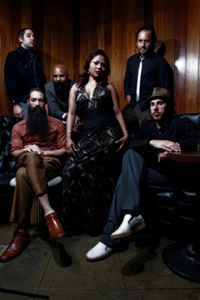
Cambodian rock band Dengue Fever has announced a series of West Coast tour dates this October that will find the band performing everywhere from San Diego to Vancouver, BC in support of their latest release Venus on Earth. Dengue Fever will also make vinyl fans happy on September 23 when M80 Music releases their sophomore effort, Escape From Dragon House on LP for the first time. Pressed on colored vinyl, this limited edition version of Escape From Dragon House will also include a download card that will entitle the buyer to a free one-time-only download of the entire album from a secure site for added portability.

Confirmed North American dates are:
09/20 @ Street Scene, San Diego CA
10/05 @ Schooled in Song, 1st and Linden, Long Beach, CA
10/17 @ Bimbo's 365 Club, San Francisco, CA
10/18 @ Napa Valley Opera House, Napa, CA
10/20 @ Aladdin Theatre, Portland, OR
10/21 @ Neumos, Seattle, WA
10/22 @ Venue TBA, Vancouver, BC, CANADA (debut)
12/04 @ Scripps College Performing Arts Center, Claremont, CA (free performance & screening of band documentary Sleepwalking Through The Mekong)

A full scale British tour in November will be announced shortly along with club dates in Ireland and Turkey.

Having spent the last three months playing massive European festivals such as Glastonbury, Roskilde and Electric Picnic the band is now the subject of intense Grammy® buzz which started overseas while on the road.

"It was shocking to me just how many journalists and fans came up to the band while we were on tour this summer in Europe and the States who asked us if we thought we would be nominated for a Grammy for Venus On Earth," said bassist Senon Williams. "We played more than thirty dates in countries like Denmark, Sweden, England, the Czech Republic as well as others and that seemed to be all anybody really wanted to know. Who knows what could happen? Dengue Fever would welcome a Grammy nomination - that's for sure!"

Earlier this summer, Peter Gabriel's Real World Records in England licensed Dengue Fever's Venus On Earth for all territories outside the US and Canada.

01 juillet 2008

Big Blue Ball News

A message from Real World Records :

Big Blue Ball is launched on Real World Records - an album of collaborations, a truly international, multi-artist project that grew from a series of extraordinary Recording Weeks in Peter Gabriel's Real World Studios in Wiltshire, England back in the early 1990's.

Real World Records: www.realworldrecords.com

Big Blue Ball Album Gatefold

Roll Out the Big Blue Ball

Produced by Peter Gabriel, Karl Wallinger and Stephen Hague and mixed by Tchad Blake - Big Blue Ball features artists from a myriad of different cultures and nations - some well known names, others hidden gems of writing and performing talent... The Holmes Brothers, Jah Wobble, Billy Cobham, Joseph Arthur, Iarla Ó Lionáird, James McNally, Deep Forest, Hukwe Zawose, Natacha Atlas, Hossam Ramzy, Marta Sebestyen, Papa Wemba, Sinead O Connor, Joji Hirota, Guo Yue, Vernon Reid, Peter Gabriel, Karl Wallinger... and more.

“After all these years, it's a fine wine ready to be drunk. It was the most fun music making I've ever had.”
Peter Gabriel
“It's like a wall of sound coming at you, listening to the planet from outer space. It's a real world-view of music, a snapshot of the music-making continents at that time.”
Karl Wallinger

Track listing:

  1. Whole Thing (Original Mix)
    (featuring Francis Bebey, Alexis Faku, Tim Finn, Peter Gabriel, Karl Wallinger, Andy White)
  2. Habibe
    (featuring Natacha Atlas, Hossam Ramzy, Neil Sparkes)
  3. Shadow
    (featuring Juan Canizares, Papa Wemba)
  4. Altus Silva
    (featuring Joseph Arthur, Ronan Browne, James McNally, Eric Mouquet, Iarla Ó Lionáird, Vernon Reid, Michel Sanchez)
  5. Exit Through You
    (featuring Joseph Arthur, Peter Gabriel, Karl Wallinger)
  6. Everything Comes From You
    (featuring Joji Hirota, Sevara Nazarkhan, Sinead O'Connor, Guo Yue)
  7. Burn You Up, Burn You Down (
    featuring Billy Cobham, Peter Gabriel, The Holmes Brothers, Wendy Melvoin, Arona N'diaye, Jah Wobble)
  8. Forest
    (featuring Levon Minassian, Arona N'diaye, Vernon Reid, Hukwe Zawose)
  9. Rivers
    (featuring Vernon Reid, Marta Sebestyen, Karl Wallinger, Jah Wobble)
  10. Jijy
    (featuring Arona N'diaye, Rossy)
  11. Big Blue Ball
    (featuring Peter Gabriel, Manu Katche, Karl Wallinger)
imageimage

Big Blue Ball is released in the USA on 24 June 2008 and the rest of the World from 28 July 2008.

For those in the UK Big Blue Ball will be available in advance as a special offer to those attending the WOMAD Festival, Charlton Park.

Available as a download, on CD or 150-gram double vinyl album in limited edition blue at 45rpm or standard black at 33rpm.

image

Big Blue Ball CDs, Vinyl, T-shirts, bags and mugs are available from our store or alternatively from Amazon.com

www.realworldrecords.com/bigblueball

Remix Big Blue Ball

image

Remix 'Exit Through You' (featuring Joseph Arthur, Peter Gabriel, Karl Wallinger) at Real World Remixed

21 juin 2008

The infectious rhythms of Dengue Fever

In the Independent

An inspired marriage of Sixties Cambodian pop and West Coast psychedelia, Dengue Fever are set to rock the festivals this summer, says Tim Cumming

The day after a sweaty debut appearance at the Borderline in London, assorted members of Dengue Fever are grouped around a table in the bar of the Columbia Hotel in Lancaster Gate. Plans are afoot: food for some, for others, music. Senon Williams, the bassist whose home studio is where much of their new album, Venus on Earth, was recorded, is still in the twilit world of jet lag, grazing on Kronenbourg in the shabbily grand confines of London's premier rock'n'roll hotel.

For many US bands, the Columbia is akin to Rick's Café in Casablanca. Since the Seventies, virtually everyone in rock'n'roll has passed through. "It's kind of stinky and damp, and the lights flicker, and there must be ghosts in the rooms because they keep creaking," says Williams, "but we love it here. I could stay here every time I come to London."

The uninitiated might be forgiven for thinking that Dengue Fever is the result of some feverish hallucination in a tropical emergency. But they're the real thing, an inspired combination of soaring Cambodian vocals from lead singer Chhom Nimol, and West Coast psychedelia as seen through the colour-drenched lens of Cambodia in the swinging Sixties.

Picked up here by Peter Gabriel's Real World label, Dengue Fever's latest album, Venus on Earth, is their first UK release, much of it recorded on analogue tape using the same generation of decks that The Beach Boys used in the Sixties at Oceanways Studios. These are songs that cross multiple time zones, with sonic textures ranging freely from psychedelia to surf, mariachi to garage rock, and even Berber rhythms and Ethiopique sax. And as well as the record deal with Real World, they'll be performing at this year's Womad, whose organisers describe them as nothing less than "the grooviest band you don't yet know".

"We're really delighted to have them perform at Womad this year," says festival programmer Nicola Henderson. "They are going to be the must-see band for this summer."

The Dengue Fever story begins with Ethan Holtzman, the man behind the humid, floating sound of the Farfisa organ. After visiting Cambodia in 1997, he returned to LA loaded with vintage Sixties Cambodian pop, a hitherto unknown genre of world music, steeped in the sounds pumped out by the American Forces that were then in Vietnam. A classic case of musical blowback.

Holtzman's brother Zac had become similarly enamoured of Cambodian pop, stockpiling tapes in the Echo Park apartment they shared. It helped that they had Cambodia Town on their doorstep in Long Beach, the West's largest concentration of Khmer-speaking folk. It was there that they tracked down Nimol, one of Cambodia's biggest singing stars, and persuaded her to join forces with this curious band of indie musicians.

Joining them for the ride was David Ralicke, whose damp, rusty sax lines fill out the songs with strong riffs and humid tones; and drummer Paul Smith, who doubles up as sound engineer and producer. Bassist Williams provided the studio, and having visited Cambodia himself in 1995, he had his own stack of tapes with garish covers of singers in Beatles-esque suits and Austin Powers hair, and women in psychedelic dresses and towering beehives.

The few clips of film that survived the murderous ascendance of the Khmer Rouge are poignant, a haunted party music from a time and place that no longer exists. So much was destroyed, of course, and millions killed. Nimol's family escaped to Thailand. Others fled to Paris and the US, and brought the music with them. Decades later, the diaspora had coalesced into the Cambodia Town of Long Beach, where the band went in search of a singer.

"We went to this club where they'd have bands with six or seven rotating singers, and there'd be an artists' table full of food and drinks – Nimol still plays those clubs. Weddings, birthdays, New Years," says Williams. They tried out others before chancing on Nimol: "We had no idea she was from this famous, Michael Jackson-type musical family. The other singers thought we were nuts, saying, 'No way is she gonna come'. I think she was just intrigued by what we were doing."

Their first show was at a tiny indie club in LA, and the response was immediate. "The crowd went nuts. LA isn't a dancing town, especially in the indie scene, but these hipsters were rolling around on stage. It was like a crazy dance party. It got everybody jazzed."

Their album debut in 2003 consisted entirely of Cambodian pop songs from the Sixties. Nimol's vocal ornamentations and improvisations – one of her specialities is the "ghost note", jumping from one scale to another – are embedded like a sixth sense in the band's trippy mix of American psychedelia and surf rock, spinning the music up into the stratosphere.

"Our concept was not to be a Sixties cover band, but to be influenced by the music and to create a band out of it," says Williams. But at the beginning, with Nimol barely able to speak English, and the Americans no better with Khmer, the attempts to record original material ground to a halt.

"We couldn't get enough even to do a set, so we decided to be a covers band on that first album. Nimol brought in songs, and we'd scour the stalls on Long Beach for tunes we liked."

For their second album, 2005's Escape from Dragon House (the name of a Long Beach nightclub where Nimol still performs), Zac Holtzman started bringing in the vocal melodies for the band to work on, while Nimol was often holed up at their Echo Park apartment, turning English lyrics into Cambodian songs. She now she mixes the two languages with ease. Check out the wonderful "Tiger Phone Card" from the new album, a duet of Zac's frail American vocal and Nimol's impassioned and beautiful phrasing, it tells the story of a transcontinental, cross-cultural love affair.

Escape from Dragon House was recorded after a month-long tour of Cambodia – Dengue Fever are the first American band ever to perform in the country. The impact on everyone involved was powerful – even overwhelming – and was captured on film by the cinematographer-turned-director John Pirozzi with a local crew. Due for DVD release in the autumn, Sleepwalking Through the Mekong tells the story of Nimol and the band, and more important, opens the doors on the music and stars of a lost generation of Cambodian music that found its feet – and its soul – in American pop to produce a truly unique, long-lost hybrid.

The day after their arrival, they were filmed for Cambodia's national TV station CTN, a two-hour special mixing interviews with songs. It ended up being broadcast three times every day for the whole month they were there. "I'd never experienced recognition or fame," says Williams, laughing, "until I got to Cambodia."

Nimol's mother and relatives were at the recording session. "They knew she was coming back but she didn't tell them we were playing Cambodian music. They were expecting her to sing Madonna, not pre-Khmer Rouge Cambodian psychedelia. They were blown away with our performance."

They played free gigs across the country, from mountaintop temples using battery-powered amps, to the riverside slums of the Ton La Basae district in Phnom Phen, the improvised stage lighting made up of the tail lights of cars powered on a noisy, churning generator and a higgledy-piggledy tower of randomly assembled speakers on one side of the stage.

"It was one of the most epic shows I've ever played," says Williams. "I had culture shock at first. It was totally wild, the poorest place I'd ever seen. Heaps of trash, people with bandages, very sick-looking, just hanging out. The crowd was completely still, completely silent, didn't even clap between songs. Crazy faces with crazy expressions."

Given that Dengue Fever are embarking on their first tour of UK open-air festivals – the likes of Glastonbury, Womad, Lovebox and Larmer Tree – a sea of crazy faces with crazy expressions could be the order of the day if the summer conspires to be another washout. For festivalgoers, meanwhile, prolonged exposure to Dengue Fever is likely to bring on delirium and involuntary movements of the legs and arms. You have been warned.

'Venus on Earth' is out now on Real World; Dengue Fever play Womad (http://womad.org), 25-27 July

03 juin 2008

Tom Diakité : Les nobles couleurs du Mali

Après avoir accompagné de nombreux artistes aux univers très divers et participé à cinq albums, depuis les années 1990, Tom Diakité s’est enfin décidé à signer un premier enregistrement sous son nom. Intitulé Fala, cet opus élégant écrit une nouvelle page de la musique mandingue. Rencontre avec ce noble malien.

RFI Musique : Vous venez de signer votre premier album sous votre nom, intitulé Fala qui signifie "orphelins". D’où vient cet intérêt particulier pour les enfants sans parents ?

Tom Diakité : Je suis issu d’une grande famille et j’ai eu la chance de grandir entouré de nombreux gamins, puisque nous sommes une vingtaine de mômes nés de même père ! Donc, je ne peux pas être insensible à la cause des enfants. En particulier ceux des rues, livrés à eux-mêmes, que ce soit en Afrique, ou ailleurs. Si on prend l’exemple de notre continent, la population est majoritairement très jeune. Par conséquent, j’ai senti le besoin d’envoyer un message à toutes les bonnes volontés et à tous ceux qui veulent m’entendre, afin d’éradiquer ce fléau. Les orphelins, comme les autres enfants, ont droit à une éducation même s’ils ont été abandonnés. Je pense qu’il faut donner une chance à toute la jeunesse. Car bien éduquée, elle aura un avenir meilleur.

Globalement, vous écrivez des chansons qui font enseignement. Quels sont les autres sujets que vous abordez dans vos textes en bambara ?

Je parle de pas mal de thèmes qui touchent le quotidien des gens. Il y a une chanson titrée que je dédie au peuple malien en dénonçant ce qu’il subit. Par exemple, le problème du pouvoir d’achat chez nous et le coût des produits manufacturés, qui deviennent difficilement supportables. A Bamako, le secteur du bâtiment est en pleine essor et le prix du sac de ciment a explosé ! Il est passé à plus de 7500 Francs CFA, alors qu’en Côte-d’Ivoire ou au Sénégal, l’unité attend à peine 5000 francs CFA. Tout cela, à cause des taxes douanières, puisque nous sommes obligés d’importer les sacs de ciment des pays voisins, depuis que nous n’avons plus de cimenterie au Mali. Sur ce même titre, je parle également de la pollution à laquelle nous sommes aujourd’hui confrontés à Bamako. Franchement, cela devient infernal ! Dans MaliKiramando, une autre chanson, je rappelle d’ailleurs que nous devons respecter l’environnement car c’est Dieu qui a fait la nature. A l’heure actuelle, nous sommes tous responsables des catastrophes naturelles que nous connaissons !

Musicalement, vous proposez un alliage entre les instruments traditionnels mandingues, comme le donzo n’goni, petit luth des chasseurs bambara, et les guitares électriques au groove pop. Pour vous, c’est une manière de proposer un nouveau son pour le Mali ?

Avec à mes grands frères -de redoutables chasseurs-, j’ai approché tout jeune le donzo n’goni à l’occasion des fêtes de village. Je joue également de la kora, que j’ai appris seulement à la fin des années 1990 aux cotés d’Ousmane Kouyaté, ce grand guitariste malien grâce à qui je suis venu m’installer en France. Bien que je m’appuie sur cette base instrumentale ancestrale, je ne joue pas dans un registre authentique, comme on peut l’entendre au Mali. Et puis, j’ai accompagné beaucoup d’artistes de différentes cultures et d’univers variés. Mise à part mes collaborations avec Salif Keita, les Gypsy Kings et Johnny Hallyday, ou encore mon aventure dans le domaine théâtral avec Sotigui Kouyaté et le metteur en scène Peter Brook, il y a eu la belle histoire avec le trio Tama. Une rencontre qui a donné naissance à deux albums sortis sur le label Real World de Peter Gabriel. Avec ce groupe, j’ai côtoyé Djanuno Dabo, le percussionniste bissau-guinéen et Sam Mills, le guitariste anglais marié avec Susheela Rahman. Toutes ces expériences m’ont enrichi, car elles m’ont permis de trouver les voies de la complémentarité. L’échange est toujours positif. Pour réaliser cet album, j’ai fais appel à l’excellent guitariste français Yves Mesnil qui l’a coproduit. Et j’avoue que je suis assez fier du résultat. C’est un disque d’empreinte mandingue, mais d’aujourd’hui.

Vous êtes issu d’une lignée de nobles peulhs. Par conséquent vous n’auriez jamais dû chanter. Comment avez-vous réussi à transgresser cette règle ?
Ça n’a pas été évident, j’avoue avoir connu énormément de problèmes. J’ai été élevé par ma tante installée en Côte-d’Ivoire. Elle était très gentille avec moi et j’ai eu une enfance tout à fait agréable à Abidjan, cette ville qui m’a vu grandir. Mais le jour où ma tante a reconnu ma voix à la radio alors que j’interprétais une chanson, elle a jeté violemment le transistor par terre. C’était en 1982. Le lendemain, elle est partie voir mon oncle, à l’époque, ambassadeur du Mali en Côte-d’Ivoire, pour que je puisse travailler avec lui au consulat. Mais, très vite, je me suis rendu compte que je n’étais pas fait pour ce genre de boulot. En me cachant, je suis de nouveau retourné à la musique. A force de faire des séances d’enregistrement, par-ci par-là, dans la capitale ivoirienne, j’ai commencé à gagner de l’argent. Un soir, je suis venu donner tout ce que j’avais gagné à ma tante. Cela représentait un bon paquet de francs CFA. En voyant tout cet argent, elle m’a jeté tous les billets à la figure, croyant que j’avais braqué une banque ! En tant que noble, c’était un déshonneur pour la famille d’avoir un enfant qui se mettait à la place d’un griot. J’étais considéré comme un amuseur public. Cela a été un véritable défi pour moi d’embrasser une carrière artistique. Au fil des années, les choses se sont arrangées. Personnellement, je crois que chacun a son destin. J’avais envie de faire ce métier. Et le fait d’être musicien me procure beaucoup de bonheur.

Ecoutez un extrait de Fala

Tom Diakité Fala (Safoul Productions/Iroko Sound) 2008

En tournée française en juin : le 3 au Zèbre de Belleville, le 4 à L’Alimentation Générale, le 6 au Pavillon de l’Eau, à Paris ; le 8 au Café de la plage à Maurepas ; le 14 à Brunoy ; le 18 au festiv’Eté à Vélizy ; le 21 à la Fnac des Termes, à Paris

Daniel Lieuze / RFI Musique

26 mai 2008

Djivan Gasparyan to lead duduk ensemble at Royce Hall

The master of the Armenian oboe will team with composer-producer Michael Brook and family members.

On Friday night, Royce Hall will resonate with the quivering sound of the duduk, an Armenian oboe, as played by its reigning master, 79-year-old Djivan Gasparyan. He will be accompanied by Michael Brook, inventor and performer of the "Infinite Guitar" and a composer and producer who has worked with such musicians as Nusrat Fateh Ali Khan, Brian Eno, U2's Edge and Jon Hassell.

The additional ensemble of musicians will include Gasparyan's grandson, also named Djivan, playing duduk, and Brook's wife, violinist Julie Rogers.

Brook produced Gasparyan's album "Moon Shines at Night" in 1993, and the pair decided on a full collaboration five years later for the album "Black Rock." Released on Peter Gabriel's Real World label, it generated considerable critical acclaim -- Gasparyan's slow, meditative phrases beautifully complemented Brook's dreamy, sustained and heavily processed guitar.

"The process when trying to work with people from other countries is to create a simple backing track, giving a bit of atmosphere, pitch and tempo. [Djivan overdubs], then I develop the frame around the picture," Brook said. "I take what he does, what is beautiful and magical, and provide a framework."

Their work, individually and together, has appeared on soundtracks for such films as "Gladiator," "Black Hawk Down" and, most recently for Brook, "An Inconvenient Truth" and "Into the Wild."

"Music is a real-time thing for me," Brook said. "There's very little planning -- it's a purely experimental process. I learned to feel comfortable with the glory of the accident."

A new album, "Penumbra," is scheduled for a fall release, and the Royce concert will include much of the new material. Brook and Gasparyan also are recording more traditionally based Armenian music.

Casey Dolan

20 mai 2008

Peter's May 08 Update

Peter talks about the mystery of our disappearing servers, the final edit of Wall e, music from the Bowers and Wilkins Music Club, new Real World signings Dengue Fever, Big Blue Ball and additions to Real World Remixed.
http://www.pixar.com
http://www.bowers-wilkins.com
http://www.myspace.com
http://www.rockstarbands.co.uk
http://www.we7.com
http://www.route-charlemagne.eu

15 mai 2008

Israeli band mixes a 'chopped salad' of world music

YouTube, with its millions of video snippets, contains only one entry from the Jewish/Israeli band Esta, featuring shots from its 2004 European tour. Yet if you can track it down, you'll probably find it most unusual: One man plucks a banjo, while another blows on bagpipes.

Later, he plays what sounds like belly dance or snake charmer music, while the female singer undulates wordlessly, as though this were a Bollywood film. You might wonder what any of that has to do with either Jews or Israelis, until the band moves seamlessly into a Middle Eastern-tinged klezmer tune and ends with a version of the Sephardic Sabbath hymn "Dror Yikra."

Clearly, this is a new generation of Israeli musicians, moving to a multicultural beat, and not impressed by the stirring dogma behind the stereotypical Israeli folk of the '50s and '60s (Theodore Bikel or "Tzena, Tzena, Tzena"). Esta don't play your grandfather's favorite folk songs. And part of the reason is this group of good-looking Sabras (first-generation Israelis) grew up in the '70s listening to British art rock, such as Genesis and Yes.

(...)

With such an impressive musical arsenal, it's no wonder Esta has been received favorably at worldwide festivals, including the granddaddy "world beat" gathering of them all -- WOMAD. The band's CD releases have trickled out -- only three in almost 20 years, including 2002's "Home Made World," but it's halfway through working on a new one, and wouldn't mind changing its do-it-yourself tactics if a formidable label such as Peter Gabriel's RealWorld stepped up to the plate. "There were always talks to be signed, and they were one of the names that popped up," says Deshet. "We could really fit well into their catalog, so that door is still open."

Indeed, there's a common thread between Esta and other bands that deal with a range of international influences, such as Afro-Celtic Sound System. But Deshet stresses that Esta has found a way to retain their uniqueness.

"Since we've played together for so many years, it's a real band, not a production," he says, "and it's also in our roots. Our music is like a really good chopped salad, where you taste all the ingredients together and it becomes one new taste, rather than just [tasting] the tomato. It's a little bit like gourmet cooking."

And in a year when the band's homeland is celebrating a momentous 60th anniversary, too many musical cooks can't spoil the broth.

"We are all very proud to be Israeli, and we think that Israel has a lot to offer the world," Deshet continues. "Through the music, we deliver many messages but underneath the surface -- we don't lecture or get into politics. I think the fact that we play music from Islamic, Christian, Jewish and Western sources, and that it all comes together for us, proves that there is more in common between people than what separates them.

"If it can happen between instruments, then it should be able to happen between people."


08 mai 2008

Emmanuel Jal Joins All Star Mandela Bday Bash

Former child soldier turned hip-hop artist Emmanuel Jal has been invited to perform at the concert event, "46664 Concert Honoring Nelson Mandela at 90," which will play to a gathering of 46,664 friends and supporters at London's Hyde Park on June 27. The concert is one event in a three-day period of celebrations that will pay tribute to one of the world's most loved leaders, Nobel Peace Prize Laureate and icon of freedom, Nelson Mandela, who turns 90 later this year.

With Mr. Mandela in attendance, Jal will perform songs from his brand new album, "Warchild," due out in the U.S. on May 13. The 13 songs on "Warchild" are rooted in Jal's extraordinary life as a Sudanese child soldier. "Nelson Mandela is one of my biggest inspirations," said Jal. "It's a great honor for me to be given this chance to celebrate his birthday on the stage and then to attend his dinner birthday party. I cannot wait for the day."

Jal will join Royalty and politicians from both sides of the Atlantic, leading names from business, sports, film and entertainment - and some of the most successful musicians of the past twenty years. Queen + Paul Rodgers, Annie Lennox, Simple Minds, Leona Lewis, as well as South African and African artists such as Johnny Clegg, Sipho Mabuse, and the legendary Papa Wemba will perform at the concert. The concert will also feature numerous surprise appearances by major artists. In addition, President Bill Clinton, Prime Minister Gordon Brown, actor Will Smith, Oprah Winfrey, Robert de Niro and Forest Whitaker are among those who will attend some of the celebrations over the three-day period.

Emmanuel Jal, who doesn't know when he was born or exactly how old he is, learned how to fire a machine gun before he could ride a bike, and lives with the nightmares of the unspeakable things he had to do as a child soldier. When he was about 13, he, along with some 400 other "child soldiers," courageously deserted the rebel lines. Only sixteen made it to the relative freedom of a refugee camp. Jal was one of them.

Music is what kept him going after returning to "the real world." On "Warchild" (Sonic360/Fontana), Jal mixes hip hop with world music rhythms to tell his incredible story in songs like "Forced to Sin," "Many Rivers to Cross," "Baaki Wara," and the title track. A feature documentary on Jal's experience, also entitled "War Child," just won the 2008 Tribeca Film Festival Cadillac Audience Award, and will screen later this month at the Cannes Film Festival. In addition, Jal is writing his autobiography for St. Martin's Press. Over the past several years, Emmanuel has befriended artists like Peter Gabriel, Bono, Moby and Sir Bob Geldof who have helped him in countless ways, whether with his music or his Gua Africa foundation that helps educate former child soldiers.

For more information on the "46664 Concert Honoring Nelson Mandela at 90," log on to http://www.46664.com/

17 avril 2008

Toto La Momposina

A la fois chanteuse et danseuse, figure emblématique de la musique colombienne, unissant rythmes africains et fièvres indiennes Toto vient, comme ses ancêtres, d'une île nommée Mompos, dío Momposina qui se trouve sur le fleuve de Magdalena.

Issue d'une famille de cinq générations de musiciens, Toto a appris à chanter et danser dès son enfance. Très jeune , elle a voyagé de village en village pour apprendre les rythmes, les danses ainsi que l\'art des "Cantadoras" (chanteuses traditionnelles des villages).

En 1968, elle forme son premier groupe et commence une carrière professionnelle. Elle acquiert une grande réputation et tourne à travers les Amériques et l'Europe.

En 1982, elle accompagne Gabriel Garcia Marquez à Stockholm pour jouer lors de la remise de son prix Nobel. Puis elle s'installe en France et en Allemagne. Deux albums ont été enregistrés à Paris à cette époque : "Toto La Momposina" pour Auvidis et "La Colombie-Musique de la côte Atlantique" pour ASPIC.

En 1987, elle rentre en Colombie mais donne de nombreux concerts dans toute l’Amérique du Sud, dans les Antilles, et étudie le Boléro à Cuba. En 1992, elle enregistre "La Candela Viva" pour le label de Peter Gabriel Real World.

Depuis lors, elle ne cesse de se produire à travers le monde. Son répertoire est composé d'une multitude d'influences. S'y côtoient la cumbia, le bullerenge, la chalupa, le garabato et le mapale issus de la côte caraïbe, mais également du son cubain, de la guaracha, de la rumba et du bolero-son.

TV5 Mondomix

13 avril 2008

Big Blue Ball, black and blue Vinyl 2 LP, CD

Originally, planned as a Peter Gabriel project, "Big Blue Ball", a Gabriel owned Real World Records release, has morphed into a collection of tracks featuring a worldwide mix of artists. It would be fair to say that the music is from “around the world” and defies characterization as "world music". The lead track, "The Whole Thing" featuring Francis Bebey, Alex Faku, Tim Finn, Peter Gabriel, Karl Wallinger, Andy White could have been included on the last Gabriel release UP” in terms of its theme and feel. “Everything Comes from You” is another outstanding track with an ethereal introduction that transitions into a chat infused Sinead O’Connor vocal supported by piano, guitar and bass drum. The album ends with the title track “Big Blue Ball” , an upbeat ballad sung by Karl Wallinger supported by Peter Gabriel and Manu Katché. Overall the record just works and after a few listens begins to reveal the notion that we and our musics are all interconnected on this big blue ball we call earth. The CD was mastered by Tony Cousins at Metroplis in London and the 2 LP vinyl editions were mastered and cut by Chris Bellman at Bernie Grundman Mastering in Hollywood, using Classic’s “ALL TUBE” cutting system. Packaged in Deluxe Gatefold Jacket.

Track Listing

"Whole Thing (Original Mix)" (featuring Francis Bebey, Alex Faku, Tim Finn, Peter Gabriel, Karl Wallinger, Andy White)

"Habibe" (featuring Natacha Atlas, Hossam Ramzy, Neil Sparkes)

"Shadow" (featuring Juan Cañizares, Papa Wemba)

"altus silva" (featuring Joseph Arthur, Ronan Browne, Deep Forest, James McNally, Iarla Ó Lionáird, Vernon Reid)

"Exit Through You" (featuring Joseph Arthur, Peter Gabriel, Karl Wallinger)

"Everything Comes From You" (featuring Richard Evans, Joji Hirota, Sevara Nazarkhan, Sinead O’Connor, Guo Yue)

"Burn You Up, Burn You Down" (featuring Billy Cobham, Peter Gabriel, The Holmes Brothers, Wendy Melvoin, Arona N’diaye, Jah Wobble)

"Forest" (featuring Levon Minassian, Arona N’Diaye, Vernon Reid, Hukwe Zawose)

"Rivers" (featuring Vernon Reid, Marta Sebestyen, Karl Wallinger)

"Jijy" (featuring Arona N’Diaye, Rossy, Jah Wobble)

"Big Blue Ball" (featuring Peter Gabriel, Manu Katché, Karl Wallinger)

THE MUSIC.COM

06 avril 2008

Big Blue Ball !


Big Blue Ball (Limited Edition 150 Gram Blue Vinyl: 2LP)
Big Blue Ball
Limited Edition blue vinyl – 1000 copies. An album of all-star international collaborations which grew from "recording weeks" at Peter Gabriel's Real World Studios in the early 1990's. Featuring Peter Gabriel, Karl Wallinger, Joseph Arthur, Sinead O’Connor, Papa Wemba, Natacha Atlas, Holmes Brothers, Hukwe Zawose and more. Produced by Gabriel, Wallinger (World Party) and Stephen Hague (Pet Shop Boys, New Order).

TRACK LISTING:

1. Whole Thing (Original Mix)
featuring Francis Bebey, Alex Faku, Tim Finn, Peter Gabriel, Karl Walllinger, Andy White
2. Habibe
featuring Natacha Atlas, Hossam Ramzy, Neil Sparkes
3. Shadow
featuring Juan Cañizares, Papa Wemba
4. altus silva
featuring Joseph Arthur, Ronan Browne, Deep Forest, James McNally, Iarla Ó Lionáird, Vernon Reid
5. Exit Through You
featuring Joseph Arthur, Peter Gabriel, Karl Wallinger
6. Everything Comes From You
featuring Richard Evans, Joji Hirota, Sevara Nazarkhan, Sinead O’Connor, Guo Yue
7. Burn You Up, Burn You Down
featuring Billy Cobham, Peter Gabriel, The Holmes Brothers, Wendy Melvoin, Arona N’diaye, Jah Wobble
8. Forest
featuring Levon Minassian, Arona N’Diaye, Vernon Reid, Hukwe Zawose
9. Rivers
featuring Vernon Reid, Marta Sebestyen, Karl Wallinger
10. Jijy
featuring Arona N’Diaye, Rossy, Jah Wobble
11. Big Blue Ball
featuring Peter Gabriel, Manu Katché, Karl Wallinger

05 mars 2008

Aye: An Affirmation of Martyn Bennett


Tuning up for tribute

Maverick Scottish musician set to be celebrated as part of Arts Council-sponsored tour

Martyn Bennett changed the face of Scottish music, marrying the high octane waves of the 90s dance scene with jazz beats, classical strings and his native Gaelic traditions. Now, the life and work of the performer and composer are set to be celebrated in suitably gallus style during this year’s Scottish Arts Council-sponsored Tune-Up tour, three years after his death at the age of 33. The maverick musician will be recognised in performances from Mr McFall’s Chamber, Tom Bancroft, Frasier Fifield and James Mackintosh, all of whom will perform pieces inspired by Bennett’s work.

Born in Canada but raised in the Highlands, Bennett famously picked up his first set of bagpipes at the age of ten. Lessons in composition, violin and piano followed. A promising stint at the RSAMD eventually led to backing from a small independent label and the foundations of a career that not only made Bennett famous but also helped change the perception of Scottish music around the world.

Mr McFall’s Chamber will perform a showcase of the late Bennett’s interpretation of Scottish folk music. The Chamber troupe will be joined by Scottish composer and multi-instrumentalist Fraser Fifield and percussionists Tom Bancroft and James Mackintosh. Leading jazz and soul artist Eska Mtungwazi will perform seven shows with her five-piece band.

Ian Smith, Head of Music at the Scottish Arts Council, said of the tour: ‘Martyn Bennett, while dying at a tragically young age, has left us with such an incredible legacy of great work, brilliantly encapsulated in his last album, Grit, for Peter Gabriel’s Real World label. This tour, featuring McFall’s Chamber, not only celebrates Martyn’s life and creative genius but also takes that music to so many of Scotland’s communities, all of whom will identify with emotive and moving music performed by such fantastic musicians.’

Aye: An Affirmation of Martyn Bennett starts Tue 18 Mar at Perth Concert Hall and ends Sat 29 Mar in Findhorn. For full tour details of the complete Tune Up programme see www.tuneup.org.uk

04 mars 2008

Daby Touré, brasseur de sons

Le chanteur a accordé un entretien à Afrik.com au Festival mer et désert de Dakhla

Ce week-end, Daby Touré a conquis le public de Dakhla, ville du Sahara Occidental, au cours du Festival mer et désert organisé sous le haut patronage du roi du Maroc. Sa musique, généreuse et inventive, mêle harmonieusement sons d’Afrique et du monde. (...)

(...) En France, il profite de la diversité musicale que lui offre son pays d’accueil pour parfaire ses connaissances et écoute les nouveaux sons que lui propose la scène pop, fréquente le milieu du jazz-rock et collabore avec le groupe Sixun. En 2001, il réalise son premier album, Diam, seul, chez lui, dans un home studio improvisé. Quand il reçoit sa maquette, Real World, le label du musicien anglais Peter Gabriel le signe instantanément pour la réalisation de trois albums. Puis Peter Gabriel lui confie les premières parties de sa tournée européenne. Le deuxième album de Daby Touré, Stereo spirit, est paru En 2007. Invité par le Festival de Dakhla, en plein cœur du Sahara, il a enchanté le public par sa générosité et sa créativité lors du concert qu’il a donné samedi soir, ainsi qu’au cours des ateliers et des bœufs animés avec les musiciens présents pendant l’événement.

extrait de l'interview :

Afrik.com : Vous-même avez rencontré beaucoup d’obstacles pour sortir votre album Diam. Alors qu’au départ vous espériez être produit en France où vous vivez et créez, c’est un anglais, Peter Gabriel, qui vous a donné votre chance. Comment expliquez-vous ce paradoxe ?
Daby Touré :
Ca a été très difficile pour moi. J’espérais beaucoup de mon pays d’accueil. J’ai vécu dix ans en France, j’ai commencé là en tant que professionnel, j’ai tout fait, les cafés, les bars… Et quand j’ai envoyé mon CD aux producteurs français, ils ne m’ont même pas répondu. J’ai été très déçu. Donc je l’ai envoyé à Realworld, le label de Peter Gabriel, et peu de temps après j’ai reçu un message qui disait : « Je suis Amanda Jones, on a reçu ton CD, on l’écoute toute la journée, Peter voudrait te rencontrer. » Tout le poids que j’avais accumulé s’est évanoui. J’ai été là-bas et tout a été très vite. Car mon album était très abouti, j’avais acheté du matos et je m’étais enfermé pour travailler parce que j’étais convaincu de mon projet. Quand je suis arrivé dans le bureau de Peter Gabriel, il m’a félicité. J’étais gêné, je ne savais pas où me mettre ! Et quand l’album est sorti, la même maison de disque, Virgin France, qui m’avait refusé, s’est retrouvée à le distribuer parce qu’elle a un accord avec Realword… Il faut dire clairement les choses : quand on ne chante pas en français, on ne peut pas exister en France. Je comprends la loi, le côté nationaliste du pays. Mais il y a des artistes qui chantent dans d’autres langues et qui méritent d’exister. Cette loi que les Français ont adopté pour privilégier les chanteurs francophones devait servir à combattre les Anglo-saxons. Mais ils sont imparables. Donc, ce sont les plus faibles qui en pâtissent. Alors j’espère qu’à l’avenir il n’y aura plus de barrières, que toutes les cultures vont se mélanger et que tout le monde écoutera les mêmes choses.

Afrik.com : Quels sont vos projets pour cette année 2008 ?
Daby Touré :
Mon projet, c’est d’abord rester en bonne santé, et garder ma famille et mes amis. Tant que j’aurai ces gens-là à mes côtés, je pourrai continuer à faire mon métier. Et puis il y a les rencontres aussi, comme celle avec Peter Gabriel, j’y crois vraiment. J’ai des projets, nombreux. De disque, en particulier. J’ai déjà commencé à bosser sur le prochain album. Donc dans quelques mois, à la rentrée prochaine normalement, on va balancer un nouveau skud !

Pour écouter et avoir plus d’informations, consultez :

- Le site officiel de Daby Touré
- Le Myspace de Daby Touré
- Commander en ligne l’album Stereo spirit, Realworld Virgin, 2007

08 janvier 2008

Peter Gabriel Hands Real Word to Ryko

In some of the first big label news of 2008, Ryko will take over U.S. distribution for Peter Gabriel’s Real World Records. As part of the agreement, Ryko will handle both digital and physical distribution of Real World’s catalog and will re-issue many of the label’s back catalog titles with new packaging and, in some cases, with exclusive bonus material. Gabriel launched the world music-centric Real World Records in 1989.

In a statement, Ryko Distribution President Jim Cuomo said, “Joining forces with Real World is a perfect complement to the artist-driven focus we have at Ryko and will enable us to reinforce Real World’s stature as the standard-bearer in World Music. We have shared and applauded Peter’s vision over many years and are both thrilled and excited to be able to contribute to Real World’s ongoing success.”

Gabriel adds, “The music on Real World is very precious to us, so we wanted to find a great home in America. We are delighted to have all our artists welcomed and look forward to building something special together.”

“Like so many, I have a profound admiration for Peter as a musician and artist, as well as a deep respect for the innovative and influential label he started nearly two decades ago,” says John Esposito, President and CEO of WEA Corp., who oversees Warner Music Group’s U.S distribution companies, including Ryko. “Real World’s impressive catalog is a true cultural gem and we will look forward to applying the resources of Ryko and WMG to assure it is treated with the care and dedication it deserves.”

The deal will include Real World’s entire catalog and future recordings. The label’s first project under the new agreement teams Gabriel and Karl Wallinger (The Waterboys, World Party) for a project that is said to be 16 years in the making. The Big Blue Ball project began back in 1992 when Gabriel opened his doors for the week to 75 international artists from over 20 countries. The first single from the Big Blue Ball project, “Whole Thing,” features Gabriel on lead vocal and keyboards, Tim Finn (Crowded House) and Andy White (ALT) on backing vocals, Karl Wallinger and Paul Allen Nord on guitar and Francis Bebey on flute. In a decidedly modern move, the single is now exclusively available via iTunes.

www.realworldrecords.com
www.rykodistribution.com

05 janvier 2008

Nusrat Fateh Ali Khan & Michael Brook: Mustt Mustt & Night Song

Singer Ustad Nusrat Fateh Ali Khan collaborated with Canadian guitarist Michael Brook on these two outstanding albums in the early to mid 1990s, aiming to reach a cosmopolitan audience by blending his traditional, religious singing style with western production values. During these years, Khan's work made successful connections in broader, secular settings throughout the world, and he was featured on Bollywood and even Hollywood soundtracks (the latter including Natural Born Killers and Dead Man Walking).

By the end of the decade, Khan was widely recognised as the greatest qawwali (sufi devotional songs) singer of his era, partly due to his adventurous approach of blending various singing styles, ranging from commercial movie songs to revered Indian classical material. By this time, he was also a popular choice for innovative, club culture production artists, turntablists and vocal sample hunters, including Massive Attack, Talvin Singh, Bally Sagoo and Peter Gabriel.

Ustad Nusrat Fateh Ali Khan & Michael Brook
Mustt Mustt
Real World
1990

Recorded with six years between them, Mustt Mustt (Real World, 1990) and Night Song (Real World, 1996) give an insight into a unique crossover project—Khan distancing himself somewhat from the traditional qawwali setup to explore Indian classical alaap and sargam forms, and Brooks excising eastern instruments for a more guitar, bass and drum laden ambient approach.

Khan popularized the khayal (vocal improvisation on a short verse) style of singing in qawwali more than any of his predecessors. Though khayal is a genre in Indian classical repertoire singing, its extensive use in Nusrat's qawwalis helped him garner praise from world music enthusiasts beyond Pakistan. Because Khan often challenged the strict regime of scale and structure followed under Indian classical music, his name doesn't frequently appear in the purist's list of Indian classical greats; yet he is still the most popular traditional singer among the masses.

With Mustt Mustt and Night Song, Khan comes out clear with his uninhibited aspiration to delve into classical style and distance, if not altogether to shun his traditional style of singing. On Mustt Mustt, he uses significant qawwali verses in just the first two songs (”Mustt Mustt (Lost In His Work)” and “Nothing Without You (Tery Bina);” the rest of the album is his adventurous foray into improvised singing in the khayal genre. What's most interesting is his extensive use of taranas (gibberish syllables) evident in songs like “Taa Deem” (Mustt Mustt) and “Avenue” (Mustt Mustt).

There are other subtle, and innovative, elements on these albums worth mentioning, including Khan's technique of note-blending, as highlighted on “Intoxicated” and “Sweet Pain”(Night Song) and “Tracery”(Mustt Mustt); melodic alaaps like “Lament” and “Night Song” (Night Song) and “Sea Of Vapours”(Mustt Mustt); and vocal vibratos in “Crest”(Night Song), “The Game”(Mustt Mustt) and “Fault Lines”(Mustt Mustt).

Ustad Nusrat Fateh Ali Khan & Michael Brook
Night Song
Real World
1996

Night Song, recorded six years after Mustt Mustt, which reached number 4 on the Billboard world music chart, is a much more mature album. Khan gives more space to guitarist Brook, who complements it with succinct bass and drums parts. Night Song has an underlying theme of longing and lament; it also has concrete verses, in contrast to the non-figurative, abstract singing featured on Mustt Mustt, and “build-up” tempos which reach a climax on each song. It's interesting to note Khan singing on occasions at a slightly faster tempo than the bass and drums, creating a wonderful, mystical ambience that's instantly adorable.

Yet Khan's singing is seemingly effortless here, and seems to defy the genre itself—high-tempo, high-octave, khayal singing requires a fair amount of dynamism and Khan does this wonderfully on each song. Night Song could have been a career highlight if Khan hadn't sung it outside the traditional style he's best known for, and thus having it labeled a fusion album.

These are two very important albums—insistent yet melancholic, sacrilegious for purists, innovative for radicals—with Khan at his adventurous best.

Tracks and Personnel

Mustt Mustt

Tracks: Mustt Mustt (Lost In His Work); Nothing Without You (Tery Bina); Tracery; The Game; Taa Deem; Sea Of Vapours; Fault Lines; Tana Dery Na; Shadow; Avenue; Mustt Mustt [Massive Attack Remix].

Personnel: Nusrat Fateh Ali Khan: vocals; Michael Brook: production.

Night Song

Tracks: My Heart, My Life; Intoxicated; Lament; My Comfort Remains; Longing; Sweet Pain; Night Song; Crest.

Personnel: Nusrat Fateh Ali Khan: vocals; Michael Brook: production.

By Bhasker Gupta (All About Jazz)

26 décembre 2007

MIDEM Talent Only’s 30 Top Artists

Thirty artists and groups have been selected to perform at MIDEM Talent Only next month. A new flagship event at MIDEM for the discovery and development of artists, MIDEM Talent Only offers four days of pop/rock, jazz and classical concerts, conferences and a range of networking events. Headliners include The Black and White Years, produced by Talking Heads' Jerry Harrison, Troy Von Balthazar, former front-man of Chokebore and Finnish act 22-Pistepirkko. Classical and jazz performers include rising stars like pianist Paddy Milner, saxophonist Géraldine Laurent, trumpet player Ibrahim Maalouf, Slovenian pianist Bojan Gorisek and violinist Diego Tosi.

They will be joined by some key industry players at MIDEM Talent Only's conferences, including Peter Gabriel both in his capacity as artist and in his role as head of the Real World label, Domino Records founder Laurence Bell, and celebrated producer Tony Visconti.

The event has already created strong buzz in the industry, with some 270 acts participating via the Sonicbids on-line promotion platform. The MIDEM Talent Only concerts will be held from Sunday 27 to Wednesday 30 January, throughout the day and into the evening, and will be open to both professionals and the general public. The MIDEM international music market will take place in Cannes from 27 to 31 January 2008.