Articles review on the net, revue d'articles sur la toile


Inscription : feeds, flux :
(Atom) Gabriel Real World News

Affichage des articles dont le libellé est radio. Afficher tous les articles

19 septembre 2007

Interview de Bernard Chérèze (France Inter)
Double exclusivité sur le Zapping du PAF cette semaine ! La première, est une interview de Bernard Chérèze, le Directeur artistique et de la musique de France Inter qui a crée les concerts privés du studio 104 pour France Inter. Seconde exclusivité, c'est qu'à l'occasion du concert privé que va donner Manu Chao le 29 septembre prochain, Le zapping du PAF en partenariat avec France Inter vous offre deux places pour ce concert privé ! Et parole de France Inter, les gagnants seront chouchoutés !

Pour gagner ces places, lisez l'interview, c'est Bernard Chérèze qui vous pose la question ! A vous de jouer !

7 ans déjà que vous avez créez ces concerts de studio 104, comment vous est venue cette idée ?

France Inter affichait déjà sa différence avec des émissions offrant des prestations live aux artistes en développement. Il nous manquait des concerts exceptionnels avec les plus grandes stars nationales et internationales. De plus le somptueux studio du 104 et la qualité des équipes techniques nous offraient la possibilité de se lancer dans l’aventure.

Depuis 7 ans, de nombreux artistes se sont produits dans ce désormais mythique studio 104, quel est votre ou vos meilleurs souvenirs ?

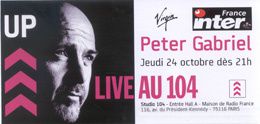
Carlos Santana car c’était le 1er concert organisé au 104. Peter Gabriel, un rêve paraissant inaccessible et qui pourtant a eu lieu et a donné une soirée mémorable au public présent et aux auditeurs de France Inter.

Le prochain concert sera donc celui de Manu Chao qui vient de sortir un nouvel album. Un concert unique en France puisque Manu ne sera pas de retour sur une scène française avant plusieurs mois. Ca a été dur de le convaincre ?

Sur l’idée, non. Car Manu connaît bien France Inter et je crois l’apprécie. Par contre, côté organisation, c’est un gros travail qui mobilise beaucoup d’énergie auprès des équipes de France Inter et Radio France.

(...)

Bernard Chérèze, quels seront les prochains artistes à se produire au studio 104 ?

Au départ il s’agit toujours d’un coup de cœur, d’une volonté partagée avec l’artiste. Et donc, par définition, il n’y a pas, et il n’y aura jamais, de planning pour ce genre d’événement.

Pour finir, y a-t-il un artiste qui vous aimeriez voir au tout prix au studio 104 ?

I have a dream : David Bowie

Merci beaucoup !

Remerciements : France Inter, Bernard Chérèze & Séverine (mille mercis !!)
Crédit photo : France Inter / DR - Radio France / Christophe Abramowitz

22 août 2007

Nusrat Was My Elvis


Tuesday 21 August 2007 13:30-14:00 (Radio 4 FM)
Repeated: Saturday 25 August 2007 15:30-16:00 (Radio 4 FM)


On the tenth anniversary of Nusrat Fateh Ali Khan's death, Navid Akhtar examines the musical legacy of the hugely influential Qawwali singer, Akhtar's spiritual and musical hero. Nusrat's haunting voice enraptured millions across the globe and he successfully collaborated with countless top western musicians and film-makers.

Listen again here

On Petergabriel.com :

To mark the 10th anniversary of Pakistani singer Nusrat Fateh Ali Khan's death, journalist and film-maker Navid Akhtar examines the legacy of this musical megastar whose haunting voice enraptured millions across the globe and who successfully collaborated with countless top Western musicians.

It was American singer-songwriter Jeff Buckley who, in 1993, described Nusrat Fateh Ali Khan as "his Elvis". In this programme, Akhtar looks at how this musician of an art form distinctive to Northern India and Pakistan became a global superstar in his own right and the most famous artist to emerge from the sub-continent since Ravi Shankar.

Akhtar examines the impact Nusrat had on Asian culture in the UK and on the global music scene of the Eighties and Nineties. He tracks Nusrat's path from a long line of Qawwali musicians who sang devotional love songs at the shrines of the Sufi priests, to the voice on soundtracks of films directed by the likes of Martin Scorsese, Oliver Stone and Tim Robbins.

And, through Akhtar's personal story, listeners learn how Nusrat's music enabled a young Pakistani teenager to connect to his own cultural background.

Contributors include Nitin Sawhney, Massive Attack's Robert Del Naja, Bollywood superstar Amitabh Bachchan and Peter Gabriel.

21 août 2007

his is the World Service - of global music

Listened to by millions, from Uganda to Iraq, Charlie Gillett may be the most influential DJ on the planet.

Charlie's world music hot properties

At last weekend's Womad festival in Wiltshire, a lot of the movers and shakers of world music - the record company bosses, promoters and media types - were absent, put off by the floods and severe weather warnings.

Wags had dubbed it Womud. But it would take more than that to put off Charlie Gillett, the 65-year-old DJ and hugely influential world-music enthusiast, who I watched playing a DJ set at the small but appropriately titled Under A Tree Stage on the Sunday.

For his weekly programme on the BBC World Service, Gillett has a considerably larger audience than the Womad crowd - it runs into millions. "One guy emailed last week from Uganda," says Gillett, "to say he woke up from a nightmare, put on the radio and heard me playing Ali Farka Touré - he included his phone number, so I called him back." Other recent emails have come from US military personnel and ordinary citizens in Iraq.

I met Gillett the day after Womad, in the South London house, where he has lived with his family and his massive record collection since 1969. He bought the place for £5,000. "The mortgage was less than my weekly paper bill," he says, which has helped him pursue his often poorly paid adventures in global music.

Next week sees the release of what has become the essential annual overview of the world music scene, his Sound Of The World compilation series. The two-CD set mixes better-known bands such as Tinariwen, Gotan Project and Ladysmith Black Mambazo with his latest discoveries. "One change in the last few years is the number of exciting new women singers," he says. "This compilation is two-thirds female."

Gillett first had the notion that he might have an ear for discovering music in 1962, when he became a Bob Dylan fanatic after hearing a track in a record store in the US "months, at least, before anyone back home". His Masters thesis for Colombia University, a history of popular music, was published to acclaim as a book, The Sound Of The City, in 1970 and is still in print.

He began his first weekly radio programme, Honky Tonk, in 1972 on Radio London, where he stayed till 1978. While punk didn't much interest him - "the rhythms were too boring" - he did discover numerous artists, including Dire Straits. "I played the demo of Sultans Of Swing and seven record companies had rung before the end of the programme." Other acts he brought to public notice included Ian Dury, who he managed for a while, Graham Parker and Elvis Costello ("the only one who rang in to thank you for playing his demo").

He joined Capital Radio in 1980 but "left before I was pushed" in 1983. Listeners complained, and he was offered another show. "I told the radio station I was getting a lot of response to what I called at the time 'tropical' records" and he began A Foreign Affair, the first world-music radio programme.

"I knew from experience that not only would there be an audience, but they would put me right if I made mistakes, and introduce me to music I didn't know about." He was the first British DJ to play Youssou N'Dour and Salif Keita.

The conservative nature of British radio disappoints him. "If you think of how other aspects of life have changed - the number of foreign players in the Premiership, the diverse range of global restaurants in the high streets - radio here is pretty xenophobic." He is puzzled that multi-million selling artists such as Spain's Manu Chao or Cesaria Evora from Cape Verde are so rarely played on Radio 1 or 2.

Gillett makes no claims to musical infallibility - he saw one of the first Velvet Underground gigs and "didn't understand them", and he has of a blind spot for Brazilian music: "a lot of it is a bit too much like lounge music for me." But he follows his enthusiasms wherever they lead "regardless of what is deemed hip or fashionable".

A bout of illness caused him to resign last year from his popular BBC Radio London show - he hopes to "come back with something maybe next year" - but the internet means his World Service show is more heard than ever, and his website soundoftheworld.com has an impressively lively forum.

With the demise of John Peel ("I didn't like most of what he played - but he was great to listen to anyway"), Gillett must be the most universally admired veteran broadcaster in the land - and his enthusiasm remains infectious. I saw him as the sun went down on the last night of Womad listening to the Portguese fado singer Mariza, who he, of course, has helped immeasurably.

"Where does she get that amazing voice from?" he asked, thrilled by yet another great global singer.

Interview by Peter Culshaw (telegraph.co.uk) 02/08/2007

24 juillet 2007

The World of Womad, BBC Radio 4, 1.30pm July 24, 2007

The title of the musician Nitin Sawhney’s programme is partially tautologous, given that Womad is itself an abbreviation of World of Music, Arts and Dance, the first festival of which took place before a small but appreciative crowd at the Bath and West Showground in 1982. These days, of course, Womad is massive – “Womads” have now been held in 27 countries, and the latest begins on Friday. Here Sawhney looks to the past, and forward to the future, with a host of cool friends, Peter Gabriel, Billy Cobham and Charlie Gillett, the journalistic guru of world music, among them.


BBC RADIO 4 Tuesday 24 July 2007/ The World Of Womad/ Tuesday 24 July/ 1.30-2.00pm BBC RADIO 4

The World of Music, Arts and Dance, or the Womad festival as it's more commonly known, brings together artists from all over the globe, and, this year, celebrates its 25th birthday. Musician Nitin Sawhney charts the festival's history, from a small crowd of open-minded music fans at the Bath and West Showground in Somerset in 1982, to a massive cultural and musical celebration that has taken place in 27 countries worldwide.

From the very beginning, educating people about the culture behind the music was as important as the music itself. To this end, the Womad Foundation charity organises workshops at the festivals as well as other educational and outreach projects in this country and abroad, and Nitin visits one of these at a school in Malmesbury, Wiltshire. He also travels to one of Womad's international festivals, in Spain, and talks to some of the musicians performing there and the audience about their Womad experiences.

The programme includes contributions from Peter Gabriel, Thomas Brooman, Billy Cobham, Sheila Chandra, Guo Yue and Charlie Gillett.

Presenter/Nitin Sawhney, Producer/Julia Hayball

http://www.bbc.co.uk/pressoffice/proginfo/radio/wk30/tue.shtml#radio4