Articles review on the net, revue d'articles sur la toile


Inscription : feeds, flux :
(Atom) Gabriel Real World News

29 février 2008

Toulouse : Youssou N'Dour en concert au Bikini

Devenu star planétaire grâce au tube 7 Seconds en Duo avec Neneh Cherry, Youssou N'Dour revient avec un nouvel opus. Huitième disque du chanteur sénégalais à bénéficier d'une sortie internationale, Rokku Mi Rokka est sorti le 29 octobre dernier. Il vient en jouer des morceaux le 4 mars au Bikini.

Rokku Mi Rokka signifie "Donner et recevoir" en Pulaar. C'est une langue parlée dans plusieurs pays d'Afrique dont le Sénégal pays d'origine de Youssou N'Dour. Sur cet album, il continue de promouvoir la musique africaine et ses traditions en invitant de nombreux musiciens locaux et chantant la majorité des titres en dialectes wolof, langue la plus parlée au Sénégal.

Youssou N Dour qui a trouvé son inspiration au nord du Sénégal et dans la zone désertique qui s'étend entre le Mali et la Mauritanie, retrouve pour le premier single extrait de cet opus, Wake Up sa partenaire fétiche Neneh Cherry. Ils avaient connu un succès mondial en 1994 avec 7 Seconds, écoulé à plus de 2 millions d'exemplaires.

Le chanteur sénégalais que le magazine américain Time considère comme l’une des 100 personnalités les plus influentes au monde en 2007, a collaboré avec des artistes comme Sting, Peter Gabriel, Tracy Chapman, Paul Simon, Axelle Red, Wyclef Jean (ex-Fugees) ou encore Dido. Il a également écrit la musique du spectacle Kirikou et Karaba actuellement en tournée en France.

C'est d'ailleurs à cette occasion qu'il se produit au Bikini le 4 mars. Alors pensez à réserver vos places dès maintenant.

Thomas Fossati

D'après le film Kirikou et la sorcière

"J'ai inventé l'histoire d'un petit garçon, intense et fonce-dedans, et d'une sorcière - une sorcière diabolique et superbe, qui fait rêver les hommes et intrigue l'enfant, dans la splendeur de l'Afrique Noire. Un premier miracle a eu lieu. Un dessin animé "dont personne ne voulait", Kirikou et la Sorcière, est devenu un succès marquant et a touché beaucoup de monde, et en bien des endroits dans le monde.

Un deuxième miracle m'émerveille : mon petit conte et mes petits dessins prennent corps extraordinairement, grâce à Victor Bosch qui a produit Notre Dame de Paris sur scène, et à Wayne McGregor, un jeune chorégraphe et metteur en scène surdoué que les théâtre et opéras du monde s'arrachent, et une troupe irrésistible". "Michel Ocelot"
Réalisateur : Michel Ocelot.
Chanteur : Youssou N'Dour, Christophe Minck, Rokia Traoré.
Chorégraphe : Wayne Mcgregor (metteur en scène).

Rock - Vampire Weekend

« Imaginez le répertoire des Talking Heads de la fin interprété par les Talking Heads du début », écrivait un critique américain (enthousiaste) à propos du premier album des New-Yorkais de Vampire Week­end. Pas mieux, comme on dit au jeu. Mais on peut toujours affiner ce jugement fort pertinent. Ne serait-ce que parce que le groupe de funk-world-new wave du très cérébral David Byrne est devenu depuis quelque temps la réfé­rence incontournable et, du coup, passe-partout, pour décrire nombre de formations dans le vent (Franz Ferdinand, Clap Your Hands..., Yeasayer...) qui mettent du rythme exotique dans leur art rock d'étudiants. C'est sûr, les quatre acolytes de Vampire Weekend, tous sortis de l'université Columbia, chantent plus volontiers l'architecture baroque (Mansard Roof) que les filles faciles et paraissent plus épris des tambours du Burundi que du « one-two-three-four » des Ramones. Mais ça n'en fait pas un groupe poseur et barbant pour autant.

Car si les chansons de Vampire Weekend se promènent entre des ambiances empruntées au soukous ou à la juju music, il en émane une candeur et une sincérité qui rappellent l'Orange Juice d'Edwyn Collins lorsqu'il subissait l'influence de son batteur zimbabwéen Zeke Manyika. Plus encore, la fluidité du doux chant d'Ezra Koenig évoque celui d'un autre New-Yorkais grand aventurier des sons, Paul Simon. « Tout ceci paraît bien forcé, un peu comme Peter Gabriel », chante-t-il sur l'un des sommets de l'album, Cape Cod Kwassa Kwassa, et l'on ne peut que sourire. Comme jadis les Talking Heads (on y revient) dans leurs savoureux clips, Vampire Week­end manie à merveille l'autodérision. Si bien que, conquis par le naturel (car rien ici ne paraît surchargé ou, justement, forcé) de ces forts en thème, on se repasse en boucle l'irrésistible M79, ravi par son kitschissime arrangement de cordes dans la pure veine du Rondo Veneziano !

Hugo Cassavetti Telerama n° 3033 - 01 mars 2008

25 février 2008

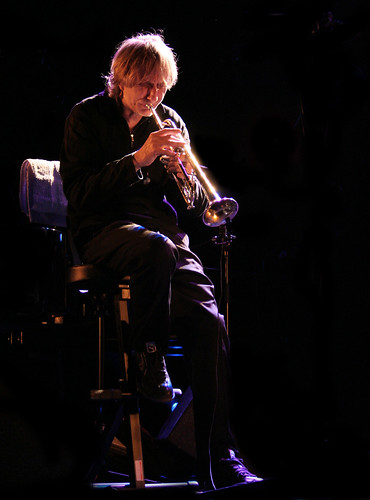
Interview d' Erik Truffaz pour Citizen Jazz

Erik Truffaz, trompettiste franco-suisse qui situe son jazz entre rock, drum’n bass et musiques ethniques, aime mélanger les genres en se souciant peu des étiquettes qu’on lui colle un peu vite. Pour Citizen Jazz, il fait le tour de ses récents projets.

extrait de l'interview:

Tous ces composants sont assez pop, est-ce parce que tu as toujours rêvé de jouer de la guitare dans un groupe de rock ?

Pas vraiment. Au départ, pour la trompette, je n’étais pas doué. Zéro. Alors j’ai creusé un truc et j’ai travaillé comme un fou sur un principe pour en tirer quelque chose qui me corresponde. Mais je n’y arrivais pas. Tu sais, la trompette, c’est comme le tir à l’arc, ou certains arts martiaux, si tu n’atteins pas l’endroit précis, c’est foutu. Donc, il faut apprendre la bonne façon de souffler. Et trouver son équilibre.

- J’ai lu dans Jazzman que l’un de tes vœux serait de pouvoir composer comme Wayne Shorter.

Tu penses que j’ai dit une connerie ?

- Non, pas du tout, je voulais savoir ce que tu entendais par là ?

Je pense que Wayne Shorter est un des plus grands compositeurs de ce siècle. Ce type amenait trois ou quatre thèmes à Miles par semaine. Il travaille avec une telle facilité, sans piano, sans rien… Ça c’est un vrai compositeur, comme Debussy ou Ravel. Ce n’est pas comme moi qui mets un mois ou plus pour écrire laborieusement une compo. Et avec un piano ! Je sais composer, mais je ne suis pas doué pour ça. Je suis peut-être plus doué pour écrire des mélodies. Des mélodies qu’on retient. Ce qui me plaît, c’est le rythme et les mélodies. Ça tombe bien, car j’ai une équipe de tueurs au point de vue rythmique, et moi j’apporte les mélodies.

- C’est à nouveau cet esprit groupe rock ?

Oui, mais on fait du jazz. Shorter faisait ça avec Miles aussi. Sur Filles de Kilimanjaro, ce sont les mélodies, des thèmes qui tournent, qui se décalent. In A Silent Way est travaillé aussi dans le même esprit. J’adore ça. Mille fois plus qu’un disque de Wynton Marsalis. Et puis, c’est vrai, j’aime les chanteurs. Dans le groupe, on est tous un peu des chanteurs frustrés. J’adore Peter Gabriel, le chanteur de Coldplay, les Beatles, Led Zep… Ça c’est la musique avec laquelle j’ai grandi et que j’aime....

(...)

Jacques Prouvost

24 février 2008

The Video: Saatchi & Saatchi Award for World Changing Ideas

LifeStraw(R), a revolutionary personal water-purification tool for use in the developing world, today has won the fifth Saatchi & Saatchi Award for World Changing Ideas. It was announced this evening by Her Royal Highness Princess Badiya of Jordan at a high profile presentation ceremony in New York. To view the Multimedia News Release, go to:
http://www.prnewswire.com/mnr/saatchi/31984/

Peter Gabriel
, commented, "LifeStraw(R) is a wonderful, simple and elegant solution to a problem that kills millions of people, especially kids, every year. I hope it gets out into the world in huge numbers very fast."

Tune Up’s tribute to late, great musician Martyn Bennett

The second Tune Up tour of 2008 will see the work of maverick Scottish musician and composer, the late and much-missed Martyn Bennett, celebrated in style, with performances from Mr McFall’s Chamber, Tom Bancroft, Frasier Fifield and James Mackintosh.

The eight-date Scottish tour ‘Aye: An Affirmation of Martyn Bennett’ opens in Perth Concert Hall on Tuesday, March 18, and will visit villages and venues across Scotland as part of the Scottish Arts Council’s Tune Up initiative.

Now in its fifth year, the initiative takes the highest quality music, from traditional to experimental, world music to cabaret, chamber music to pop and rock, to venues across Scotland, and has established itself as a significant international touring programme.
Bennett, who died in 2005 aged 33, was a piper, fiddle player and creative genius who combined classical and jazz elements with Scottish traditional music and the beats of the 90s rave and dance scenes, creating powerful and memorable compositions.

Upon hearing Bennett’s final masterpiece ‘Grit’, revered folklorist Hamish Henderson commented “what brave, new music…”, an observation shared by members of Mr McFall’s Chamber and reflected in their own, often experimental, repertoire.

An eclectic chamber ensemble, Mr McFall’s Chamber will perform a unique programme which highlights Martyn Bennett’s profound understanding and unique interpretation of Scottish folk music.

The band features a core string quartet from The Scottish Chamber Orchestra with piano, bass, drums and percussion. Formed in the mid-90s, the ensemble is well-known across Scotland, the UK and on the European festival circuit for their innovative mix of musical genres. They creatively programme the work of classical and contemporary composers alongside rock, tango, kletzmer, cartoon music and jazz.

A range of Martyn’s work including Cuillin Music (a composition for string quartet, percussion and small Scottish pipes) now features as part of the McFall’s varied body of live and recorded work, which in the past has included the likes of King Crimson, Frank Zappa, Ennio Morricone and contemporary composers such as Gavin Bryars and Dave Heath.

Mr McFall’s Chamber is joined by Scottish composer and multi-instrumentalist Fraser Fifield and percussionists Tom Bancroft and James Mackintosh. The set will include pieces by Fifield and composer Edward McGuire (both written exclusively for Mr McFall’s Chamber).

Commenting on the tour Ian Smith, head of music at the Scottish Arts Council, said: Martyn Bennett, whilst dying at a tragically young age, has left us with such an incredible legacy of great work, brilliantly encapsulated in his last album “Grit” for Peter Gabriel’s Real World label. This tour, featuring McFall’s Chamber, not only celebrates Martyn’s life and creative genius, but also takes that music to so many of Scotland’s communities, all of whom will identify with emotive and moving music performed by such fantastic musicians.”

(...)

Alison Anderson

Candid Records Launch New Label Imprint Cake

London based label, Candid Records have launched a new imprint as a platform for new dynamic bands and artists at the forefront of the British jazz music world. Cake reflects a new A & R strategy and move towards instrumental jazz that is forward thinking with a contemporary edge and includes artists such as The Blessing and The Neil Cowley Trio.

The Blessing
are four seasoned musicians who have played with bands such as Portishead, Goldfrapp and Peter Gabriel and now producing some of the edgiest and freshest jazz/rock around at the moment. They have stormed onto the UK jazz scene, taking riffs and rhythms from rock and dance music and artfully welding them onto fearsomely inventive improvisation. The Blessing's catchy, rocking tunes and snappy arrangements create a genre-bending blend of sounds that is all their own. The album 'All Is Yes' is now available on CAKE (audio sample now available on www.candidrecords.com) and this exciting band are currently on tour of the UK.

The Neil Cowley Trio is jazz act with a unique voice. Witty, dynamic and exciting, their themes feature catchy hooks, soulful moments and thrilling climaxes. After stints with artists such as Pasadenas, Gabrielle, Brand New Heavies, Zero 7 and his own band, Fragile State, Cowley formed a jazz trio and released his debut album 'Displaced' to huge critical acclaim (BBC Jazz album of the year 2007). With Richard Sadler on double bass and Evan Jenkins on drums, Cowley has assembled a master jazz trio. The NCT is set to release its debut for the Cake label 'Loud..Louder...Stop!' due for UK release on 31st March 2008.

Distinction internationale pour LifeStraw

LifeStraw : Distinction internationale pour l'inventeur suisse d'un dispositif de purification d'eau

Une entreprise helvétique s'est vu décerner le "Saatchi & Saatchi Award For World Changing Ideas" pour le développement du LifeStraw, un dispositif astucieux et économique permettant de purifier l'eau polluée.

Le LifeStraw est un dispositif révolutionnaire de purification d'eau que l'on peut porter en permanence sur soi et qui retient les bactéries et les virus. Sa mise au point a valu à l'entrepreneur lausannois Mikkel Vestergaard Frandsen de recevoir le "Saatchi &Saatchi Award For World Changing Ideas" lors d'une cérémonie à New York.

Cette distinction mondiale, décernée tous les deux ans par Saatchi & Saatchi, récompense des idées susceptibles de changer le monde. Le gagnant reçoit la somme de 100 000 dollars, dont 50 000 en liquide et 50 000 sous forme de soutien marketing accordé par Saatchi & Saatchi.

Pour plus d'un milliard d'êtres humains n'ayant aucun accès à une eau propre, le LifeStraw est une invention révolutionnaire. Ce dispositif permettant de boire se présente sous la forme d'un tube de plastique mesurant 31 centimètres de long, trois centimètres de diamètre et pesant 40 grammes. Les tests montrent qu'il retient 99,9999 pour cent des bactéries et 99,99 des virus. Le LifeStraw contient des filtres textiles et des chambres de purification chimique. Sa durée de vie est d'une année et il peut purifier environ 700 litres d'eau.

L'inventeur du LifeStraw, Mikkel Vestergaard Frandsen, a déclaré: "Nous sommes extrêmement heureux d'avoir reçu cette importante récompense. Elle renforcera la notoriété du LifeStraw et facilitera sa diffusion auprès des plus pauvres de ce monde."

Et Bob Isherwood, Creative Director de Saatchi & Saatchi Worldwide, d'ajouter: "Chacun des dix finalistes était exceptionnel et source d'une grande inspiration pour nous tous. L'idée qui a prévalu est absolument extraordinaire. Pour la première fois, le LifeStraw promet une eau potable propre à plus d'un milliard d'êtres humains, ce qui changera le monde."

Le jury se composait du médecin et auteur britannique Edward de Bono, du musicien et artiste de vidéo britannique Peter Gabriel, du prince jordanien El Hassan bin Talal, de l'artiste et créateur de mode britannique Malcolm McLaren, de l'astrologue américaine Carolyn Porco et du designer français Philippe Starck.

Pour toute information complémentaire sur le LifeStraw, connectez-vous sur: www.lifestraw.com

17 février 2008

Tuva Begins the Year of Khoomei

In Tuva a gala-concert in the Muzdramteatr (Music-Drama Theater) officially opened February 13 the Year of Khoomei. Khoomei is a unique vocal phenomenon, whereby in the performer's throat sounds of different pitches are created simultaneously. In effect, the person becomes like an orchestra. Today khoomei became the worldwide calling card of Tuva. In the summer of 2007 the art of Tuvan throat singing enraptured Vladimir Putin and his guest Albert II, Prince of Monaco.

Tuvans were first acknowledged by outsiders back in the 1980s. In 1992, the first international symposium about throat singing in Kyzyl attracted not only scientists, but also performers from around the world--from France, Japan, Canada, the Netherlands, and Finland.

Today, Tuvan masters of khoomei (the name of two-voiced singing) have gained the ability to hang out at the houses of western mega-stars, the attention of Hollywood, and participation in the most distinguished talk shows in America. Legendary Frank Zappa persistently invited the musicians of group "Huun-Huur-Tu" to his home, gladly fitted himself with a Tuvan folk outfit and eagerly listened to throat singing. And Stevie Wonder, according to eyewitnesses, simply burst into tears when he heard a joint appearance by Tuvan throat singers and a Bulgarian women's chorus. Peter Gabriel was offended by the Tuvans of the group "Shu-de", who "worked too long and forgot about everything" in his studio and ignored the maestro's invitation to come to his daughter's birthday. With the help of khoomei, Kongar-ool Ondar associated with highest-paid showmen of America, David Letterman and Chevy Chase, on their high-rated talk shows.

Each of these Tuvan groups has its army of worshippers, who listen to all their discs, adjust their schedules according to the tour schedules of their idols and readily follow them around the world.
Every year, hundreds of worshippers of Tuvan throat singing travel to Tuva, wanting to study khoomei in its native land--in the center of Asia. Associations of throat singers appear and work in Japan and Finland. In these countries, champions in the performance of throat singing are determined at "domestic" tournaments. These national champions, in turn, are granted the honor of leaving for Tuva to compete with Tuvan throat singers.

On "khoomei" more than one dissertation has been defended. (See Mark van Tongeren of the Netherlands and Tran Quang Hai of France.) Musicologist Zoya Kyrgys dedicated 25 years of study to Tuvan throat singing. The result of this study became her doctoral thesis. In the opinion of the scientist, specifically in the technique of sound production lies a vital distinction of Tuvan khoomei from other types of throat singing. Tuvan performers do not limit themselves to using the oral cavity and the larynx, as often occurs from in two-voiced singing of other people, but rather they sing with support of the chest, with the chest acting as a sound resonator, asserts the author. This is one type of corporomusic, in which the body actually works as a musical instrument. To denote Tuvan throat singing, the Tuvan musicologist uses the new working term "khorekteer" ("to chest-sing" in Tuvan).

Zoya Kyrgys became one of the head promoters in advancement of khoomei. At the end of the 1980s, she together with notable throat singer Gennady Tumat initiated the creation of the first ensemble of throat singers--"Tuva". The core of the group's repertoire was archival writings (songs, tales, prayers), collected in the course of field expeditions by the scientists of TNIIYALI. Then "Tuva", in time, became a factory of "throat" personnel. Out of "Tuva" came Kaygal-ool Khovalyg, Kongar-ool Ondar, Stanislav Tanmaa, Boris Kherlii, Otkun Dostay, Ivan Saryglar, Evgeniy Oyun and many others. Many of them decided to make their own groups which further on became quite popular. "Tuva"'s repertoir made up of Zoya Kyrgys archive findings served as a basis for them. Thus unknown old songs became sung everywhere.

The resolution about the declaration of 2008 as Year of Khoomei was accepted at the end of 2007 by the Government of the Republic. "Khoomei is one of the main properties of our culture," states Vice-Premier Anatoli Damba-Khuurak, who heads the organizational committee for conducting the

Year of Khoomei in Tuva. "The Year of Khoomei is declared not only with the goal of advertising this unique cultural phenomenon, but also for dealing with practical questions. In particular, earlier retirement for performers of throat singing, and creating a digital audio-visual archive of throat singing. We also intend to attain inclusion of khoomei in the list of objects of nonmaterial cultural heritage of UNESCO."

Declarations of the Year of Khoomei will pass not only in Tuva, but also in cities in Russia and abroad. In the Republic of Tuva, where practically one out of three men performs khoomei, a gathering of throat singers will take place in the summer of 2008. There is even an idea to register a record in the Guinness Book for the greatest number of people simultaneously performing khoomei.

Rodney King's Children

Human rights activist Sam Gregory on fighting oppression with video cameras

Over the last few years, a brave group of Arab activists has circulated footage of Egyptian cops striking, lashing, and even raping detainees. The torture videos, which had been filmed by the policemen themselves, prompted protests both inside and outside the country. They also prompted censorship: YouTube temporarily shut down the dissident blogger Wael Abbas' digital video channel after the company received complaints about the violent clips.

The channel can now be viewed on YouTube again. Much of its footage can also be seen on a website called The Hub, which is what YouTube would look like if it had been designed by Mohandas Gandhi. The site first appeared in pilot form in 2006, and a beta version launched in December 2007; over 500 pieces of media—videos, audio clips, photo slideshows—have been uploaded to it since its debut. The offerings range from raw footage of a massacre in Guinea to a detailed documentary about forced labor in rural Brazil. Most are accompanied by further information on the issues examined and on ways to take action against the abuses.

The site was created by Witness, a Brooklyn-based group founded by the pop star Peter Gabriel in 1992. Conceived in the wake of the Rodney King beating, the group first focused on getting cameras into the hands of human rights groups around the world and then on training them in the most effective ways to use those tools—creating, in Gabriel's phrase, a network of "Little Brothers and Little Sisters" to keep an eye on Big Brother's agents. Now Witness wants to move that community of camera-wielding activists online.

Gabriel serves as the group's celebrity face and as chairman of the board, but he stays out of the organization's day-to-day operations. Those decisions are made by people like program manager Sam Gregory. A human rights activist since he first joined Amnesty International in his teens, the U.K.-born Gregory became a student filmmaker at college, where he "was always trying to find a way to combine" his two interests. In addition to his managerial work, Gregory, 33, has co-produced videos about human rights issues in Burma, the Philippines, Argentina, Indonesia, and the United States.

Managing Editor Jesse Walker met Gregory at the DIY Video Summit at the University of Southern California, where Gregory gave a presentation about The Hub; Walker interviewed him via phone in mid-February.

reason: How did Witness get started?

Sam Gregory: Peter Gabriel had been traveling the world with the Amnesty human rights tour in the late '80s. He repeatedly encountered activists who were saying, "We've experienced this abuse, we've heard these stories of abuses, and we have no ways of responding." He had been carrying a Hi-8 camera with him, and it struck him that if those activists had access to cameras they would be able to document what was happening around them and share it in a way that would be totally different from the typical text-based approach.

(....) read more here...

Jesse Walker | February 15, 2008

Polar Arts : Richard Evans Management

About Polar Arts

Polar Arts was founded in 2000 by Juliette Slater & Jane Kelly. The company offers a bespoke service for management, tours and events in the live industry.

Richard began working at Realworld Studios, not long after graduating from Guildhall School of Music. He was nurtured under the creative eye of Peter Gabriel, and many talented producers such as Daniel Lanois, Travor Horn, Stephen Hague, Bob Ezrin, John Leckie and Brian Eno. He has since gone on to work on many albums, films & multimedia projects. Recent work included co-producing and co-writing the Golden Globe nominated score for ‘Rabbit Proof Fence’. He has also performed around the world as multi-instrumentalist in Peter Gabriel’s touring band.

Richard has worked on records, commercials, documentaries, feature films and 2006 has found Richard working on a typically varied set of projects. He is always looking for new creative challenges. Please contact us for further details or to set up a meeting.

WALL-E Gets Some Tunes From Peter Gabriel

I’m terribly excited over WALL-E. Pixar has shown that they can do no wrong so far, and this year’s release doesn’t look to change that at all. Every glimpse we get of the little robot, from his newfound place in the Pixar logo to the Super Bowl commercial featuring Buzz Lightyear and Woody talking about WALL-E just excites me more and more.

Today’s cause for excitement: Andrew Stanton has apparently brought Peter Gabriel on board to help with the music for WALL-E. The scope of Gabriel’s involvement ins’t quite clear, but in his latest video blog, Gabriel discusses a little about the picture, revealing a few things we didn’t know before and drawing some comparisons between WALL-E and the classic 2001: A Space Odyssey.

We know from the trailers that the movie centers around a small robot who was left behind on Earth to clean up garbage after mankind moved to the stars. The environmentally conscious musician says that Pixar consulted with NASA and, based on description of bone deterioration in space, humans are being made to look like “flat blobs in armchairs.” That sounds really cool to me.

Apparently Gabriel has been involved with the picture for some time (he says Stanton approached him in 2005) and he thinks the movie is going to continue the Pixar legacy of films that are appropriate for kids but also contain content for adults as well. I’m guessing that’s the environmental message Gabriel is talking about, but only those involved know for sure right now.

As for how much Gabriel is creating for the movie, the musician describes his contribution as creating one or two new things as well as putting some glue on things he’s done before. I’m not sure if that means he’s just creating a few songs for the movie or if he’ll be scoring it as well, like he has previously with films like The Last Temptation of Christ. Either way, I’m excited to hear some Gabriel tunes accompanying WALL-E.

I’ve hit the high points here, but if you want to hear Gabriel talking about his involvement himself, click over to his video blog entry. Be warned however: the musician talks about his broken leg (the result of a skiing accident) as well as engineering designs of a friend of his before he even begins to mention the Pixar project in what winds up being a thirteen minute long video.

preview

By Rafe Telsch: 2008-02-13

13 février 2008

Grammy winner Angelique Kidjo launches headlining trek

Fresh off her first Grammy win, world music songstress Angelique Kidjo is getting ready to hit the road for headlining tours of North America and Europe.

The African-born singer will kick things off Feb. 21 in Seattle and play cities all over the US, as well as a couple of Canadian provinces, through April 9. She will immediately segue into her European jaunt, which runs into late May. North American dates are listed below and overseas shows can be found at Kidjo's website.

Last Sunday, the singer won the Best Contemporary World Album Grammy for her latest release, "Djin Djin." In her acceptance speech, she dedicated the award to the "women of Darfur, the women who are fighting every day to give their kids an education."

"Djin Djin," which surfaced in May, has Kidjo partnering with guest stars including Alicia Keys, Peter Gabriel, Carlos Santana, Joss Stone, Ziggy Marley, Branford Marsalis and Josh Groban, with whom she toured last year. The critically acclaimed set, produced by Tony Visconti (David Bowie, Morrissey), reached No. 58 on The Billboard 200 and nabbed the top spot on the magazine's World Albums chart.

The record follows 2004's "Oyaya!" and is billed as a return to Kidjo's Beninese roots, capturing the most traditional rhythms from her country. It comprises material sung in her native languages as well as in English and French. A couple of songs from the set are streaming at Kidjo's MySpace page.

In addition to her music career, Kidjo has devoted much of her adult life to global charity work, according to a press release. She is a spokesperson for UNICEF and Oxfam, and recently created her own charity, Batonga, which aims to create a culture that values and supports the secondary education of girls in Africa.

February 12, 2008 By Kym Kilgore LiveDaily Contributor

WOMAD February 2008 Update

By now, those New Year's resolutions will have been broken and the detox diet forgotten. So, you'll be ready to gorge on a feast of musical delights and flavours at WOMAD Charlton Park 2008.

The festival returns for a second time to Charlton Park and the confirmed dates are Friday 25th - Sunday 27th July 2008.

The WOMAD festival weekend aims to create a musical adventure, a journey with no particular destination. Your fellow travellers are the sixty-odd artists from 36 countries who bring their music, dance and expression to the festival.

We have a really great line-up in store for you at WOMAD Charlton Park this year plus we'll be offering more workshops, more participation and a re-designed and expanded festival site with improved access, car parking and camping facilities.

Some of the artists featured at WOMAD Charlton Park 2008 will be familiar to the festival audience, others entirely new. It's just up to you, to jump in and take a bite!

and more... http://www.realworld.co.uk/mailouts/womad_110208/wm_110208.html

10 février 2008

Flautist to pipe in Chinese New Year

Internationally acclaimed flautist Guo Yue


As the Chinese New Year dawns today, there is a plethora of related cultural events taking place around Liverpool and the region. The internationally acclaimed flautist Guo Yue, whose music enhanced films like The Last Emperor and The Killing Fields, arrives with his charming bamboo flutes on Friday.

His is the first in a series of Chinese related concerts in the Philharmonic Hall’s Rodewald Suite as part of its After Eight programme. He is followed by cellist Semay Wu and singer Seaming To who appear with their amazing electronic effects in a couple of weeks, followed by The Silk String Quartet at the end of the month.

Guo was born in Beijing, but left China in 1982 to study at the Guildhall School of Music. With his brother Guo Yi, he has performed at international festivals and concerts, including The World of Music, Arts and Dance.

He first performed his bamboo flutes concerto My Peking Alley with the BBC Concert Orchestra at Womad almost 10 years ago, and also performed the soundtrack for the Channel Four television documentary Beyond the Clouds.

Guo commented: “In ancient Chinese philosophy, life is about four things: sadness, happiness, being apart and being together. Looking back on my childhood as the youngest son of a violinist, growing up in a large musical family in the alleys (hutongs) of Beijing, I would agree.”

The Rodewald concert is part of an exciting six-month programme of events promoted through the China Now banner to raise the profile of China in Britain in 2008. But the first Year of the Rat event is surely the launch of a major Chinese art exhibition at The Egg Cafe venue in Newington tonight. It features the works of five Chinese artists, and has been coordinated by well-known painter and calligrapher Xia Lu, who is based in Liverpool. Along with other artists from China, she is showing 57 different pieces.

* GUO YUE – Rodewald Box Office 0151 709 3789/Chinese Art Exhibition: www.eggspace.org

Feb 7 2008 by Lew Baxter, Liverpool Daily Post

09 février 2008

"Book of Love" wake-up

The seven Atlantis astronauts are awake for their first full day in space and getting ready for today's chief activity: inspecting their spaceship's heat shielding for any damage that might have been done during Thursday's launch from Kennedy Space Center. Mission Control beamed up Peter Gabriel's Book of Love as this morning's wake-up music for the shuttle astronauts.

http://www.news-press.com/apps/pbcs.dll/article?AID=/20080208/NEWS01/80208001/1002


The astronauts awoke Friday to "Book of Love" by Peter Gabriel, a dedication to French Air Force Gen. Leopold Eyharts from his wife and family. Eyharts greeted his loved ones in English and French, saying, "I know it has been a somehow hard day for them and I want to thank them."

http://ap.google.com/article/ALeqM5h1W8dcUP9H70AmlSfDSenPteDT9gD8UM78R80

Artists Support Record Store Day

Saturday, April 19 has been declared Record Store Day in the USA and big name artists are getting behind the campaign.

Paul McCartney said in a statement, "There's nothing as glamorous to me as a record store. When I recently played Amoeba in LA, I realised what fantastic memories such a collection of music brings back when you see it all in one place. This is why I'm more than happy to support Record Store Day and I hope that these kinds of stores will be there for us all for many years to come. Cheers!" The day is a promotional drive by Independent retailers to rekindle the thrill of scouting through music releases.

"I was introduced to lots of great music through my local record store. It was a place where people knew music and they knew me, and could make great suggestions and discoveries. Whether it is in the physical world or on-line, the value of a great and knowledgeable record store has not gone away,"
said Peter Gabriel. Singer/Songwriter was a little bit more poetic with his quote. "Dusty violin maker shop small corner record store water holes for dreamers don't stop breathe more," he said.

Blur's Damon Albarn says his local store is like a library. "My local independent record shop (Honest Jons) is a library, where you can go to listen to music, learn about it, exchange ideas about it and be inspired by it. I think independent record shops will outlive the music industry as we know it because long term their value to people is far greater, because even in our era of file-sharing and blogs, you cant replace the actual look on someone's face when they are playing something they really rate and think you should listen to it too. It's special," he said in his statement.

As a prelude to Record Store Day, an introductory party will be held at Waterloo Records at SxSW in Austin on March 15.

by Paul Cashmere - February 6 2008

Lanois’ U2 Warm-up

“I’M doing some writing with (Brian) Eno and U2,” mega-producer Daniel Lanois tells Spinner magazine when asked about his work with Bono and the boys on their new CD. “We’re gonna knock out another record that’s promising to be a fantastically innovative collection of songs. I’m excited about that.”

Lanois is much more than a U2 insider. His fingerprints have been all over the production knobs of some of the greatest CDs by the likes of Peter Gabriel, the Neville Brothers, Willie Nelson and Bob Dylan. He creates that trademark spooky, atmospheric vibe on the discs he touches. It’s that same aura that made U2’s The Joshua Tree unlike anything you ever heard.

Lanois has also made a number of albums on his own, and they’re just as satisfying as some of the ones he shepherded for his famous friends. He just started a record company, Red Floor Records, and has chosen to release his newest disc on the label.

A soundtrack to a homemade documentary film of the same name, Here Is What Is sports a haunting collection of rough hewn tunes. “Joy” is a spooky gospel tune set atop a churchy organ and watery pedal steel guitar riff. It’s a little bit country, a little bit Sunday morning. “On my way home I looked up at the sky/and the stars held up the night/destiny set me free,” he sings, a trio of pleading voices behind him in chorus. “Luna Samba” has a wicked backbeat that bounces the guitar riffs to new heights.

Lanois also revels in his collaboration with Eno, also a former U2 collaborator who appears in Lanois’ film, Here Is What Is. “I play really well with Eno,” Lanois says. “In a manner of minutes we’ve got something happening in the room that’s special — even without talking about it. We just pick up our instruments and we’re there. We just thank our lucky stars that we have that chemistry within us.” There is a snippet of dialogue from the film spoken by Eno. “I hope this film shows how beautiful things grow out of s***,” he says. “Everyone thinks Beethoven has those tunes in his head and they think that they just tumbled out. Things come out of nothing. The most beautiful seed can sometimes grow into a promising forest.”

This disc is a fascinating look into a very different kind of life. Log onto www.daniellanois.com for more information.

February 6, 2008 From the hob

Young singer creates intelligent pop music

Courtney Jones is a self-confessed “piano-lesson dropout.” However, she did find “a couple of chords I liked. I just played them over and over again and then found some words I liked,” Jones says. It all started when she was walking home from school one day. “I just had a concept stick in my head,” she says. “Nobody ever told me I couldn’t write a song.”

That’s quite apparent from her new album “Awake & Dreaming,” a tasteful collection of her soft rock tunes that would fit comfortably in anyone’s collection along with titles from Fleetwood Mac, Sarah McLachlan and Paula Cole.
The album was mixed by Mark Needham, who’s worked with Fleetwood Mac as well as The Killers, and features a number of standout musicians, including Stevie Blacke, Bob Glaub and Butch Norton, who’ve worked with Jennifer Hudson, Bob Dylan and Lucinda Williams, among others.

One of the CD’s cuts, “Long Way Down,” is part of the soundtrack for the new movie “Cosmic Radio,” which stars Michael Madsen and Daryl Hannah, and which also features cuts from Peter Gabriel, Elton John and Cat Stevens. It’s a long way from her days as a regular karaoke singer in a pizza parlor, Jones notes. “It started to bother me after awhile,” she says. “I didn’t want to keep singing other people’s songs.”

But she also knew she didn’t quite fit in with her peers, some of whom are more concerned with producing blaring, belligerent music that rips out your heart rather than tickles your ears. She feels called to a more meditative sound. “It’s not angry enough to be any number of genres,” she says with a chuckle. “I think there’s a really subtle connection that’s happening here with music that doesn’t smash your face in with a lot of bass and percussion.”

She also knew she had no desire to create escapist fantasies for her audience. “A lot of people go for flash because they want to distance themselves from reality, their reality. But that’s not me. I go for the narrative. I want it to be what’s actually happening.”

With her father, Andrew, encouraging her to concentrate on music, Jones left college a few years back and devoted her self to writing and singing. Just 21 years old, Jones, who hails from the Salem area, has made a relatively quick rise, having already worked with some top music industry guns, including Peter Malick, who’s played his guitar alongside another Jones – Norah Jones – not to mention Muddy Waters, John Lee Hooker, Otis Spann and others.

Malick notes that unlike Norah, whose first hit “Don’t Know Why,” was written by Jesse Harris, Courtney pretty much wrote all of “Awake & Dreaming.”

“She’s a much stronger writer than Norah,” Malick says of Courtney, adding that her words betray great emotional depth. “I think lyrically she really gets into the heart of human existence, and you can’t do much better than that.”

Courtney, who’s done 140 shows over the past 15 months, has played everywhere from the House of Blues in Chicago and Room 5 in Los Angeles to Berbati’s Pan and The Roseland in Portland. She’s set to perform with her band – guitarist Mike Dongug, bassist Steve Morgan and drummer Steve Turnell – at Borders in Gresham this Saturday.

Jones hooked up with Malick through myspace.com, sending him a demo of her music, and the rest was history. “She’s got a great voice,” he says. “She is captivating.” Jones adds that she hopes his opinion is something people of all generations share. “I want to reach everybody,” she says. “I really aim to write and make music that everyone can draw from.”

By Rob Cullivan The Gresham Outlook, Feb 5, 2008 (news photo)

05 février 2008

'Songlines': How a world music magazine came full circle and found itself

The genre wasn't even recognised until 1987, but 'Songlines', which marks its 50th issue, has found an irrepressible beat, writes Jonathan Brown

"It is not a much-liked term," the former BBC producer concedes. The term "world music", it seems, was dreamt up over a few pints at the Empress of Russia pub, in the distinctly British confines of Islington in 1987. Among the group gathered were record-company owners, festival organisers and promoters who had become frustrated at the inability of their potential customers to find the latest cut by their favourite Ethiopian begena player or Portuguese fado singer when browsing in their local record shop.

"Now, you can put all these people with unpronounceable names in one place, alongside classical or opera. It has worked brilliantly," says Broughton.

The north London drinkers not only brought practically the entire musical world together under one umbrella, they even agreed to spend £3,000 promoting their niche. And while there are some – including the British-Asian composer Nitin Sawhney – who refuse to label their music thus, the niche has grown large enough to sustain a publication devoted entirely to fans willing to part with £4.25 to read the lowdown on the latest sounds emanating from the streets of Dakar, Belize or Jerusalem.

Songlines sprang into life in 1999 as an occasional supplement to the stately Gramophone magazine, the leading classical-music publication. The venture was conceived in response to a growing interest in music from beyond the English-speaking world and outside the confines of Anglo-American musical norms.

Aware that they had tapped into a vibrant market, the publishers soon spun off the supplement into a quarterly, if somewhat academic-looking, magazine in its own right. Broughton, who had broadcasting experience and had worked on the original Rough Guide to World Music published in 1994, was at the helm when Gramophone was acquired by Haymarket.

"They inherited it and kept it going for a couple of years, but Haymarket didn't really know what to do with it. It just wasn't their scene, so they decided to stop it. But by this time, it had made a big impression and a lot of people were upset to see it go," he recalls.

The magazine was still fairly niche, barely breaking even with just 1,500 subscribers out of 8,000 copies sold. But brighter times were in store when the title was purchased for the nominal fee of £1 – complete with the potential debt of unmet subscription payments.

Financial backing was secured from Chris Pollard, the former owner of Gramophone, and Rough Guides veteran Mark Ellingham. The magazine was redesigned, with a larger format, and it went to eight issues a year – each with a free multi-track CD of new music attached to the front cover.

Today, with a staff of five journalists and a small army of freelance writers, all experts in their field around the world, Songlines has undergone another injection of capital and relocated to new headquarters in Shepherds Bush. The bottom line is also looking healthier with a circulation of 20,000 copies, a quarter of which are sold by subscription.

Although the majority of readers are in the UK, the magazine reaches a significant audience overseas, particularly in the United States where it has no competition and where publishers see major potential for growth. The Songlines website offers a slimmed-down version of what is on offer in the magazine, plus the opportunity to listen to free podcasts on iTunes and the rundown of the latest world-music chart.

With a predominately well-educated, affluent, thirty-something readership, which Broughton says includes as many women as men, the appeal to advertisers is obvious, not least on the back of the current boom in live music.

Full-colour adverts for a dizzying array of festivals, shows, albums and travel feature heavily throughout the 100-plus pages of the magazine.

But world music offers much more than some simply beautiful tunes, says Broughton.

"It is not just about the musical interest – it is also a window on politics around the world. It is a way of looking at a much broader picture. What is interesting is that people come to it from so many different denominations, whether it is Radio 3, through folk or through travel. I am very aware we have to cater for all these audiences," he says.

It is also a force for good, Broughton says. "Take Pakistani Sufi music: someone like Nusrat Fateh Ali Khan (below). Extremist Islam is what grips the headlines, but if you listen to his work you realise that there is a whole different side to Islam, which is about peace and love."

We're having a vinyl revival

Everywhere you look, dark clouds are gathering over the music industry. Sales were down 10 per cent last year. The number of songs illegally ripped off the internet outnumbers legal downloads 20 to one. Last week, the musician Peter Gabriel told an industry conference in Cannes: "It's time to put the corpse of what we know as the record industry in the ground and let some other beautiful things start to grow out of it." At the same conference, U2's manager, Paul McGuinness, saw things differently - even if he agreed on the death bit. "The collapse of the old financial model for recorded music will also mean the end of the songwriter," he warned. As REM once sang, "It's the end of the world as we know it".

Yet there is a bright spot amid all this gloom: specialist vinyl shops are experiencing a mini-boom, and they're feeling fine. "Vinyl record sales aren't affected by downloads," says Phil Thomson, the owner of The Vintage Record in Annandale, which specialises in vinyl LPs from the 1940s onwards, with a classic rock bent. He bought the shop two years ago, and doesn't stock CDs. "It's all doom and gloom if you're selling CDs now," Thomson says. "I figured you can't download a record, you have to go out and buy it. So I took a punt, and it's paying off."

The mood is similarly buoyant at many of Sydney's other specialist music shops, from Newtown's Egg Records (second-hand vinyl, CDs, DVDs and memorabilia) to Birdland (jazz, soul and blues) in the city and Erskineville's Revolve Records Relics ('50s to '80s vinyl, prog, funk, jazz and hip-hop).

A steady stream of analogue purists, collectors, diehard fans, DJs and young converts keeps business turning over nicely. "Rumours of our demise are [exaggerated]," says Kieran Stafford, the owner of Birdland since 1991.

To a certain extent, specialist outlets are insulated from the effects of illegal downloading because of the type of customers they attract by offering deep back catalogues, rarities and knowledgeable staff.

"The downloads market is predominantly the Top 40 market - which is why singles don't exist any more," Stafford says. "They're the kind of people who think they've got a record collection when they've got two records. Our average customer probably buys one or two albums a week."

The appeal of LPs is not only nostalgic; it is also tactile and aesthetic. You lose sound quality and the romance of the object with downloads, say the store owners. Coveting a limited-edition green vinyl 12-inch of the Cure's song The Forest? (That's $80 at Revolve.) An original local pressing of INXS's Listen Like Thieves? ($16 at The Vintage Record.) The complete On The Corner sessions by Miles Davis in an embossed metal box? ($180 at Birdland.) To teenagers used to getting their music for free, the maths doesn't add up; but for fans the price is beside the point.

"I'm finding that kids are starting to come back into the shop thanks to bands like Wolfmother citing their influences as Led Zeppelin, or similar," Thomson says. "There's also been a bit of an '80s revival - Duran Duran, Adam and the Ants, the Eurythmics - kids are coming in and buying them on vinyl."
Barry Scott, the owner of Egg Records, has also seen a surge in vinyl sales. "Business is fine," he says. "We also sell reconditioned turntables, and I sell one every week or two. It figures they're going to buy vinyl." CD sales are only a tiny fraction of the business at Revolve - the bulk is vinyl and memorabilia. Employee Peter Prifunovic says: "The boss tells me vinyl sales have been growing over the last three years. It was one of the reasons he hired me. We get fairly young customers, anywhere from 18 up, and generally male. Younger guys don't collect so much, they come in to buy records to sample."

The vinyl market is not only second hand: reissues are good sellers, and such acts as Radiohead, Bjork, the White Stripes and Ben Harper have released their latest records on vinyl. Recently, a boutique pressing plant called Vinyl Factory Australia opened in Marrickville. Thomson talks about unsigned bands offering songs for download on MySpace and then pressing a seven-inch when enough people have shown an interest.

It's not all good news. Graham Nixon, who has run the punk and hardcore specialty shop Resist Records in Newtown for 10 years, says downloading has had an enormous impact on his sales. "I'd say 80 per cent of customers under 20 come in and they don't look at music, they go straight to the T-shirts," he says.

Stafford thinks the future of music retailing will include physical and digital sales.

"I think it won't be one or the other but a mixture of both," he says. "Not everyone's interested in downloading. The quality is not as good. As for the big stores - whether or not they survive, I don't care. We'll still be here."

Time they are changing

- The recorded music industry has changed enormously in the past five years. In 2003, there were about 30 legal download services available; now there are more than 500.

- People can legally access about 6 million songs online.

- The digital music share of the global music market has moved from almost zero in 2003 to 15 per cent or $US3 billion last year.

- In 2003, customers could buy an artist's release in only a few formats - typically on CD.

- Last year, Justin Timberlake's Future Sex/Love Sounds was released in 115 products or formats (including ringtones, mobile full-track downloads, video, iTunes and others) which sold a total of 19 million units. Only 20 per cent of its sales were CDs.

Kelsey Munro