Articles review on the net, revue d'articles sur la toile


Inscription : feeds, flux :
(Atom) Gabriel Real World News

24 septembre 2007

Manu Katché: "Miles Davis est un maître"

Batteur attitré du gotha de la scène pop-rock et juré impitoyable de La Nouvelle Star, Manu Katché, signe son retour avec Playground (terrain de jeu) son deuxième opus, enregistré à New York avec son quintet de musiciens européens. Douze ballades aux climats zen et impressionnistes qui évoquent le Miles Davis de Kind of Blue et de Birth of the cool...Il s'explique pour leJDD.fr.


A écouter l'album, on vous devine comme un type assez contemplatif...

Définitivement. Je peux m'asseoir pendant trois heures pour regarder la montagne et les nuages. Sans m'ennuyer une seconde. Pareil à la mer ou sur la terrasse d'un café. C'est une activité solitaire, pas toujours facile pour mon entourage, mais j'ai besoin de me retrouver seul avec moi pour laisser mon esprit se balader et me retrouver dans une espèce de somnolence. Chacun a sa manière de se retrouver en soi-même pour ensuite délivrer de purs moments de plaisir.

Certains morceaux évoquent directement Miles Davis...

Dans mon premier album, il y avait aussi des références à l'album Kind Of Blue. C'est un maître, un leader d'opinion musicale, il a su passer les époques sans jamais se répéter, avec le souci constant de se renouveler et de se réinventer. Je l'ai rencontré une seule fois pendant la tournée Amnesty 88 avec Peter Gabriel dans le New Jersey, au Giant Stadium. Après le concert, Miles était dans les loges et il me dit de sa voix caverneuse: Man, you sound great (Mec tu sonnes bien). Je n'ai malheureusement jamais joué avec lui.

Vous semblez adhérer à sa philosophie: "Jouer peu de notes mais de belles notes...

Oui, je ne suis pas un grand fan de milliards de notes jouées en une mesure. Mais je respecte, chacun sa façon de s'exprimer. Dans la musique, il faut toujours penser au silence, le respecter, lui laisser une place. Cela peut paraître étonnant pour un batteur de dire ça. Mais quand le silence est bien placé, la note qui suit est juste magique.

L'album a été enregistré en trois jours. Pourquoi si vite ?

C'est la règle dans le jazz. Les budgets ne sont pas les mêmes que pour les albums "mainstream" pop ou rock. Trois jours, c'est quand même un peu court. Avec une semaine on aurait été vraiment très confortables. Là, il faut aller un petit peu plus dans l'urgence. Ce qui n'est pas désagréable non plus. On va à l'efficacité. On a répété une journée et on a enregistré en deux jours, dans les conditions du live, tous ensemble dans le studio, à l'ancienne.

Enregistrer à New York, c'est inspirant ?

Quoi qu'on en dise, New York demeure la Mecque du jazz. Et puis j'adore cette ville pour son architecture, son énergie, avec les coursiers le matin, le bruit... Et même si l'album est assez zen, je trouvais bien de me nourrir de cette énergie parfois agressive, au sens positif du terme, pour ensuite se retrouver dans un îlot ouaté et de jouer une musique assez zen, plénitude. Le prochain album, on ira peut-être l'enregistrer au Caire, une mégalopole bouillonnante que l'on présente souvent comme le "New York du Proche-Orient".

Dans votre quintet, on retrouve deux musiciens polonais et deux musiciens norvégiens. Fâché avec les jazzmen américains ?

Evidemment, j'adorerais jouer avec Branford Marsalis ou d'autres. Mais je me sens plus d'affinités avec les Européens. En fait, j'ai l'impression que le jazz européen a vraiment pris le pas sur le jazz américain. Il fut une époque où on était vraiment très complexé. Si on n'était pas noir américain né à New York, c'était une catastrophe. Ce n'est plus le cas aujourd'hui. La musique instrumentale européenne se construit par le mélange du jazz avec sa liberté d'improvisation mais aussi avec l'influence de la musique classique. Bien plus que dans le jazz américain. Et c'est une force.

"Je ne me revendique pas comme un jazzman"

Vous avez une éducation musicale classique. A quand remonte la rencontre avec le jazz ?

Cette musique a été omniprésente durant toute mon enfance. De huit à douze ans. A la maison, mon beau-père écoutait beaucoup de be-bop. A l'époque, je m'entraînais à la batterie dans la cave de mes grands parents en écoutant les disques de Dizzy Gillepsie, Bird ou du regretté Art Blakey...

Vous vous considérez comme un jazzman ?

En fait j'ai du mal à utiliser le mot "jazz" pour décrire ma musique... Dans ce milieu, on trouve beaucoup de puristes, des "intellectuels de la chose" très sourcilleux quant à l'utilisation du mot "jazz". Pour eux, "Manu Katché ne saurait être un jazzman". Et c'est vrai. Je ne me revendique pas comme un jazzman. A mon petit niveau, je fais de la musique instrumentale, à connotation jazz. Le problème avec les puristes, c'est qu'ils refusent souvent de voir cette musique s'enrichir d'autres influences et d'autres univers. Au risque de la scléroser et d'en faire une musique "musée".

On vous retrouvera à la télé dans le jury de La Nouvelle Star ?

Non c'est fini. Pour de bon. J'ai fait quatre saisons, je me suis bien amusé, ça m'a apporté beaucoup et je n'ai pas l'impression d'avoir vendu mon âme. Mais cette année, j'avais envie de concentrer sur la tournée. En revanche, je continue One Shot Not sur Arte, qui passe en mensuel en janvier 2008. Je fais encore un peu de télé, mais différemment, moins grand public, plus axée sur mes goûts personnels... On retrouvera Annie Lennox, Ben Harper, Craig Armstrong, Jamie Cullum et Peter Gabriel.

Votre album s'appelle Playground, soit terrain de jeu... c'est un clin d'oeil au terrain vague de votre enfance ?

Je n'y avais pas pensé, mais c'est vrai que môme, j'ai passé beaucoup de temps à jouer sur un terrain vague près de chez mes grands-parents. Pour la petite histoire, c'est sur ce même terrain que fut construit le conservatoire où j'ai commencé mes études de musique. Sans doute un signe du destin...

CD. Playground (ECM/Universal)
En concert le 8 octobre. Théâtre des Champs-Elysées.

Propos recueillis par Eric MANDEL/ leJDD.fr

23 septembre 2007

Rhythms without frontiers

Angélique Kidjo delights in breaking the boundaries of ‘world music’ – even when she is going back to her roots

Angélique Kidjo’s singing career began at the age of six, with her mother’s theatre troupe in Benin, west Africa. But when the military dictatorship forced her to sing for them, “I felt raped in my soul, my free will stepped on,” she recalls. She fled to Paris in the 1980s to become the West’s most successful African diva, a singer-songwriter melding African sounds with jazz and funk, latin and gospel. Yet her message for anyone wanting to harness her voice – whether tyrannical regimes or roots purists sniping at her “crossover” appeal – is clear. “It’s my vision of my music and my culture,” she stabs the air. “Nobody has a right to tell me what to do with it.”

We are sipping herbal tea in a smart hotel in the centre of Paris, though Kidjo, a petite dynamo with a close crop of dyed-blonde hair, now lives mainly in New York. She will be at the Barbican, in London, on September 28 as part of Passage of Music, a series of events marking the bicentenary of Britain’s abolition of the slave trade.

Her new album, Djin Djin, features longtime collaborators Carlos Santana and Branford Marsalis, with song partners including Peter Gabriel, Amadou and Mariam, Alicia Keys, Joss Stone and Ziggy Marley. Kidjo’s powerful voice combines classical and jazz training in Paris with zilin, a blues-like vocal technique from Benin. Most of her songs are in her mother tongue, Fon – including a mesmerising a cappella version of Ravel’s Boléro. “I can sing a cappella any music you give me,” she says. “Traditional musicians in Africa have no microphones – all you have is your ear.”

Djin Djin is a return to her source: “In Benin, the rhythms are so complex.” Finding a flowering of talent there after the return to democracy in the early 1990s, she built the album around traditional percussionists from the Gangbé Brass Band. The album producer, Tony Visconti (veteran of David Bowie and T Rex recordings), was sceptical. She laughs, “I said, ‘Tony, trust me. I know the power of the drums. When they start speaking, you follow.’ ” She says that the “world music” tag “used to make my blood boil. Now I don’t care – I know it’s human nature to try to categorise people in order to feel in charge”. She is also used to annoying the purists, who cast doubt on her authenticity. “I’ve been bashed left and right by people who want to have control. I never fit those clichés. I grew up listening to all genres.” For the musicians of her childhood, “music had no frontiers, no colour, no language – you do what you have to do to touch people’s soul”.

Africans should be unafraid to borrow from American music, she says, since “they’re only taking back what’s theirs”. Her album trilogy, Oremi (1998), Black Ivory Soul (2002) and Oyaya! (2004), traced West African influences along the slave routes into the Americas, from the Deep South to Cuba and Bahia in Brazil. “Everywhere I go, I find a bit of my country and the African continent,” she says. Listening to reggae, she heard traces of the gogbahoun rhythm from her own village, while in samba she heard drumming from Benin’s ceremonial vodu – a term local followers of the ancestral religion prefer to “voodoo”.

“Rock’n’roll would not exist without the blues, which started in the cotton fields. They took the drums away so Africans couldn’t communicate, but we communicated by song.”

It was music that first made her aware of slavery, when she saw an image on an album cover, and asked “how people could be African and American at the same time”. She was born in 1960 in Ouidah, on Benin’s coast, a key port in the slave trade. But at school “everything made for an amnesia. It had to be explained by my grandmother”. Benin was a musical crossroads, from Zairean rumba and Cameroonian makossa, to the samba of slave descendants returning from Brazil speaking Portuguese creole – including Kidjo’s maternal grandfather.

One of nine children, she was introduced by her siblings to rock and Motown, and sang with the Kidjo Brothers Band. But when the 1972-90 dictatorship of Mathieu Kérékou decreed that “all artists had to praise the regime, I said I’d rather die”. Moving to Paris in 1983, she had ambitions to be a human-rights lawyer. “But after three months in law school I thought, I’m better off with a microphone.” After singing with the afro-jazz group Pili Pili in Holland and Germany, Kidjo was signed by Chris Blackwell of Island Records in 1989, and had dancehall hits in the 1990s.

Her classically trained husband, bass guitarist Jean Hébrail, became her producer. They have a teenage daughter, Naima, who plays piano. Her work in the American diaspora “redoubled the pride I had”, she says. “If we Africans could have such a musical influence, then we can use music to have an impact on other issues.” She sees Live8 as a “good idea, but the way it was handled was wrong. If you want to help Africa, you have to work hand in hand with Africans. You can’t be Bob Geldof and tell us African artists can’t play in Hyde Park because people will turn off the television. It’s taking the public as stupid”.

Kidjo has been a Unicef good-will ambassador since 2002, and recently met French politicians in Paris after visiting Sudan’s Darfur region. “The politicians are realising if they don’t find a solution to Darfur, they’ll be held responsible – unlike the Rwandan genocide,” she says. She has also just launched Batonga, a foundation to pay for girls’ education in five African countries. “When you get that chance in life,” she says, “you’ve got to give back.”

Djin Djin is out tomorrow; Angélique Kidjo plays the Barbican, EC2, on Friday

Maya Jaggi

I would make a great courtesan

Seventies supermodel Marie Helvin lived and loved at the centre of a hyper-glamorous set but in all her affairs all she wanted was sex

There was a time when it was pretty much impossible to pick up a fashion magazine without seeing a picture of Marie Helvin. Alongside her best friend Jerry Hall she was an icon of the late 1970s, a proto-supermodel married to David Bailey, the bad-boy cockney photographer who had elbowed aside the Lichfields and Snowdons to become the toast of Harper’s and Vogue.

Helvin’s look defined the times: her face had a combination of innocence and knowingness and her exotic heritage – Japanese mother, Danish-American father, childhood on the beaches of Hawaii – stood out, even in a hyper-glamorous crowd. Mick Jagger, Hall’s then boyfriend, made up a foursome with the Baileys and there were parties seemingly every night – with Eric Clapton, Jack Nicholson, Trudie Styler and Sting, Peter Gabriel and Warren Beatty just a few of the celebrity cast on an ever changing guest list. (...)

22 septembre 2007

About Helvin

(...) Marie Helvin started modelling as a teenager and has worked non-stop ever since on catwalks, on the pages - and covers - of every magazine imaginable, and on television. She published three books and designed her own line of clothes before returning to modelling at 50, proving that not only wine and cheese improve with age. But she's bought a ranch in a tiny Hawaiian town with a hitching post outside the grocery shop, so you can tie up your transport while doing the weekly shop. (....)

Helvin takes a lot of flak for her honesty because she's open about enjoying sex and romance without any urge to cohabit or remarry. Her beaux make an impressive list, from a pre-Withnail Bruce Robinson to Peter Gabriel and Eric Clapton. She turned down Warren Beatty, and succumbed to Jack Nicholson after many years, only to find it a let-down. Mark Shand proposed, but she turned him down. "The last thing I wanted to do was get married again. I was free. I am spoiled, and back then I was even more so. I missed out on a chance to be with somebody great. I can't regret these things, I can only explain how it happens. It doesn't work for me to say, 'Oh, I'm so sad.' I was in love with two really great guys but I was not able to keep them. It's my fault." (....)

LEE RANDALL

Daniel Lanois : Here Is What Is

HERE IS WHAT IS (Documentary -- Canada ) A 422190 Ontario Inc. production. Produced by Daniel Lanois. Directed by Adam Vollick, Daniel Lanois, Adam Samuels.

With: Daniel Lanois, Brian Blade, Garth Hudson, Brian Eno, Adam Samuels, Tony Garnier, Brady Blade Sr., Carolina Cerisola, Aaron Neville, U2, Sinead O'Connor, Emmylou Harris, Willie Nelson, Billy Bob Thornton, Steve Nistor, Aaron Embry.

Devoted fans of producer-performer Daniel Lanois might enjoy the welcome-to-my-studio tour "Here Is What Is," which he co-directed with Adam Vollick and Adam Samuels. Anyone else, though, is likely to find this an interminable vanity project whose subject proves an inarticulate guide to his own creative process. Crudely shot glimpses of U2, Aaron Neville, Sinead O'Connor and others at work provide just a modest boost to a pic destined for modest DVD release.

Lanois has lent a distinctive touch to other's records, creating a dense, ethereal character via his pedal-steel guitar and experimentally layered mixing. His own music takes this atmospheric style to its logical end, though the songs tend to blur together. He's not the best explicator ("I just kinda got hooked into doin' cool things with sound") of his methods, providing little insight into his work with famous folk (Dylan, Peter Gabriel, etc.). Longtime collaborator Brian Eno proves contrastingly down-to-earth and cogent in several tete-a-tetes. Beyond capturing some impressive musicianship (notably from innovative drummer Brian Blade), this deliberately low-grade presentation is a chore to watch, unalleviated by solarized-color bits and gratuitous dance interludes.

Camera (B&W/color, DV-to-35mm), Vollick; editors, Vollick, Lanois; music, Lanois. Reviewed at Toronto Film Festival (Special Presentation), Sept. 12, 2007. Running time: 88 MIN.

By DENNIS HARVEY

Les passeurs de Culture

Dimanche après-midi


Pierre Foglia/ La Presse

Cela s'appelle On fait tous du show business , c'est à la télé de Radio-Canada et cela s'annonce comme une très bonne émission culturelle d'après mon collègue Hugo Dumas. C'est animé par Catherine Perrin, la madame culture de C'est bien meilleur le matin. Si j'ai bien compris, elle va refaire, mais en moins people, ce que Christiane Charette faisait Chez Roger, qui était une très bonne émission aussi, mais égarée aussi le dimanche après-midi. C'est là que je voulais en venir: le dimanche après-midi.

Cela s'appelle On fait tous du show business, je ne trouve pas que c'est une bonne idée pour un magazine culturel. La culture, ça devrait être justement quand on arrête de faire du show business. Je ne la regarderai pas, pas à cause du titre. Mais parce que le dimanche après-midi, de 15h à 17h heures, je ne regarde pas la télé. Je suis dehors, je marche dans le bois ou je pédale. Quand il ne fait pas beau, je lis ou je travaille. Et si j'allume la télé, c'est pour regarder la NFL. Jusqu'au mois de janvier la NFL, après janvier on recommence à rouler (à la cave) pour préparer la saison de bécyk.

Pourquoi c'est toujours le dimanche après-midi les émissions culturelles à Radio-Canada?

Parce que, m'explique mon collègue Hugo Dumas.

Merci, Hugo.

Allez, je ne suis pas si déconnecté que ça. Je sais bien pourquoi. Les cotes d'écoute et tout ça. Un magazine culturel parce que la culture c'est dans le mandat d'une télé publique. Mais le dimanche après-midi parce qu'au fond, la télé publique, elle s'en crisse de la culture. Comme ça tout le monde est content. On pourrait dire que la culture c'est comme le jus de pruneaux, c'est bon pour la santé, mais ça fait chier.

D'ailleurs, je crois qu'il y a un grand malentendu à propos de la culture à la télé et de la culture en général.

La culture est souvent définie comme une somme. J'ai lu 12 millions de livres (je ne parle pas de moi, là). Je suis allé 43 257 fois au musée (là non plus!). J'ai étudié le Siècle des lumières. J'ai étudié non seulement les beaux-arts mais l'art de vivre des différentes civilisations et des différentes classes à l'intérieur de chacune de ces civilisations. J'ai appris à reconnaître les objets que ces civilisations ont produits. Eh bien non. La culture n'est pas la somme de ces connaissances-là.

Au lieu de considérer la culture comme un état, on devrait l'envisager comme un moment, le moment où l'on reçoit, où l'on participe à un discours culturel, où l'on est mis en présence de mots, de sons, de formes qui viennent nous arracher au quotidien, aux habitudes, je sens que vous allez regimber, qui viennent nous arracher à la consommation, tout particulièrement à la consommation de la culture.

Céline Dion ne nous arrache à rien du tout. Mais Anna Gavalda non plus. Pavarotti non plus. Giacometti non plus. On est dans l'assouvissement.

On reprend les mêmes et on demande à des intellectuels - des passeurs - de dégager un discours sur l'influence de Céline Dion, de détricoter le minimalisme de Gavalda, de comparer l'opéra-pop à la world de Peter Gabriel. On demande à des passeurs - la culture est le moment du passage - de nous émanciper de la simple consommation.

La culture, c'est la tentative que l'on fait de devenir adulte de temps en temps, de fermer un peu la gueule à l'enfant en nous, l'enfant qui veut toujours jouer, toujours manger des bonbons sucrés à s'en rendre malade, l'enfant qui veut toujours jouer à des jeux merdiques, la valise, le banquier, le paquet voleur.

La culture, ce n'est pas tout savoir du Quattrocento florentin, c'est quelqu'un qui t'en parle, et le lien que tu fais tout seul avec la musique ou avec la création romanesque. C'est le moment où tu penses tout seul. Juste un petit moment adulte. Juste un petit moment culture. La télé est, enfin serait, un sacré bon médium pour ce genre de moment. Pas toutes les cinq minutes, bien sûr. En tout cas, pas le dimanche après-midi quand Pittsburgh, deux victoires aucune défaite, reçoit les 49ers invaincus aussi...

19 septembre 2007

Interview de Bernard Chérèze (France Inter)

Double exclusivité sur le Zapping du PAF cette semaine ! La première, est une interview de Bernard Chérèze, le Directeur artistique et de la musique de France Inter qui a crée les concerts privés du studio 104 pour France Inter. Seconde exclusivité, c'est qu'à l'occasion du concert privé que va donner Manu Chao le 29 septembre prochain, Le zapping du PAF en partenariat avec France Inter vous offre deux places pour ce concert privé ! Et parole de France Inter, les gagnants seront chouchoutés !

Pour gagner ces places, lisez l'interview, c'est Bernard Chérèze qui vous pose la question ! A vous de jouer !

7 ans déjà que vous avez créez ces concerts de studio 104, comment vous est venue cette idée ?

France Inter affichait déjà sa différence avec des émissions offrant des prestations live aux artistes en développement. Il nous manquait des concerts exceptionnels avec les plus grandes stars nationales et internationales. De plus le somptueux studio du 104 et la qualité des équipes techniques nous offraient la possibilité de se lancer dans l’aventure.

Depuis 7 ans, de nombreux artistes se sont produits dans ce désormais mythique studio 104, quel est votre ou vos meilleurs souvenirs ?

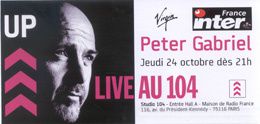
Carlos Santana car c’était le 1er concert organisé au 104. Peter Gabriel, un rêve paraissant inaccessible et qui pourtant a eu lieu et a donné une soirée mémorable au public présent et aux auditeurs de France Inter.

Le prochain concert sera donc celui de Manu Chao qui vient de sortir un nouvel album. Un concert unique en France puisque Manu ne sera pas de retour sur une scène française avant plusieurs mois. Ca a été dur de le convaincre ?

Sur l’idée, non. Car Manu connaît bien France Inter et je crois l’apprécie. Par contre, côté organisation, c’est un gros travail qui mobilise beaucoup d’énergie auprès des équipes de France Inter et Radio France.

(...)

Bernard Chérèze, quels seront les prochains artistes à se produire au studio 104 ?

Au départ il s’agit toujours d’un coup de cœur, d’une volonté partagée avec l’artiste. Et donc, par définition, il n’y a pas, et il n’y aura jamais, de planning pour ce genre d’événement.

Pour finir, y a-t-il un artiste qui vous aimeriez voir au tout prix au studio 104 ?

I have a dream : David Bowie

Merci beaucoup !

Remerciements : France Inter, Bernard Chérèze & Séverine (mille mercis !!)
Crédit photo : France Inter / DR - Radio France / Christophe Abramowitz

Best of two worlds

"Every artist dips his brush in his own soul, and paints his own nature into his pictures" said Henry Ward Beecher.

Art resides in every human being; whether its nature or day to day happenings we all create art in our minds but it's very few who are able to paint through their mind's eye.

"I have been painting for 17 years now, what started as a hobby has become my profession," beamed Alex Stewart.

Alex Stewart, a British born artist is show casing his 7th art exhibition in our little island, while speaking to him , he shared his passion and history with us.

"My paintings are based on the spiritual aspect of what I see, like the Fool (the jester in a king's court), I see the jester as an innocent thinking figure that appears in my paintings. Like the fool there are also angels clothed in saris and flying three wheelers which have their own significance."

Speaking about the exhibition at the Barefoot Gallery, Alex added that it took him 6-9 months to prepare 31 paintings for the show. The pictures for the exhibition were painted in two basic themes; lovers and separation and used only water colours as his mode of painting for this exhibition. While some paintings explore people going through their day to day lives some pictures portray the theme and some paintings represent people's dreams.

"I staged my first exhibition in 1995 and since then have staged around 7 shows. The last exhibition I held in Sri Lanka was themed on the tsunami and I also have staged exhibitions in the United Kingdom, India and America," he added.

Speaking on how he gets his ideas on canvas ,Alex said, "Though I start off with an exact idea, something happens in between and then I end up painting something very different from what I started."

He also added that when observing his environment, he makes note of things he wants to paint in a book and then later recalls the situation which will in the end trigger a feeling which he would base his painting on.

Unlike most artists, Alex is lucky having enough to experience in the best of two worlds, "being an artist and a DJ gives me the opportunity to live and experience the world of solitude and also enjoy the world of society, so I live life in two extremes," he added smilingly.

Alex in presently DJs at popular nightclubs in the U.K once a month and was also the guest DJ when WOMAD performed in Sri Lanka.

"After I finish a painting, I spend time with it and then exhibit it. There are times where I have understood the painting only after looking at it 6 months after I finished painting it. I try not to sell any painting that I have not completed or spent time with, since each painting is very important to me," he voiced. Alex said that painting for him is like writing; a method he uses to put down his thoughts into canvas and that color is very important as it incorporates with the paintings. "I'm very happy with this exhibition because it has changed me inwardly,"

The exhibition will commence on the 14th of September and it will go on till 30th at the Barefoot Gallery.

By Sherwani Synon

17 septembre 2007

Tutu leads world leaders to Sudan

A council of peacemaking world leaders and Nobel laureates launched by former President Nelson Mandela is taking up Darfur as its first mission, with a trip to Sudan planned later this month, the organisation said Monday.

Archbishop Desmond Tutu, who chairs the group known as The Elders, will lead a delegation that will include former US President Jimmy Carter; Mandela's wife Graca Machel, a long time campaigner for children's rights; and Lakhdar Brahimi, a former UN envoy to Iraq. Mandela will not be part of the mission. "We want the suffering to end - and we hope to contribute to that," Tutu said in a statement.

More than 200 000 people have died in Darfur and 2,5 million have been displaced in four years of fighting between rebel groups and government-backed militias.

Tutu's delegation, which will be in Sudan from September 30 to October 5, will meet in Sudan's capital with government and opposition, civil society and international organisation representatives, and will then travel to Darfur to visit local community leaders and displaced people.

"We want community leaders in Darfur to feel that they have been heard by us. And to the extent that we could then communicate their aspirations, their longings, particularly the women's groups, we will do so," Tutu said.

The new humanitarian alliance was launched to celebrate Mandela's 89th birthday in July and is dedicated to finding new ways to foster peace and resolve global crises, and to support the next generation of leaders.

The brainchild of British entrepreneur Richard Branson and musician Peter Gabriel, its members include former UN Secretary-General Kofi Annan; former Irish President Mary Robinson and Muhammad Yunus, founder of Grameen Bank, the pioneering micro-credit institution.

By Celean Jacobson- Sapa-AP

SA commemorates Steve Biko's death

Steve Biko's message of black pride appealed to many black South Africans

Black Consciousness leader Steve Biko's death in detention 30-years-ago will be commemorated today. Biko died on September 12, 1977, while in the custody of apartheid security police.

Biko's message of black pride appealed to many black South Africans. His death made him a martyr in the anti-apartheid movement and inspired films such as Cry Freedom starring Denzel Washington and British musician Peter Gabriel's anthem Biko.

The secretary-general of the Black People's Convention, Kedibone Molema, says black consciousness is now more relevant than ever. President Thabo Mbeki is scheduled to deliver the eighth Steve Biko Memorial Lecture at the University of Cape Town tonight. Mbeki is expected to focus on the relevance of Biko's legacy and black consciousness in South Africa.

Meanwhile, Azapo leader Mosibudi Mangena says the culture and value of African identity needs to be entrenched in society. Mangena, who is also science and technology minister, says he is concerned about transformation.

Youssou Ndour offre "Rokku Mi Rokka", un nouvel album en fin octobre

Le chanteur Youssou Ndour présentera le 29 octobre prochain à Paris un nouvel album intitulé "Rokku Mi Rokka (Give And Take)" qui signifie "donner et recevoir" en pulaar, une langue commune à l'ethnie peul et parlée dans plusieurs pays africains dont le Sénégal, indique le site de Sentoo, portail de Sonatel.

"Le chanteur lui-même reconnait vouloir faire un clin d'œil à cette partie du Sénégal et à ses habitants à travers son huitième album international"
, souligne le site visité dimanche à l'Agence de presse sénégalaise.

Youssou Ndour avait sorti en avril dernier au Sénégal "Alsaama Day" - un mélange de mandingue et d'anglais pour dire bonjour -, un opus de huit titres constituant une ébauche de "Rokku Mi Rokka".

A part le nom du disque, explique Sentoo, Ndour titre un de ses morceaux "Pullo Ardo" et "décline 'Sama Gàmmu', 'Dabbaax' et "Sportif" dans un style musical très proche du registre acoustique de Baaba Maal, icône de la musique pulaar au Sénégal et en Afrique".

S'y ajoute "l'apport du guitariste feu Ali Farka Touré, invité par le disque d'or sénégalais et qui a teinté les morceaux 'Létt Ma" et 'Baay Faal' de forts accents peuls et mauresques qui fait de cette galette une belle surprise musicale très sahélienne".

C'est "un vrai swing nomade propre aux peuples éleveurs de cette région sémi-désertique du continent", commente le portail relevant que la star africaine rend hommage à la société sénégalaise et au continent africain en général et la culture hal pulaar ou peul en particulier, très présente au nord, à l'est et au sud-est du Sénégal.

En outre, pour le premier single extrait de cet opus, "Wake Up", Youssou Ndour retrouve sa partenaire fétiche Neneh Cherry avec qui il avait connu un succès planétaire pour le titre "7 Seconds" en 1994 (2 millions de copies vendues).

Il y a aussi "4-4-44", "Bàjjan", "Xel" et "Tukki" qui viennent compléter la liste de cette nouvelle sortie de Youssou Ndour qui s'apparente déjà à "un futur carton", assure Sentoo.

Dans le passé, le "roi du mballax" que le magazine américain Time considère comme l'une des cent personnalités les plus influentes au monde, a collaboré avec de nombreux artistes comme Sting, Peter Gabriel, Tracy Chapman, Paul Simon, Axelle Red, Wyclef Jean (ex-Fugees), ou encore Dido.

Youssou Ndour a composé, en 1998, la musique du film d'animation "Kirikou et la sorcière" et "La Cour des Grands", hymne de la Coupe du monde de football disputée la même année en France. Il a remporté de nombreux prix dont celui du meilleur artiste africain au Kora Awards (1996). En février 2005, il a été récompensé d'un Grammy Award pour son inclassable album "Egypt" dans la catégorie meilleur album de Musiques du monde.

"Rokku Mi Rokka" est le 8-ème album que Youssou Ndour sort à l'international. Il vient après "Egypt" (Nonesuch/2004), (Nonesuch/2002) "Coono Du Réér (Nothing's In Vain)""Joko (From Village To Town)" (Virgin/2000), (Sony/1994), "Wommat (The Guide)""Eyes Open" (Sony/1992), "Set" (Virgin/1990) et "Gaïnde (The Lion)" (Virgin/1989).

Youssou Ndour est ambassadeur de bonne volonté du Fonds des Nations unies pour l'enfance (Unicef) et du Bureau international du travail (BIT). Il a mis sur pied une maison de production Jololi, le studio Xippi, et le groupe de presse Futurs Médias.

Agence de Presse Sénégalaise (Dakar)

16 septembre 2007

Come Celebrate WITNESS' 15th Birthday!

Focus for Change Benefit, Nov. 7, 2007

Come Celebrate WITNESS' 15th Birthday!

WITNESS' Focus for Change Benefit Dinner and Concert

Co-hosted by Peter Gabriel and Maggie Gyllenhaal

PGabriel_headshotFeaturing musical performances by Jackson Browne, The Roots, and other special guests

Wednesday, November 7th, 2007
The Grand Ballroom at Manhattan Center Studios, New York City
jackson_browne_headshot
At this year's third annual gala we will be spotlighting the Hub, a website where anyone, anywhere can upload videos about human rights violations from their cell phones or laptops, and connect the reality they witness to communities committed to making a difference. Come in your festive attire and be prepared to have an incredible time.

VIP Reception 6:00
Cocktail Reception 6:30
Dinner & Concert 7:15


RSVP: 718.783.2000 ext. 303 or
events@witness.org

theroots

Click here to buy tickets

RESERVATIONS

Visionary WITNESS Package - $100,000
Exclusive listing as sponsor of VIP reception
Seating for 2 at the Host Table
Plus 2 separate tables of 10 with PREMIER SEATING
Invitation for 22 guests to VIP reception
Personalized gift for each of your guests from Peter Gabriel
Recognition in event press releases & 2 invite email flashes

Star WITNESS Package - $50,000
Star WITNESS sponsorship listing at event
Seating for 2 at the Host Table
Plus separate table of 10 with PREMIER SEATING
Invitation for 12 guests to VIP reception

Lead WITNESS Package - $25,000
Lead WITNESS sponsorship listing at event
Seating for 2 at table with musical artist, host or other celebrity guest
Plus separate table of 10 with PREMIER SEATING
Invitation for 12 guests to VIP reception

Eye-WITNESS Package - $15,000
Eye-WITNESS sponsorship listing at event
Table of 10 with PRIME SEATING
Invitation for 10 guests to VIP reception

WITNESS Package - $10,000
WITNESS sponsorship listing at event
Table of 10 with PREFERRED SEATING
Invitation for 2 guests to VIP reception

Partner - $5,000
Two tickets with PRIME SEATING
Invitation for 2 guests to the VIP reception

Advocate - $1,500
One ticket with PREFERRED SEATING

Individual Ticket(s) - $750

NOTE: At the event, all corporate sponsors will be recognized at the appropriate sponsorship level with signage, logo projection and in the printed Focus for Change program. In addition, corporate sponsors will be recognized in the WITNESS annual report and on the WITNESS website’s event page.

Read more to view the Host Committee for the event!

Click here to view footage from our 2006 Gala


Read more...

Witness Turns 15!


As Witness gears up for the next fifteen years, they are highlighting the Hub, a participatory website where anyone, anywhere can upload human rights related media that can be used to create change.

Users will be able to create groups of community members with similar interests or concerns for issues that incorporate videos, online forums, event organizing and the ability to create campaigns and petitions so that video is not only seen, but also acted upon.

At Witness' third annual Focus for Change Benefit and Concert, Witness will be garnering support for the Hub amongst stars like The Roots, Maggie Gyllenhaal and Peter Gabriel.

The launch will be before 2007 ends, so keep up on the latest developments and ideas regarding WITNESS' Video Hub initiative: www.witness.org/vhblog or email tina@witness.org.

Witness is also looking for a a Hub Editorial Coordinator to work closely with the initiative. Find out more!

Starts 09/11/2007 Ends 12/31/2007

Homepage www.witness.org

Contact tina@witness.org

Biko Is Fashion Icon in South Africa

JOHANNESBURG, South Africa (AP) — T-shirts bearing the image of Steve Biko, the symbol of black resistance worldwide who was killed by apartheid police, can be found for sale at flea market stalls and exclusive boutiques across South Africa.

The question is whether the latest fashion is a sign the post-apartheid youth culture is embracing Biko's message of racial pride and African unity, or just crass commercialization of one of the most important figures in South African history.

Biko, 30, died of a brain injury in a cell in Pretoria Central Prison on Sept. 12, 1977, after being beaten and tortured by apartheid police. The 30th anniversary of his death was to be commemorated in South Africa this week with events including a speech by President Thabo Mbeki.

At 22, Kenneth Mulaudzi was born after Biko's death, and was still a boy when apartheid ended in 1994. In a trendy Johannesburg store over the weekend, Mulaudzi eyed a $28 T-shirt bearing Biko's image. "It's not just a fashion statement. It is also a political statement," Mulaudzi said. "Young people are proud of him. He is a hero. He fought for us." Mulaudzi, an aspiring journalist, knew quite a bit about Biko but hasn't read "I Write What I Like," Biko's seminal collection of essays. He does have a poster of Biko in his home and can sing the lyrics to Haitian-American rapper Wyclef Jean's song "Diallo," which draws parallels between the 1999 shooting of an African immigrant by New York police and the murder of the South African activist. "I was surprised when I heard that song," Mulaudzi said. "It means Biko has gone far."

Biko's message of black pride appealed to many people in South Africa's townships. His death made him a martyr in the anti-apartheid movement and inspired films such as "Cry Freedom," starring Denzel Washington and British musician Peter Gabriel's anthem "Biko." The end of white rule in 1994 saw Biko's appeal wane as South Africa's black majority reveled in new political and economic freedoms. However, today there is a growing disenchantment among young people who see the country's leaders embroiled in scandal and a new black elite growing richer while most blacks find it harder and harder to keep up with inflation.

Jackie Radebe, 23, who bought a Biko T-shirt after reading "I Write What I Like," sees him as a selfless leader whose politics of brotherhood are still relevant to South Africa. "He had genuine compassion for the plight of the people, genuine concern about poverty, crime and loss of pride," Radebe said. While Biko would celebrate the "breakthroughs this young democracy has achieved," Radebe believes his hero would be disappointed in the country's leaders. "As far as morals, integrity and principles ... contemporary political leaders seem to be driven by money and self-interest," he says.

June Josephs-Langa, managing director of the African-focused Xarra Books in Johannesburg's Newtown Cultural Precinct, says those wearing Biko T-shirts are making a statement. "In the same way many don't know much about Cuban politics, the revolutionary status of Che Guevara is someone they want to identify with, want to parade," she said. But Johannesburg-based academic and cultural commentator Achille Mbembe, who is delivering a lecture in Biko's honor this week, doesn't see fashion as a fitting tribute to a man whose "death and life dramatically embodies the idea of freedom. I think South Africa could commemorate Biko's contribution to black emancipation in more powerful ways," he said.

Nkosinathi Biko, who was 6 when his father died, takes a more reconciliatory tone. He points to the tradition in the anti-apartheid movement of using T-shirts to spread political messages or pay tribute to fallen comrades. He also acknowledges the wealth of artistic material created in his father's name has been important in keeping the memory of Biko alive. "He is one of the attractive symbols of popular culture. Not just here but on the streets of New York, Brasilia and Liverpool, he is someone who resonates well," he said.

On the Net: Steve Biko Foundation: http://www.sbf.org.za

By CELEAN JACOBSON

Soweto choir returns home

Theatregoers will feel an African Spirit at the Civic Theatre when the Soweto Gospel Choir arrives in town for five performances later in September.

(...) The Soweto Gospel Choir has performed alongside music icons such as Bono of U2 fame, Peter Gabriel, Queen, Red Hot Chilli Peppers, Diana Ross, Johnny Clegg, Jimmy Cliff and Bebe Winans.

The choir also sang at the 75th birthday celebrations for Archbishop Desmond Tutu.

By Tabisa Mntengwana /Johannesburg News Agency (www.joburg.org.za)

Marie Helvin about Peter Gabriel

Marie Helvin reveals why she turned down the world's most famous lothario

Marie Helvin was the world's most glamorous model and in her candid memoirs, serialised exclusively in the Mail, she reveals in the final part of our extracts, why she turned down the greatest lothario of all...

(...) Then I saw Peter Gabriel on MTV. He was my type of man. And by complete chance, I met one of his agents, who invited me down to visit Peter's studios in Bath. As soon as we met, there was that connection, that livewire charge that tells you something is going to happen, whether it lasts a night or a month or several years. We ended up having a very on/off relationship for a year or so (I was more on and he more off, to be honest). (...)

Mbeki dénonce la persistance du racisme en Afrique du Sud

30 ans après la mort de Steve Biko, les vieux réflexes perdurent

Le président Thabo Mbeki s’est déclaré, mercredi soir, "préoccupé" par la persistance du racisme et de la soumission des Noirs dans la société sud-africaine. Mbeki, qui animait la conférence annuelle sur Steve Biko dans la soirée de mercredi, à l’occasion du 30ème anniversaire de la disparition du leader de la Conscience Noire, a déclaré que la mission que Steve Biko avait donné au peuple noir, qui était de reconquérir sa dignité, était toujours d’actualité malgré la fin de l’apartheid.

"Je parle de la mission consistant à faire échec à des siècles de tentatives de nous définir comme des sous-humains que leur nature condamnait à être inférieurs aux personnes de race blanche et comme une espèce proche de l’animal caractérisée par des capacités intellectuelles limitées, la bestialité, la lascivité et la dépravation morale. Nous devons nous demander si la majorité de notre peuple, pour la liberté duquel Steve Biko a sacrifié sa vie, est véritablement consciente de sa qualité d’être humain et si ces gens ne se considèrent toujours pas comme des appendices de nos supérieurs auto-proclamés".

Le souvenir de Steve Biko

M. Biko, né en 1946 et assassiné par les forces de sécurité de l’apartheid était un militant anti-apartheid réputé en Afrique du Sud dans les années 60 et au début des années 70. D’abord leader étudiant, il avait par la suite fondé le Mouvement de la Conscience Noire qui devait responsabiliser et mobiliser une bonne partie de la population noire urbaine.

Depuis son décès dans les locaux de la Police, il est devenu un martyr du mouvement anti-apartheid. En 1972, M. Biko était devenu président d’honneur de la Convention du Peuple Noir. Son mouvement avait été interdit au plus fort de l’apartheid en mars 1973.

Malgré la répression du gouvernement de l’apartheid, Steve Biko et le BCM ont joué un rôle important dans l’organisation de manifestations dont le point culminant a été le soulèvement de Soweto le 16 juin 1976. Le message de M. Biko de la fierté noire avait séduit bon nombre d’habitants des townships d’Afrique du Sud.

Il était aussi célèbre pour son slogan "Black is beautiful". Sa mort en a fait un martyr du mouvement anti-apartheid et inspiré des films comme "Cry Freedom", avec Denzel Washington et l’hymne "Biko" du musicien britannique, Peter Gabriel.

La fin de la domination blanche en Afrique du Sud a placé au second plan les idéaux de Steve Biko, alors que la majorité noire commençait à jouir de nouvelles libertés politiques et économiques.

12 septembre 2007

Afrique du Sud: Steve Biko, reste la "Conscience noire" 30 ans après sa mort

JOHANNESBURG (AFP) — Steve Biko reste une figure populaire en Afrique du Sud, trente ans après sa mort dans les geôles du régime d'apartheid, même si les idées du père du "Mouvement de la Conscience noire" ne pèsent plus directement sur la scène politique.

"Dans la culture populaire, il est un puissant symbole d'espoir, une figure du changement", déclare son fils, Nkosinathi Biko, président de la Fondation Steve Biko.

Pour marquer les 30 ans de la disparition du militant anti-apartheid, la Fondation organise depuis juin une série d'évènements qui doivent culminer mercredi au Cap (sud-ouest) avec un discours du président Thabo Mbeki.

"Il nous a aidés à comprendre et à construire notre identité, et cela parle toujours aux jeunes Sud-Africains", poursuit Nkosinathi Biko, assurant que l'influence de son père reste réelle.

"Steve Biko est sur les T-shirts, dans des chansons, dans les journaux (...) Il attire toujours beaucoup de considération mais ses idées n'ont plus d'influence dans l'élaboration de la politique, ni au parlement", relativise Kopano Ratele, professeur à l'Université d'Afrique du Sud (Unisa).

Biko, selon lui, "est bien plus influent dans la culture populaire que dans la politique au sens strict."

Arrêté par la police du régime ségrégationniste le 18 août 1977, Steve Biko alors âgé de 30 ans, était retrouvé sans vie dans sa cellule le 12 septembre.

Dans un premier temps, le pouvoir a soutenu qu'il n'avait pas résisté à une grève de la faim mais des journalistes ont réussi à prouver que sa mort avait été provoquée par des traumatismes crâniens.

Interrogé, le ministre de la Justice de l'époque, Jimmy Kruger avait déclaré que la mort de Biko le laissait "froid". Indignée, la communauté internationale avait adopté pour la première fois des sanctions contre le régime d'apartheid.

L'écho international de cette mort tragique a fait de Steve Biko un héros de la lutte pour la libération. Les hommages se sont multipliés: films, livres, chansons. "Oh Biko, Biko... Yehla Moya, The man is dead..." (Oh Biko, Biko, esprits calmez-vous, l'homme est mort), chante le Britannique Peter Gabriel.

Trente ans plus tard, cette chanson fait toujours pleurer un autre héros de la lutte anti-apartheid, l'archevêque Desmond Tutu, qui s'est effondré quand Peter Gabriel l'a entonnée en juillet, pour le 89e anniversaire de Nelson Mandela.

"Ce morceau me touche beaucoup", confie Premesh Lalu, professeur à l'Université du Western Cap (UWC), qui estime indispensable de commémorer la mort de Steve Biko.

"Mais on doit tirer plus de ses idées", note-il. "Aujourd'hui on a tendance à mettre dans le même pot tous les opposants à l'apartheid et à oublier qu'il y avait des visions différentes".

Steve Biko s'était distingué en créant en 1969 le premier syndicat étudiant exclusivement noir, l'Organisation des Etudiants sud-africains (SASO). Contrairement aux autres mouvements de libération, la SASO refusait l'aide des libéraux blancs.

Pour Biko, la lutte devait commencer sur le terrain psychologique: "la Conscience Noire est la prise de conscience par l'homme noir de la nécessité de faire front commun avec ses frères contre l'oppression (...). Elle vise à communiquer à la communauté noire une nouvelle fierté", expliquait-il en 1971.

Treize ans après la chute de l'apartheid, ses idées restent "pertinentes", estime son fils. Pour lui, à cause du chômage et de la pauvreté, "les noirs courent toujours le risque d'être spectateurs d'un jeu auquel ils devraient participer".

Monstres de la mer: Une aventure préhistorique

v.f. de Sea Monsters: A Prehistoric Story


Date de sortie en salle : 03 octobre 2007
Genre :Documentaire
Durée : 0h40

Synopsis : La découverte d’un fossile inusité déclenche une enquête paléontologique passionnante! Faisant appel aux recherches effectuées aux quatre coins du globe, des scientifiques reconstruisent l’extraordinaire et terrible univers des océans de l’ère Crétacée : suivez Dolly, un de ces monstres des profondeurs, au cours des péripéties de son existence, recrées sur écran géant et en 3D. Un film de National Geographic et une musique originale composée par Peter Gabriel.

10 septembre 2007

30 years on Biko maintains his appeal

Former president Nelson Mandela adressed a gathering to celebrate National Heritage Day, on Robben Island, on 24 September 1997. The then-president is dwarfed by a mural of three leaders representing the three main streams of political consciousness in the country. From left to right: Nelson Mandela, leader of the African National Congress (ANC), prior to his 27-year period of imprisonment; Steve Biko, a leading figure in the Black Consciousness Movement (BCM), prior to his death in detention in the 70s; and Robert Sobukwe, head of the Pan-African Congress (PAC), prior to his imprisonment on Robben Island in the 60s.

Thirty years after dying in prison in apartheid South Africa, Steve Biko remains a historical icon, even if his "Black Consciousness Movement" no longer carries political weight. A fervent anti-apartheid and freedom activist, Biko's popularity in the new South Africa is rooted in culture, providing ideas for the shaping of the identity of young blacks rather than formal politics. "Steve Biko is on T-shirts, in music, in the newspapers," said Kopano Ratele, a researcher with the University of South Africa's Institute of Social and Health Sciences. "People who were teenagers or in their 20s in the 1970s still remember Biko with nostalgia and they credit him for giving them a sense of pride in themselves."

In 1971, Biko explained that Black Consciousness was the realisation that blacks should rally together against the cause of their oppression. "... It seeks to infuse the black community with a new-found pride in themselves, their efforts, their value systems, their culture, their religion and their outlook to life." To mark the 30th anniversary of his death on Wednesday, the Steve Biko Foundation has put on a series of events across the country since June which will culminate in a lecture by President Thabo Mbeki in Cape Town.

"In popular culture, he is a very powerful symbol of hope... an icon of change. He helped to articulate our understanding, our own identity that continues to resonate in young South Africans to this day,"
said Biko's son Nkosinathi, who manages the foundation. "His ideas have a real influence well beyond the political field, in cultural organisations, in research organisations and in churches..."

Ratele said if Biko were still alive he would be disappointed to see his ideas compromised by poverty and inequality still evident in South African society 13 years after the demise of apartheid. "If you are unemployed and poorly-paid and you see the rich blacks, of what use is your pride?" However the younger Biko feels his father's ideas are still relevant to black South Africans, and should be used by leaders to propel the country forward. "People who are entrusted (to) a position of power do not recognise the extent to which they can give direction to change in this country," he said. "In that extent his ideas are still relevant, there is a need to link consciousness of self to development programmes".

On 18 August 1977, 30-year-old Biko was arrested by police under the white minority apartheid government, and taken to a prison in the coastal city of Port Elizabeth. He was transferred to the capital Pretoria on 11 September, and was found dead in his cell the following day, becoming the 20th person to die in the prison in 18 months. While authorities said that he died after going on a hunger strike, South African newspapers did extensive investigations, revealing he had died from brain injuries.

At the time, justice minister Jimmy Kruger told Parliament: "The death of Biko left me cold." The explanations of Biko's death were not convincing to the international community who, for the first time, adopted sanctions against the apartheid regime. Biko's tragic death turned him into a liberation struggle hero, with his memory praised in flims, books and song. "You can blow out a candle/ But you can't blow out a fire/ Once the flames begin to catch/ The wind will blow it higher," sang British artist Peter Gabriel in his 1980 song about the activist.

Thirty years after Biko's death, the song moved another liberation hero, Nobel laureate Archbishop Desmond Tutu to tears, when Gabriel sang it during the July celebrations of former president Nelson Mandela's 89th birthday. Premesh Lalu, an associate professor at the University of Western Cape, said it was important to commemorate Biko's death, but not enough was being done with his legacy in modern South Africa. "I personally think there is much more to be said about Biko and done with Biko's thoughts."

Charlotte Plantive AFP